


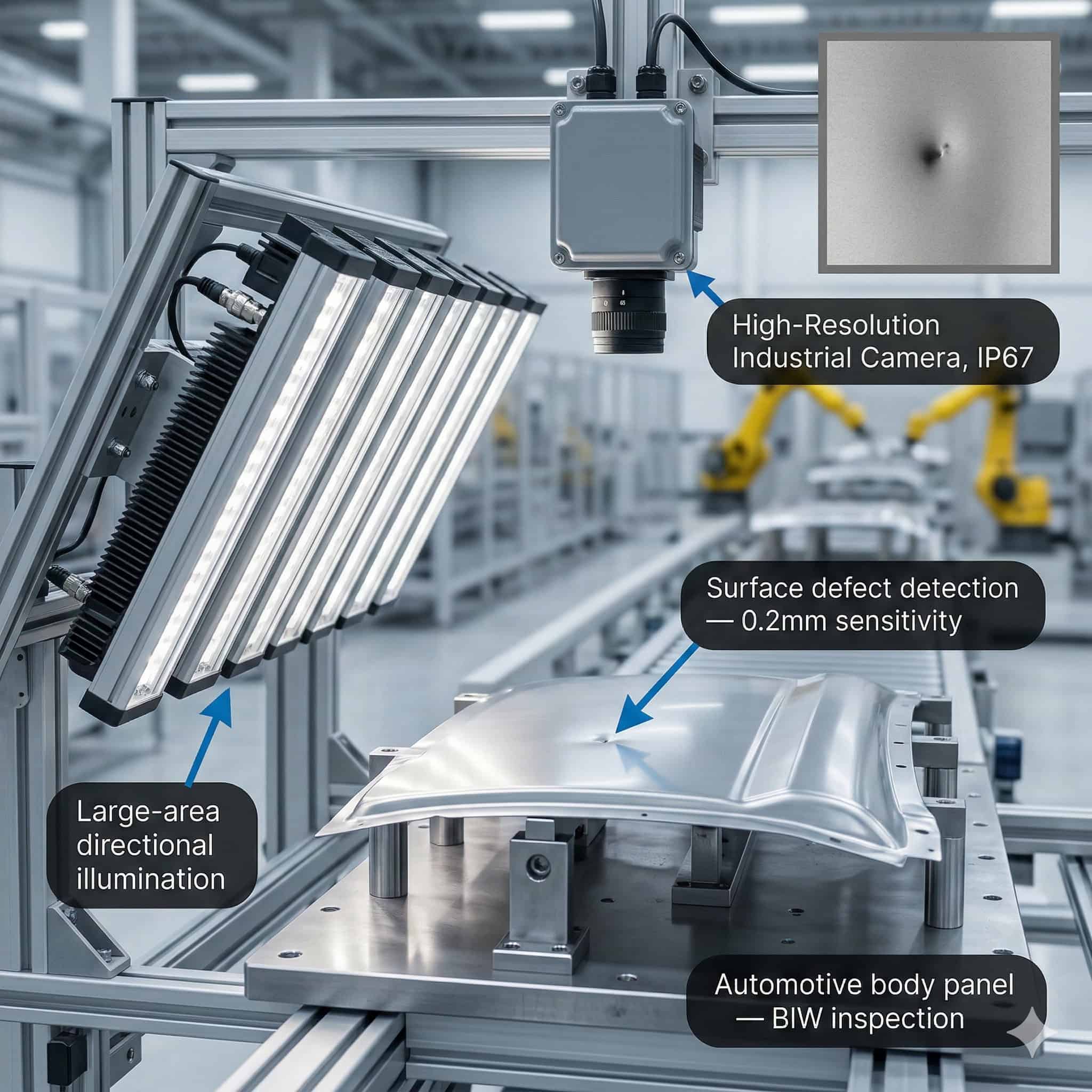
Automotive production lines combine high throughput with some of the most demanding quality requirements in any manufacturing sector. Body panels, welded joints, painted surfaces, machined components, connectors and wire harnesses must each pass optical inspection before the vehicle moves to the next station. A single defect escaping detection can trigger costly recalls, warranty claims, and reputational damage for OEMs and tier suppliers alike.
Machine vision systems are now standard equipment across automotive production, from stamping and welding through paint finishing and final assembly. The performance of every vision system depends first on image quality — and image quality depends first on illumination. Selecting the correct LED illuminator geometry, wavelength, and control technique for each automotive inspection task is the foundation of a reliable quality control system.

Do you want help choosing the product?
Automotive Quality Challenges: Scale, Speed and Variety
A modern automotive assembly plant may include hundreds of individual inspection stations. Each covers a different material, surface finish, defect type, and production speed. Body-in-white welding lines run at high cycle rates. Paint booths require 100% surface coverage. Component assembly cells mix metallic, plastic, rubber and electronic parts, each with different optical properties.
No single illumination technique works across all these tasks. Engineers must match the illuminator to the inspection geometry, the surface material, and the defect signature. The choice between direct, diffuse, darkfield, coaxial and backlight illumination determines whether the inspection system can reliably detect the target defect at production speed.
Body Panel Inspection: Surface Defects, Dents and Paint Flaws
Detecting Defects on Stamped Metal Surfaces
Stamped steel and aluminium body panels must be inspected for dents, creases, surface waviness, and forming defects before painting. Both inspection stages require illumination that reveals surface relief with high contrast.
Darkfield (low-angle) illumination is the preferred technique for stamped metal surface inspection. Light directed at a grazing angle to the panel surface creates bright highlight patterns on raised defects and dark shadows in depressions. Flat areas appear uniformly dark, providing a high-contrast background against which small dents become clearly visible.
Paint Surface Inspection: Gloss and Texture Defects
After painting, panels must be re-inspected for orange peel texture, runs, sags, inclusions, and paint skip. For painted surface inspection, diffuse dome or flat dome illumination minimises specular reflections from the gloss finish. A uniform, shadowless illumination field reveals surface defects without the bright specular hot spots that directional lighting creates on high-gloss surfaces.
White LED illumination provides balanced contrast across different automotive paint colours. For metallic paints, polarised illumination combined with a polarising filter on the camera lens reduces specular glare and reveals flake distribution. Near-infrared illumination at 850 nm can penetrate clear coat layers to detect subsurface contamination invisible at visible wavelengths.
Weld Inspection: Bead Geometry, Porosity and Spatter
Illumination Techniques for Spot and Seam Welds
Resistance spot welds and laser seam welds are critical structural joints in automotive body construction. Vision systems inspect weld nugget size, shape and position, detect spatter deposits on surrounding metal, and identify porosity or incomplete fusion at the weld bead surface.
Low-angle ring light illumination at 15° to 30° reveals weld bead geometry, spatter height, and surface texture variation through shadow and highlight patterns. Coaxial illumination is effective for inspecting flat weld surfaces and detecting surface cracks or porosity. Both techniques are used in combination at multi-angle inspection stations.
High-Intensity Strobed Lighting for Weld Line Integration
Weld inspection stations are often located immediately after the welding process, where residual heat and process vibration are present. Short-exposure strobed imaging eliminates motion blur and reduces ambient light interference. High-intensity LED ring lights with strobe controller synchronisation deliver the peak brightness required for sub-millisecond exposures at welding line cycle rates.
Component Gauging: Dimensional Measurement of Machined Parts
Backlight Silhouette for Profile and Tolerance Verification
Machined automotive components — brake callipers, steering knuckles, engine parts, gear blanks — require dimensional gauging to verify that tolerances are within specification. Backlight illumination is the standard technique for profile measurement and dimensional inspection of turned, milled and ground components.
A backlight illuminator positioned behind the component projects a sharp, high-contrast silhouette onto the camera sensor. The component profile is measured from the silhouette boundary with sub-pixel precision. The uniform bright background eliminates surface reflectivity variables from the measurement, making the result independent of whether the part is shiny, anodised, or coated.
Direct Illumination for Surface Features and Traceability Markings
Bore threads, chamfers, surface finish, and stamped or engraved part markings require direct or coaxial illumination. High-density LED matrix illuminators provide uniform, high-intensity front illumination for inspecting machined surfaces, detecting burrs, and verifying traceability markings. Multi-angle illumination rigs combining ring lights at different angles reveal both surface features and dimensional profiles in a single image.
Connector and Wire Harness Inspection
Electrical connectors and wire harnesses are among the most complex and defect-sensitive components in a vehicle. Vision systems inspect connector pin presence and position, terminal seating depth, wire colour coding, label readability, and seal integrity.
Pin presence and seating depth inspection benefits from coaxial or low-angle ring light illumination, which reveals the specular reflection of a correctly seated metal terminal versus the shadow of a missing or recessed pin. Wire colour sorting requires white LED illumination with high CRI to reliably distinguish insulation colours. Label and barcode inspection on connectors uses high-intensity direct illumination with strobe synchronisation.
Illumination Selection Guide for Automotive Inspection Tasks
The following summary guides illumination selection across the main automotive inspection tasks.
- Stamped panel surface defects: Low-angle darkfield ring light or bar light at 10°–20° grazing incidence.
- Painted surface inspection: Flat dome or diffuse dome illumination for glare-free, uniform coverage.
- Weld bead geometry and spatter: Low-angle ring light or high-intensity bar light with strobe control.
- Weld surface porosity and cracks: Coaxial illumination for flat reflective weld surfaces.
- Component profile and dimensional gauging: High-uniformity backlight illumination.
- Machined surface and marking inspection: High-density direct LED matrix illumination.
- Connector pin presence and terminal seating: Coaxial or low-angle ring light.
- Wire colour sorting: High-CRI white LED direct illumination.
- Label and barcode reading: High-intensity direct ring or bar light with strobe.
RODER Vision Solutions for Automotive OEMs and Tier Suppliers
RODER Vision LED illuminators cover all the automotive inspection tasks described above. The product range includes ring lights in all diameters and illumination angles, high-density matrix illuminators, flat dome and diffuse dome lights, backlights in standard and custom formats, and bar lights for line scan and area scan applications.
All RODER Vision illuminators are designed for industrial production environments. They accept constant-current or PWM-controlled LED drivers and support hardware trigger inputs for strobe synchronisation with machine vision cameras. The HTTM thermal management technology minimises LED junction temperature, extending service life and maintaining stable optical output across the full operating temperature range.
For automotive tier suppliers requiring compact illuminators for robot-mounted or end-of-arm tooling (EOAT) vision systems, RODER Vision offers miniature and OEM format illuminators compatible with standard machine vision interfaces. Custom configurations for specific field-of-view, working distance, and wavelength requirements are available from the RODER Vision engineering team.
Products and Technologies
The following product families are the most representative for automotive body, weld, paint and component inspection applications.

DL5 — High Intensity Modular LED Matrix Illuminators
Scalable modular illumination for large-area automotive inspection. 100 mm incremental architecture covers wide conveyor belts and large robotic cells with uniform high-intensity output.

DL6 — High Density LED Matrix Illuminators
High-density LED matrix with screw-less cleanable surface for automotive body and component inspection. Exceptional luminous homogeneity eliminates hot spots for reliable sub-pixel measurement.

DL1 — LED Matrix Illuminators
Compact high-intensity LED matrix with integrated optics for robot-mounted vision systems and automotive assembly inspection. Direct-body mounting and HTTM thermal management for continuous-duty operation.

DL3 — High Intensity LED Matrix Illuminators
High-flux compact LED illuminators with strobe and overdrive compatibility for high-speed automotive line synchronisation. Low-profile design for integration in space-constrained inspection stations.
Frequently Asked Questions
Flat dome or diffuse dome illumination is the preferred technique for painted surface inspection. The uniform, multi-directional light eliminates specular reflections from gloss paint finishes, allowing the camera to detect orange peel texture, runs, sags and inclusions without glare interference.
Weld inspection uses low-angle ring light illumination to reveal bead geometry and spatter through shadow and highlight patterns. Coaxial illumination is added for flat weld surface crack and porosity detection. High-intensity strobed operation freezes motion at production line speeds.
Backlight LED illuminators are the standard solution for dimensional gauging. Positioned behind the component, they project a high-contrast silhouette that allows sub-pixel precision profile measurement independent of the part surface finish, coating or material reflectivity.
Yes. Coaxial or low-angle ring light illumination creates contrast between the specular reflection of a correctly seated metal terminal and the shadow of a missing or recessed pin. This allows reliable pin presence and seating depth inspection at production speed.
RODER Vision offers ring lights (DC series), high-density matrix illuminators (DL series), backlight illuminators (BL series), and flat dome lights (FD series), all designed for industrial production environments with strobe compatibility, constant-current drivers, and trigger synchronisation for automotive machine vision systems.
More information and contacts
Systems and Sensor Integration Partners : www.roder.it
Artificial Vision Division : www.rodervision.com
More information about RODER VISION : about us
Contact for general information : info@roder.it
The information on this website is provided for information purposes only. Although it has been prepared with the utmost care, it does not constitute a contractual offer or a binding commitment to supply. It may contain transcription, translation or typographical errors. For precise and up-to-date information, please contact our company directly.
Related topics :
 Electronic Component Placement: Lighting Strategies for Pick-and-Place Robots
 Plastic Injection Molding: Checking Part Completeness with Darkfield Lights
 AI-Powered Machine Vision: How Deep Learning Is Changing Inspection Lighting Requirements
 SCARA Robotics and Shape Recognition: Simplifying Complex Silhouette Detection with LED backlight.
 LED Illumination for PCB and Electronics Inspection: Soldering, Components and Trace Verification