


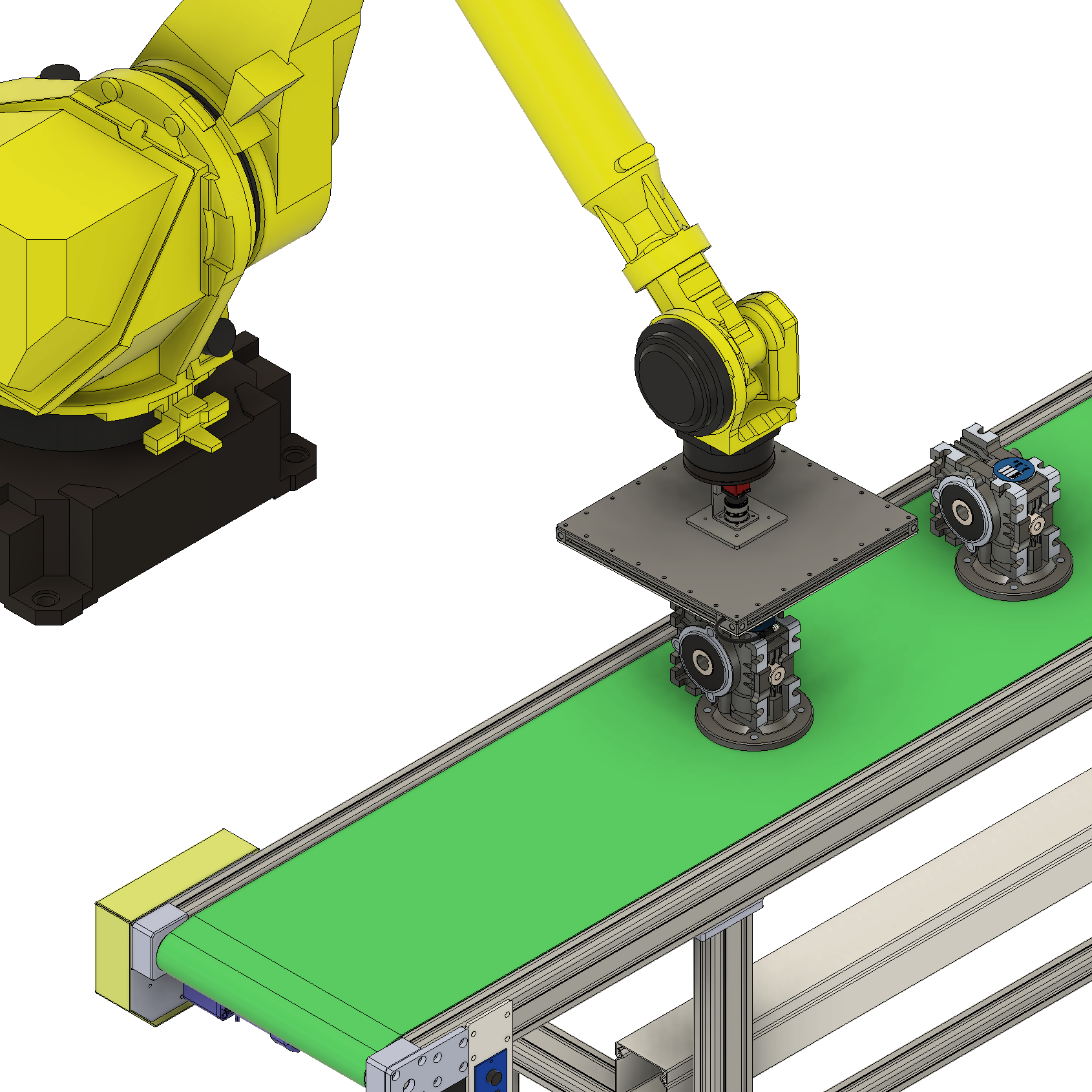
Reliable machine vision in conveyor-based automation depends on uniform and controlled illumination. Flat dome LED lights provide diffuse, glare-free lighting that enhances image consistency, improves object detection, and supports precise robotic guidance.
Their ability to minimize reflections and deliver stable brightness makes them a key element in inspection and quality control across industrial environments.

Möchten Sie Hilfe bei der Auswahl des Produkts?
Flat Dome LED Lights for Conveyor Applications: Ensuring Uniform Illumination for Industrial Automation
Industrial automation increasingly relies on machine vision systems to guarantee efficiency, accuracy, and safety across production environments. Among the many challenges faced by engineers when designing such systems, the quality of illumination is often underestimated. Proper lighting is essential to provide cameras with the necessary information to capture consistent, sharp, and analyzable images.
One of the most effective solutions in this context is the use of Flat Dome LED Lights for Conveyor Applications, particularly in robotic guidance systems or inspection tasks where products move on conveyor belts or pallets. This article explores the importance of uniform illumination, the unique characteristics of flat dome lights, and their relevance in guiding robots and ensuring reliable visual inspection.
Die Rolle der Beleuchtung in der industriellen Bildverarbeitung
Machine vision systems depend not only on the resolution of cameras and the robustness of software algorithms but also on the quality of the illumination. Poor lighting can create shadows, reflections, and inconsistent contrasts, all of which make it harder to detect features, measure dimensions, or recognize objects.
For conveyor-based automation systems, the challenge is even greater. Products often move continuously, sometimes at high speed, under different angles and surface textures. A single point light source may cause glare or hotspots, while insufficient lighting may prevent the camera from distinguishing relevant features. To overcome these issues, engineers must design lighting setups that provide uniform brightness, minimized reflections, and sufficient intensity across the entire field of view.
Was sind Flat-Dome-LED-Leuchten?
Flat dome LED lights are a specialized type of illumination device designed for machine vision applications. Unlike standard dome lights, which provide hemispherical lighting from above, flat dome lights are engineered to produce a highly diffused, uniform light distribution within a relatively compact form factor.

Das Design umfasst typischerweise:
- An array of LEDs positioned around the perimeter of the device.
- Eine diffusierende Oberfläche, die das emittierte Licht gleichmäßig streut.
- A flat, low-profile geometry that makes it suitable for installations where space is limited, such as above conveyor belts or robotic cells.
This structure ensures that objects passing under the light are illuminated evenly from multiple angles, reducing shadows and minimizing specular reflections.
Flat-Dome-LED-Beleuchtung für Förderbandanwendungen
When applied to conveyor systems, Flat Dome LED Lights for Conveyor Applications offer significant benefits. They create a homogenous lighting environment that allows cameras to capture consistent images regardless of variations in product shape, surface finish, or positioning.
Zu den wichtigsten Aspekten gehören:
- Uniform Illumination
The flat dome design eliminates bright spots and ensures that every part of the object is equally visible. This is crucial for automated inspection systems, where even small variations in brightness could affect image processing algorithms. - Minimized Glare and Reflections
Surfaces such as metals, plastics, or glossy coatings often produce reflections under direct lighting. Flat dome lights diffuse the illumination, reducing glare and making features easier to detect. - Consistency in Motion
Since conveyors involve constant movement, lighting conditions must remain stable across the entire width and length of the belt. Flat dome lights provide the consistency required for accurate recognition, tracking, and measurement. - Compact Integration
The flat design makes it easier to integrate the light into conveyor systems without interfering with product flow or camera positioning.
Anwendungen in der Roboterführung
Robotic systems used in industrial automation rely heavily on vision for navigation and object handling. Whether the task is to pick items from a conveyor belt or align components on a pallet, robots require precise, real-time information.
Flat-Dome-LED-Leuchten unterstützen die Roboterführung auf mehreren Wegen:
- Object Detection: Uniform lighting ensures that object boundaries and features are clearly visible to the vision system, improving detection rates.
- Position Accuracy: Robots require exact coordinates to pick or place items. Flat dome lights help cameras capture distortion-free images that enable precise positioning.
- Handling Variability: In applications where different products move on the same conveyor, flat dome lights ensure that surface variations do not compromise detection.
By reducing visual noise such as shadows and reflections, these lights allow algorithms to focus on meaningful features, enhancing reliability in robotic operations.
Angemessene Szenenbeleuchtung sicherstellen
Uniformity is only one part of the equation. The total amount of light reaching the object and, ultimately, the camera sensor is equally critical. Cameras require a certain level of brightness to operate at optimal exposure times and gain settings. Insufficient illumination may result in noisy images, motion blur, or loss of detail.
Bei Anwendungen auf Förderbändern und Paletten sind mehrere Parameter zu berücksichtigen:
- Illuminance Level: The total light intensity on the surface must be sufficient for the camera’s sensitivity.
- Working Distance: The distance between the light, object, and camera affects brightness distribution.
- Camera Settings: Shutter speed, aperture, and sensor sensitivity must be matched with the lighting conditions.
Flat dome LED lights are designed to address these challenges by providing a high-output, evenly distributed illumination that can be adjusted depending on the application requirements.
Herausforderungen bei der Beleuchtung von Förderbändern und Paletten
Despite their advantages, implementing flat dome lights in conveyor and pallet-based systems involves technical considerations:
- Installation Space
The conveyor environment may be crowded with sensors, actuators, and protective structures. Engineers must ensure that the flat dome light can be mounted without interfering with other equipment. - Energy Efficiency
Since conveyors often run continuously, energy-efficient lighting is essential to minimize operational costs. LED technology already provides an advantage in this respect, but power management remains a design factor. - Heat Management
High-intensity LEDs generate heat that must be dissipated effectively to maintain performance and lifespan. Proper cooling or thermal design is necessary in continuous-use scenarios. - Integration with Control Systems
Modern automation often requires lights to be synchronized with camera triggers or robot actions. Flat dome lights must support electronic control for precise timing.
Vorteile für die Qualitätskontrolle
Quality control is one of the most demanding areas in industrial automation. Defects, scratches, misalignments, or incorrect labeling must be detected reliably. Flat dome LED lights support these tasks by creating a stable imaging environment where small details are visible.
Zum Beispiel:
- Surface Inspection: Scratches or irregularities on metal surfaces become visible under uniform, glare-free lighting.
- Label Verification: Printed text or barcodes can be read accurately when the lighting eliminates shadows.
- Dimensional Measurement: Edges and contours appear sharp, improving the accuracy of measurement algorithms.
The result is a higher level of consistency in inspection, leading to fewer false positives or missed defects.
Zukunftsperspektiven der Flat-Dome-Beleuchtung
As machine vision technology evolves, lighting solutions will continue to play a pivotal role. Future flat dome lights are likely to integrate features such as:
- Adjustable Wavelengths to adapt to different materials or inspection requirements.
- Smart Control Systems allowing dynamic adjustment of brightness and diffusion.
- Compact, Modular Designs for easier integration into diverse conveyor setups.
These innovations will further strengthen the role of flat dome LED lights in conveyor and robotic applications, enhancing both flexibility and performance.
Fazit
In modern industrial automation, lighting is not just a supporting element but a fundamental enabler of reliable vision systems. Flat Dome LED Lights for Conveyor Applications provide uniform, glare-free, and consistent illumination that meets the demanding requirements of conveyors, pallets, and robotic guidance.
By ensuring sufficient light intensity and distribution, these devices enable cameras to capture images that are both stable and analyzable, leading to improved accuracy in inspection, tracking, and quality control.
For engineers and professionals working in automation, investing in proper illumination design is not merely a detail—it is a cornerstone of system reliability and efficiency.
In dieser Anwendung eingesetzte Produkte

Flat Dome LED Illuminators FD3 Series

Large format LED Ring Lights DC7 Series

Large format LED Matrix illuminators DL7 Series
Häufig gestellte Fragen
Kontakte & Informationen
Kontakt für allgemeine Informationen : info@roder.it
Partner für System- und Sensorintegration : www.roder.it
RODER Bildverarbeitungs-Abteilung : www.rodervision.com
RODER Abteilung Messinstrumente : www.innovacheck.com
Mehr Informationen über RODER VISION : about us
Die Informationen auf dieser Website dienen ausschließlich Informationszwecken. Obwohl sie mit größter Sorgfalt erstellt wurden, stellen sie kein vertragliches Angebot und keine verbindliche Lieferverpflichtung dar. Sie können Übertragungs-, Übersetzungs- oder Tippfehler enthalten. Für präzise und aktuelle Informationen wenden Sie sich bitte direkt an unser Unternehmen.
Bitte beachten Sie: Einige Bilder auf dieser Website wurden absichtlich mittels Künstlicher Intelligenz (KI) generiert. Dies liegt daran, dass es bei vielen Anwendungen und Projekten aufgrund von Vertraulichkeitsvereinbarungen, Vertragsklauseln und Geheimhaltungsvereinbarungen (NDAs) nicht möglich ist, Fotografien der tatsächlichen Anlage oder des Systems zu veröffentlichen.


