


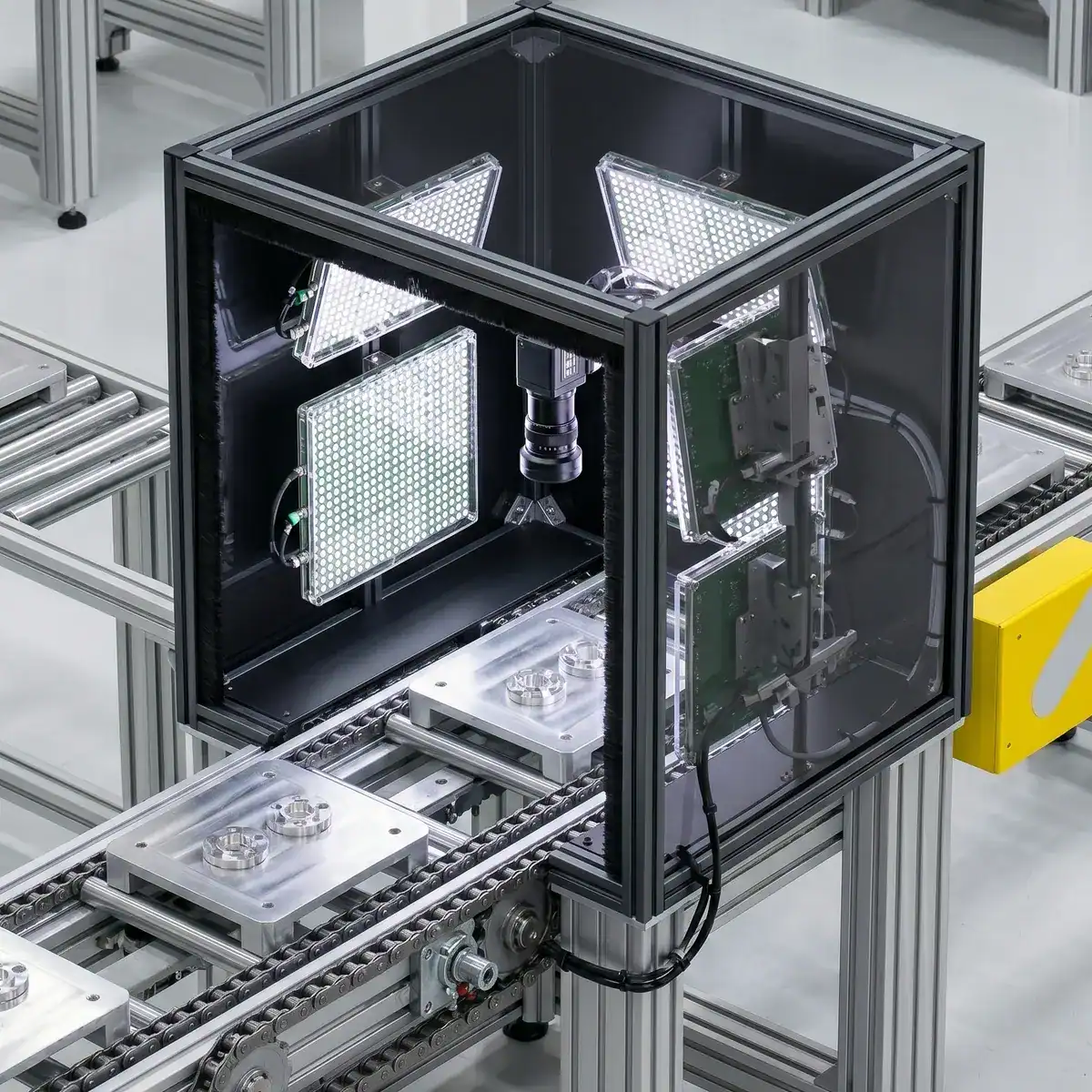
In the high-stakes world of mechanical manufacturing, “close enough” is never enough. When parts travel down a pallet line, they aren’t just moving; they are heading toward a trial of precision. Machine vision dimensional inspection has become the gold standard for verifying tolerances that the human eye simply cannot perceive. However, the biggest hurdle to achieving sub-millimeter accuracy isn’t usually the camera sensor—it’s the physics of light.
On a pallet line, components often feature complex geometries, reflective surfaces, and deep recesses that create deceptive shadows. A single light source often fails to illuminate the critical edges needed for measurement. This is where the RODER DL8 series shines, quite literally. By utilizing multi-illuminator setups—often surrounding the part in a “light box” configuration—manufacturers can eliminate the optical noise that leads to measurement drift. Proper lighting for mechanical quality control ensures that every edge is crisp and every hole is perfectly defined. With the DL8’s ultra-uniform output, your vision system can stop “guessing” where an edge begins and start measuring with the centesimal confidence your customers demand.

Vuoi essere aiutato a scegliere il prodotto giusto?
Il mandato di precisione nelle moderne linee di pallettizzazione
Palletized systems are designed for stability, making them the ideal environment for high-precision inspection. However, because parts are often oily or metallic, they behave like mirrors. In machine vision dimensional inspection, a “hotspot” or a stray reflection can be interpreted by the software as a physical edge, leading to a false reject or, worse, an out-of-tolerance part being shipped.
To combat this, the DL8 series is frequently deployed in multi-panel arrays. By positioning four or more DL8 illuminators around a pallet station, you create a “diffuse dome” effect. This ensures that light hits the component from all angles, neutralizing the texture of the material and highlighting only the dimensional boundaries that matter.
Eliminare la distorsione ottica con illuminazione multi-direzionale
When measuring diameters or distances between centers, the “shadow” cast by a single light can shift the perceived position of a feature. This is known as parallax or perspective error. High-quality lighting for mechanical quality control minimizes this by providing a flat, telecentric-like illumination profile.
The DL8 matrix is particularly effective here because of its high LED density. Unlike standard backlights that might show individual “points” of light, the DL8 acts as a solid luminous surface. When multiple DL8 panels work in tandem, they fill in the shadows of complex parts (like engine valves or gear housings), allowing the vision system to extract a perfect 2D profile for metrology.
Il vantaggio DL8: stabilità e ripetibilità
In quality control, repeatability is everything. If your light intensity fluctuates even by 5%, your measurement results will drift. RODER has engineered the DL8 series with advanced thermal management and high-stability drivers to ensure that the light output remains constant from the first shift to the last.
This stability is critical for systems that perform automatic inspection of mechanical samples. On a pallet line, where cycle times are measured in seconds, the DL8 supports high-intensity strobing. This allows the camera to capture ultra-high-resolution images without the risk of thermal degradation to the LEDs, ensuring that your “Golden Image” remains the standard for months of continuous operation.
Integrare la metrologia nel flusso di produzione
The compact and robust design of the DL8 series allows it to be integrated directly into the pallet conveyor’s aluminum framing. It transforms a standard transit point into a sophisticated metrology cell. By using RODER’s standardized mounting systems, OEM integrators can quickly set up multi-angle lighting environments that are protected from the harsh conditions of the factory floor.
Ultimately, investing in a multi-illuminator DL8 setup is an investment in your brand’s reputation. By providing the clearest possible data to your vision system, you ensure that your quality control is not just a checkbox, but a competitive advantage.
Prodotti e tecnologie


Domande frequenti
Le luci ad anello LED sono la soluzione standard per la visione dei robot pick-and-place. Si montano coassialmente all’obiettivo della telecamera e forniscono un’illuminazione direzionale uniforme per il rilevamento di bordi e feature dei pezzi. Le ring light a basso angolo accentuano il rilievo superficiale. Le ring light stroboscopiche ad alta intensità si usano nei cicli di prelievo ad alta velocità.
Utilizzare illuminatori LED stroboscopici ad alta intensità che sovrastino la luce ambiente durante l’esposizione della telecamera; racchiudere la zona di acquisizione con una cuffia darkfield; impiegare LED a banda stretta e filtro bandpass sull’obiettivo della telecamera; oppure scegliere l’illuminazione NIR a 850-940 nm, dove la luce ambientale di fabbrica è più bassa.
I sistemi a luce strutturata richiedono proiettori LED ad alta intensità per la proiezione di pattern ad alto contrasto. I sensori a stereo attivo e ToF utilizzano illuminatori LED NIR. L’illuminazione diffusa o a dome riduce le riflessioni speculari sui pezzi metallici. Sono da preferire illuminatori a matrice ad alta potenza con intensità regolabile.
Gli illuminatori LED devono rispettare i limiti di sicurezza fotobiologica della norma IEC 62471. Gli illuminatori del Gruppo di Rischio 0 o 1 sono adatti alle applicazioni con cobot in presenza di operatori. Il funzionamento PWM al di sopra di 1 kHz o in vera DC evita il flicker visibile per i lavoratori vicini.
Il montaggio EOAT mantiene una geometria di illuminazione costante, ma richiede illuminatori compatti e leggeri entro i limiti di payload. Il montaggio fisso consente illuminatori più grandi e potenti, ma impone posizioni di prelievo definite. Il fisso è più semplice per operazioni in zona singola; l’EOAT è adatto alla guida flessibile multi-posizione.
Contatti e informazioni
Contatto per informazioni generali : info@roder.it
Partner per l’Integrazione di Sistemi e Sensori : www.roder.it
Divisione Roder Artificial Vision : www.rodervision.com
Divisione RODER Instruments : www.innovacheck.com
Ulteriori informazioni su RODER VISIONE : chi siamo
Le informazioni contenute in questo sito web sono fornite solo a scopo informativo. Sebbene siano state preparate con la massima cura, non costituiscono un’offerta contrattuale o un impegno vincolante alla fornitura. Possono contenere errori di trascrizione, traduzione o tipografici. Per informazioni precise e aggiornate, ti invitiamo a contattare direttamente la nostra azienda.
Nota bene: alcune immagini presenti in questo sito web sono state intenzionalmente generate utilizzando l’Intelligenza Artificiale (AI). Ciò è dovuto al fatto che, per molte applicazioni e progetti, non è possibile divulgare fotografie dell’installazione o del sistema reale a causa di accordi di riservatezza, clausole contrattuali e accordi di non divulgazione (NDA).