


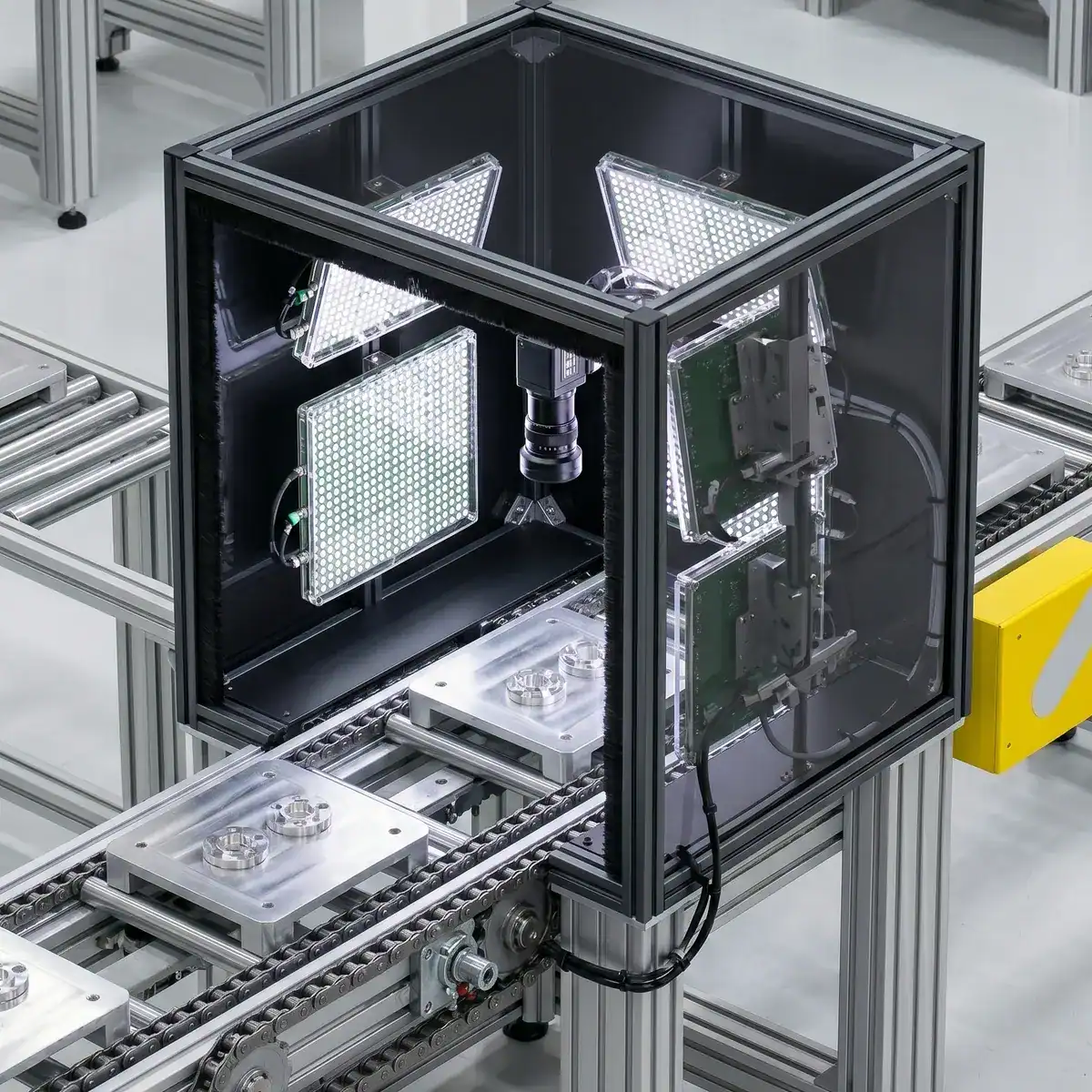
In the high-stakes business of mechanical manufacturing, “close enough” never cuts it. As parts ride down a pallet line, they are not just being moved; they are heading into a test of precision. Machine vision dimensional inspection has become the benchmark for verifying tolerances the human eye cannot make out. Yet the biggest barrier to sub-millimetre accuracy is rarely the camera sensor—it is the physics of light.
On a pallet line, components often carry complex geometries, reflective surfaces, and deep recesses that throw deceptive shadows. A single light source frequently fails to light up the critical edges a measurement depends on. This is exactly where the RODER DL8 series shines, quite literally. By turning to multi-illuminator setups—often wrapping the part in a light-box configuration—manufacturers can clear away the optical noise that drives measurement drift. Sound lighting for mechanical quality control makes sure every edge is crisp and every hole is cleanly defined. With the DL8’s ultra-uniform output, your vision system can stop guessing where an edge starts and begin measuring with the centesimal confidence your customers expect.

Do you want help choosing the right product?
The Precision Mandate in Modern Pallet Lines
Palletised systems are designed for stability, which makes them an ideal home for high-precision inspection. But because parts are often oily or metallic, they behave like mirrors. In machine vision dimensional inspection, a hotspot or a stray reflection can be read by the software as a physical edge, triggering a false reject or, worse, letting an out-of-tolerance part ship.
To counter this, the DL8 series is often deployed in multi-panel arrays. Positioning four or more DL8 illuminators around a pallet station creates a diffuse-dome effect. Light then reaches the component from every angle, cancelling out the texture of the material and leaving only the dimensional boundaries that matter.
Eliminating Optical Distortion with Multi-Directional Lighting
When measuring diameters or centre-to-centre distances, the shadow cast by a single light can shift where a feature appears to sit. This is known as parallax or perspective error. Good lighting for mechanical quality control holds it down by providing a flat, telecentric-like illumination profile.
The DL8 matrix excels here thanks to its high LED density. Where standard backlights might reveal individual points of light, the DL8 reads as a solid luminous surface. When several DL8 panels work together, they fill in the shadows of complex parts (engine valves or gear housings, for instance), letting the vision system pull a clean 2D profile for metrology.
The DL8 Advantage: Stability and Repeatability
In quality control, repeatability is everything. If light intensity drifts by even 5%, measurement results drift with it. RODER engineered the DL8 series with advanced thermal management and high-stability drivers so the light output stays constant from the first shift to the last.
That stability is critical for systems running automatic inspection of mechanical samples. On a pallet line, where cycle times are counted in seconds, the DL8 supports high-intensity strobing. This lets the camera grab ultra-high-resolution images with no risk of thermal degradation to the LEDs, keeping your golden image the reference for months of continuous operation.
Integrating Metrology into the Production Flow
The compact, rugged design of the DL8 series lets it mount straight into the pallet conveyor’s aluminium framing, turning an ordinary transit point into a capable metrology cell. Using RODER’s standardised mounting systems, OEM integrators can quickly build multi-angle lighting environments that stay shielded from the harsh conditions of the factory floor.
In the end, investing in a multi-illuminator DL8 setup is an investment in your brand’s reputation. By feeding the clearest possible data to your vision system, you make quality control not just a checkbox but a competitive edge.
Products and Technologies


Frequently Asked Questions
A single light source often leaves shadows and reflections that the vision software can misread as edges. Surrounding the part with four or more DL8 illuminators creates a diffuse-dome effect that lights the component from every angle, neutralising surface texture and revealing only the dimensional boundaries, which keeps sub-millimetre measurements stable.
Oily or metallic parts behave like mirrors, so a stray reflection can be read as a physical edge. A flat, telecentric-like illumination profile from high-density DL8 panels fills in shadows and cancels specular hotspots, cutting parallax and perspective error so the vision system can extract a clean 2D profile for metrology.
If light intensity drifts by even 5 percent, measurement results drift with it. The DL8 series uses advanced thermal management and high-stability drivers to hold output constant from the first shift to the last, which keeps the golden reference image valid across months of continuous operation.
Yes. On pallet lines where cycle times are counted in seconds, the DL8 series supports high-intensity strobing. Pulsing the LEDs lets the camera capture ultra-high-resolution images without thermal degradation, so accuracy holds even at high throughput.
The compact, rugged DL8 mounts directly into the pallet conveyor aluminium framing using RODER standardised mounting systems. OEM integrators can quickly build multi-angle lighting cells that turn an ordinary transit point into a protected metrology station shielded from factory-floor conditions.
Contacts & Information
Contact for general information : info@roder.it
Systems and Sensor Integration Partner : www.roder.it
RODER Artificial Vision Division : www.rodervision.com
RODER Instruments Division : www.innovacheck.com
More information about RODER VISION : about us
The information on this website is provided for informational purposes only. Although it has been prepared with the utmost care, it does not constitute a contractual offer or a binding commitment to supply. It may contain transcription, translation, or typographical errors. For precise and up-to-date information, please contact our company directly.
Please note: Some images on this website have been intentionally generated using Artificial Intelligence (AI). This is due to the fact that, for many applications and projects, it is not possible to disclose photographs of the actual installation or system due to confidentiality agreements, contractual clauses, and Non-Disclosure Agreements (NDAs).
