


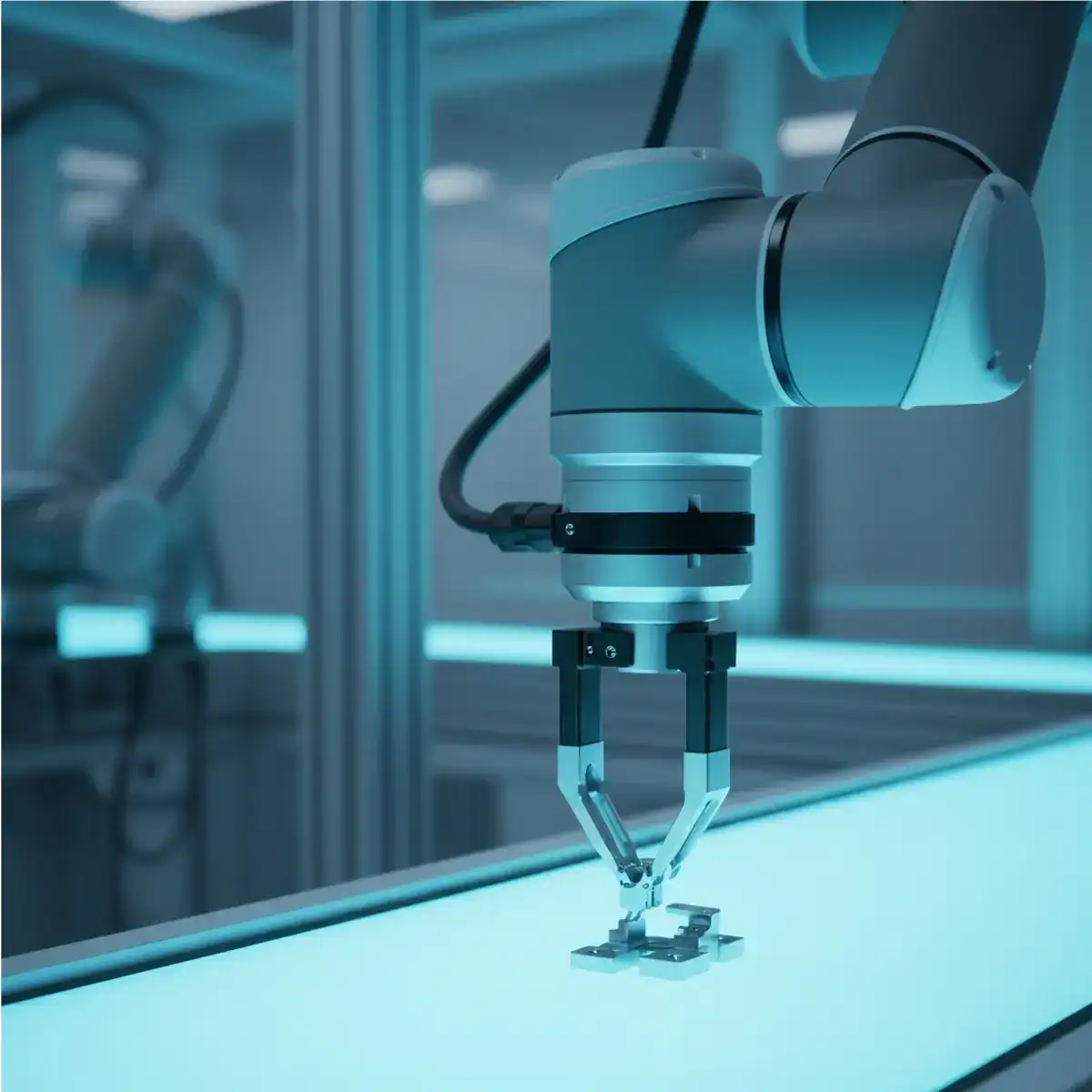
Robot guidance applications require vision systems to deliver accurate, repeatable pose estimation at production speed. The camera sees what the light reveals. When illumination is inconsistent — due to ambient light interference, thermal drift, or incorrect geometry — the vision algorithm receives ambiguous image data, and robot placement errors follow. Selecting and positioning the correct LED illuminator is as important as selecting the camera and lens in any robot vision system.
The three main categories of robot guidance application — pick-and-place from a defined feeder or fixture, bin picking from a randomly filled container, and collaborative robot (cobot) guidance in shared workspaces — each impose different requirements on the illumination system. Working distance, part geometry, ambient light conditions, safety constraints, and imaging modality all influence the correct illuminator choice.

Möchten Sie Hilfe bei der Auswahl des richtigen Produkts?
Warum konsistente Beleuchtung für die Pose-Schätzung des Roboters entscheidend ist
Robot pose estimation algorithms — whether rule-based template matching or deep learning-based detection — calculate part position and orientation from image features. The reliability of this calculation depends on the contrast, sharpness, and repeatability of those features in the image. Illumination directly controls all three parameters.
Any change in illumination intensity, colour temperature, or spatial distribution between calibration and production causes the image feature set seen by the algorithm to differ from the training or reference data. This manifests as increased localisation uncertainty, higher pick failure rates, and reduced throughput. In practice, the most common cause of robot vision instability in production is not algorithm failure — it is lighting drift or ambient light contamination.
2D-Roboterführung: Flächenkameras und direkte LED-Beleuchtung
Two-dimensional robot guidance systems use area scan cameras to capture a top-down or angled image of the part. The vision algorithm calculates the 2D position and rotation of the part within the field of view. The robot corrects its approach trajectory based on this information before picking.
Ringbeleuchtungen für Pick-and-Place-Bildverarbeitung
LED ring lights are the most widely used illumination solution for 2D pick-and-place robot guidance. Mounted coaxially with the camera lens, a ring light provides directional illumination from a consistent angular position relative to the camera optical axis. This geometry produces repeatable shadow patterns that enhance part edge contrast for template matching and feature extraction algorithms.
Low-angle ring lights direct illumination at grazing incidence to the part surface, accentuating surface texture and edge relief. This technique is effective for inspecting parts with raised features, logos, or surface markings that define the pick orientation. For flat, smooth parts on diffuse backgrounds, high-angle ring lights or direct matrix illuminators provide more uniform field illumination and better overall contrast.
Balken- und Matrixbeleuchtungen für große Bildfelder
When the robot picks from a wide conveyor or pallet area, a single ring light cannot illuminate the full field of view uniformly. Bar lights or large-format matrix LED illuminators positioned at controlled angles provide the uniform, directional illumination required across extended fields. Multiple bar lights arranged symmetrically around the field eliminate directional shadow asymmetries that cause orientation errors in vision algorithms.
3D-Roboterführung: Strukturlicht und Musterprojektion
Three-dimensional robot guidance systems recover the full 6-DOF pose of a part — position in X, Y, Z and rotation around three axes. This capability is required for picking parts from fixtures, trays, or mixed-orientation presentations where 2D guidance cannot resolve ambiguity in depth or tilt.
Structured light 3D systems project a known pattern — typically fringe patterns, grids, or coded light sequences — onto the part surface. A camera captures the distortion of the projected pattern caused by part surface geometry, and a reconstruction algorithm calculates the 3D point cloud. Illumination for structured light must deliver high contrast between the projected pattern and the part background. This requires a high-intensity, stable LED projector with a narrow emission angle.
For time-of-flight (ToF) and active stereo 3D sensors, LED illuminators operating in near-infrared (NIR) wavelengths — typically 850 nm or 940 nm — project the reference pattern. The camera incorporates a narrowband optical filter matched to the illuminator wavelength to reject ambient light. High-power NIR LED illuminators with stable peak output are essential for reliable 3D reconstruction at robot guidance distances.
Bin Picking: Beleuchtung für die Inspektion ungeordneter Schüttgüter

Bin picking requires the vision system to locate and identify individual parts from a randomly filled container, with parts at arbitrary orientations, partially occluded, and at varying heights. This is the most demanding robot guidance application from an illumination perspective.
Beleuchtungsherausforderungen beim Bin Picking
Parts in a bin present multiple challenges simultaneously. Metallic parts create specular reflections from any directional illumination. Overlapping parts produce complex shadow patterns. The vertical depth variation within a bin may span 200 mm or more, causing significant changes in illumination intensity and shadow geometry across the working volume. No single illumination geometry resolves all these challenges for all part types.
For 3D bin picking systems, the structured light projector or active stereo illuminator must provide sufficient contrast for reliable 3D reconstruction across the full bin depth range. High-power LED matrix illuminators with adjustable intensity allow the system integrator to optimise the illumination level for each specific bin geometry and part reflectivity. Diffuse or dome illumination is often combined with the 3D sensor to reduce specular artefacts on metallic parts.
Beleuchtungsmodi für robustes Bin Picking kombinieren
Many production bin picking cells use multiple illumination sources in sequence. A structured light projector captures the 3D scene for part localisation. A separate directional LED illuminator fires during 2D image capture for grasp point selection and quality verification. This multi-stage approach optimises each lighting condition independently.
Beleuchtung für kollaborierende Roboter: Sicherheit, Bauform und flickerfreier Betrieb
Collaborative robots operate in shared workspaces alongside human workers. Lighting for cobot vision systems must satisfy requirements that do not apply to fully guarded robot cells: photobiological safety, compact form factor compatible with the cobot end-of-arm tool, and flicker-free operation that does not cause discomfort or hazard to nearby operators.
Photobiologische Sicherheit bei Cobot-Beleuchtung
LED illuminators used in proximity to human workers must comply with IEC 62471 photobiological safety limits. This standard defines Risk Group 0 (exempt), Risk Group 1 (low risk), and Risk Group 2 (moderate risk) classifications based on measured optical radiation levels. For cobot applications, Risk Group 0 or Risk Group 1 illuminators are appropriate to ensure operator safety without requiring additional protective barriers.
High-intensity blue LED illuminators at short working distances can present blue light hazard risk and must be assessed against IEC 62471 limits before deployment. Infrared illuminators beyond 780 nm are invisible to the human eye and do not trigger the blink reflex, requiring particular attention to emitted power levels relative to IEC 62471 infrared radiation limits.
Flickerfreier LED-Betrieb für Mensch-Cobot-Umgebungen
LED illuminators driven at mains frequency (50 or 60 Hz) or at low PWM frequencies produce visible flicker that causes eye strain for human operators working nearby. In collaborative workspaces, LED illuminators should operate in true DC continuous mode with regulated constant-current drivers, or in high-frequency PWM mode above 1 kHz that places flicker above the human perception threshold.
Roboter-montierte vs. feste Beleuchtung: Vor- und Nachteile
Illuminators for robot guidance can be mounted on the robot end-of-arm tool (EOAT), moving with the camera, or fixed relative to the workspace. Each mounting strategy has specific advantages and limitations that influence system design decisions.
EOAT-montierte Beleuchtung (End-of-Arm)
EOAT-mounted illuminators maintain a constant geometric relationship between the light source, camera, and part surface regardless of robot position. This ensures consistent illumination geometry throughout the workspace. The constraints are size and weight: illuminators for EOAT mounting must be compact and lightweight to stay within the robot payload budget. Cable routing to a moving EOAT requires careful management to prevent fatigue failures over the illuminator service life.
Feste Beleuchtung
Fixed illuminators are positioned at a defined location in the robot cell. The robot moves the part or camera to the illuminated zone for image capture. Fixed illumination decouples the illuminator from robot payload constraints, allowing larger, higher-power illuminators. For well-defined pick positions and single-zone illumination, fixed mounting is simpler and more reliable.
Umgebungslichtunterdrückung in Roboter-Bildverarbeitungszellen
Factory ambient light — from overhead fixtures, welding arcs, or sunlight through skylights — contaminates robot vision images when its intensity is comparable to the LED illuminator output at the part surface. Effective ambient light rejection strategies include: high-intensity strobed LED illuminators that overpower ambient light during the camera exposure; darkfield hoods or shrouds enclosing the capture zone; narrowband LED illuminators paired with matching bandpass optical filters on the camera lens; and NIR illumination at 850 nm or 940 nm where factory ambient light levels are lower than in the visible spectrum.
Produkte und Technologien


Häufig gestellte Fragen
LED-Ringleuchten sind die Standardlösung für die Bildverarbeitung von Pick-and-Place-Robotern. Sie werden koaxial zum Kameraobjektiv montiert und bieten eine gleichmäßige direktionale Beleuchtung zur Erkennung von Kanten und Merkmalen. Niedrigwinkel-Ringleuchten betonen das Oberflächenrelief. Hochintensive Stroboskop-Ringleuchten werden bei Hochgeschwindigkeits-Greifzyklen eingesetzt.
Verwenden Sie hochintensive LED-Stroboskopbeleuchter, die das Umgebungslicht während der Kamerabelichtung dominieren; schließen Sie den Aufnahmebereich mit einer Darkfield-Haube ein; setzen Sie schmalbandige LEDs und einen Bandpassfilter am Kameraobjektiv ein; oder wählen Sie NIR-Beleuchtung bei 850-940 nm, wo das Umgebungslicht in der Fabrik geringer ist.
Systeme mit strukturiertem Licht benötigen hochintensive LED-Projektoren für die Projektion kontrastreicher Muster. Aktive Stereo- und ToF-Sensoren verwenden NIR-LED-Beleuchter. Diffuse oder dome-förmige Beleuchtung reduziert Spiegelreflexe auf metallischen Teilen. Bevorzugt werden Hochleistungs-Matrix-Beleuchter mit einstellbarer Intensität.
LED-Beleuchter müssen die photobiologischen Sicherheitsgrenzwerte der IEC 62471 erfüllen. Beleuchter der Risikogruppe 0 oder 1 sind für Cobot-Anwendungen mit menschlichen Bedienern geeignet. PWM oberhalb von 1 kHz oder echter Gleichstrombetrieb vermeidet sichtbares Flackern für Personen im Nahbereich.
Die EOAT-Montage gewährleistet eine konstante Beleuchtungsgeometrie, erfordert jedoch kompakte und leichte Beleuchter innerhalb der Traglastgrenzen. Die feste Montage erlaubt größere und leistungsstärkere Beleuchter, setzt aber definierte Greifpositionen voraus. Die feste Variante ist einfacher für Einzonen-Operationen; EOAT eignet sich für flexible Multi-Positions-Führung.
Kontakte & Informationen
Kontakt für allgemeine Informationen : info@roder.it
Partner für System- und Sensorintegration : www.roder.it
RODER Bildverarbeitungs-Abteilung : www.rodervision.com
RODER Abteilung Messinstrumente : www.innovacheck.com
Mehr Informationen über RODER VISION : about us
Die Informationen auf dieser Website dienen ausschließlich Informationszwecken. Obwohl sie mit größter Sorgfalt erstellt wurden, stellen sie kein vertragliches Angebot und keine verbindliche Lieferverpflichtung dar. Sie können Übertragungs-, Übersetzungs- oder Tippfehler enthalten. Für präzise und aktuelle Informationen wenden Sie sich bitte direkt an unser Unternehmen.
Bitte beachten Sie: Einige Bilder auf dieser Website wurden absichtlich mittels Künstlicher Intelligenz (KI) generiert. Dies liegt daran, dass es bei vielen Anwendungen und Projekten aufgrund von Vertraulichkeitsvereinbarungen, Vertragsklauseln und Geheimhaltungsvereinbarungen (NDAs) nicht möglich ist, Fotografien der tatsächlichen Anlage oder des Systems zu veröffentlichen.
Related topics :
 Linienbeleuchtungen für die Bahninspektion: Maximierung des Durchsatzes in der kontinuierlichen Produktion
 Integration von LED-Beleuchtung in automatische Maschinen: Lösungen für die Teilebeladung.
 Dimensional Inspection and Quality Control: Multi-Illuminator Setups for Pallet Lines.
 High-Speed Vision on Conveyor Belts: Achieving Uniformity with RODER LED Illuminators.
 SCARA Robotics and Shape Recognition: Simplifying Complex Silhouette Detection with LED backlight.