


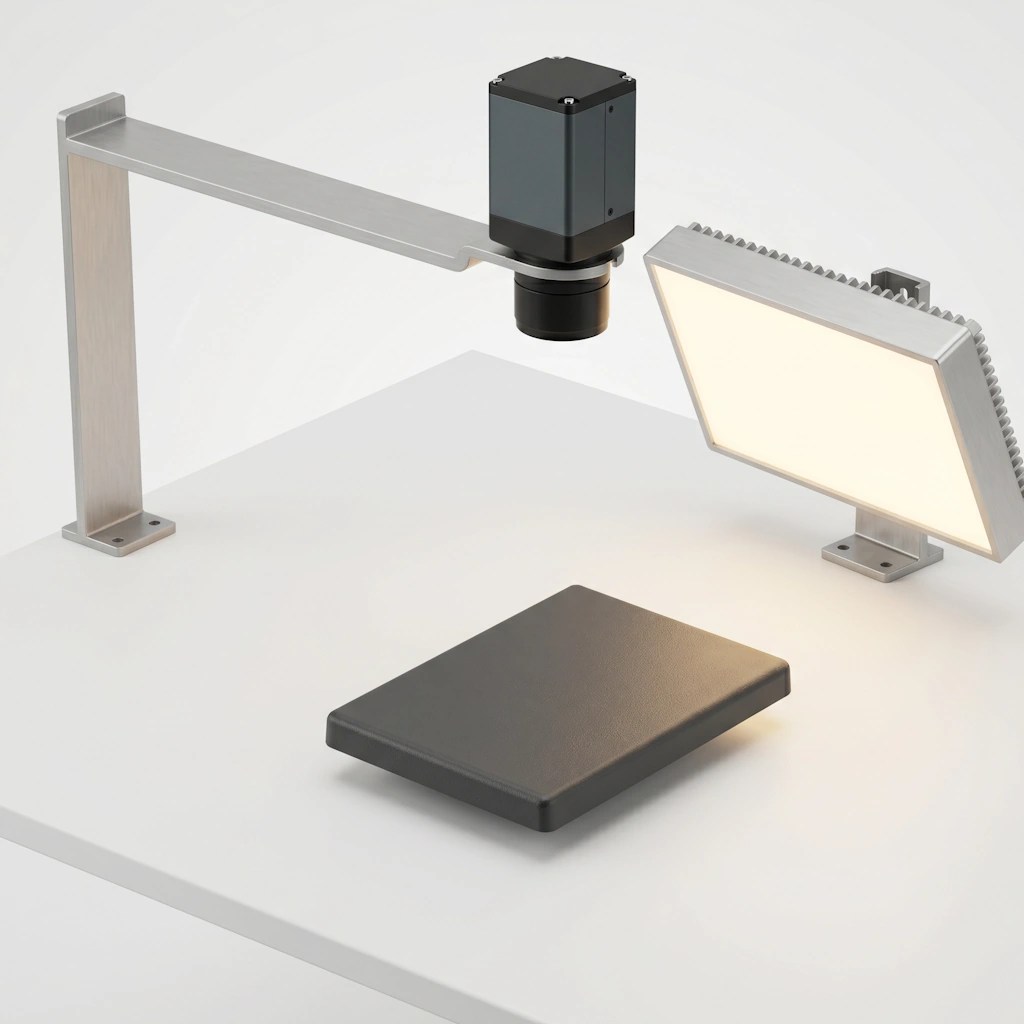
Soft Front Illumination for Cooperative and Semi-Glossy Surfaces
- Frosted, holographic or microstructured diffusers broaden LED emission into a softer angular cone while preserving directional contrast.
- Best fit for matte, semi-matte and moderately glossy surfaces: printed packaging, moulded plastic, electronics assemblies.
- Active emitting area must exceed the field of view by a margin set by the diffusion angle and working distance.
- Mount at 30 to 45 degrees for balanced texture visibility and glare suppression.
- Pulsed and strobed operation fully compatible — recommended above ~1 product per second.
- Residual specular reflection persists on highly polished surfaces — switch to dome or flat dome geometry instead.
Diffuse light describes any LED illuminator that incorporates a scattering optical element to broaden the angular distribution of the emitted photons. The principal aim is to soften specular reflections and shadows on cooperative or semi-cooperative surfaces while retaining sufficient directionality for the camera to capture useful contrast. Diffuse panels are the most common form of front-side illumination in industrial inspection and serve as the baseline against which all more specialised diffuse geometries (dome, flat dome and continuous tunnel) should be compared.
Working Principle of Diffuse Light
A diffuse light typically consists of an array of LEDs covered by a translucent front panel that scatters the emission into a broader angular range. The scattering element can be a frosted polycarbonate sheet, a holographic film, a microstructured optic, or a combination of these elements. The choice of diffuser determines both the angular distribution and the transmission efficiency of the panel: tighter diffusion patterns preserve more intensity but reduce the angular spread, while broader diffusion patterns deliver wider angular coverage at the cost of intensity loss.
Unlike a dome configuration, which surrounds the target on all sides, a diffuse panel illuminates from one direction only. The light arriving at the target spans a range of angles around the central illumination axis, which softens both shadows and specular reflections compared to a directional source, without eliminating them entirely. This makes diffuse panels a practical compromise for surfaces that are not extremely reflective and do not require absolute shadow elimination.
Diffuser Types and Their Optical Behavior
Frosted-film diffusers are the most common and produce a roughly Lambertian emission pattern: light is scattered approximately equally in all directions, with intensity falling off as the cosine of the angle from the normal. Microstructured diffusers, also known as light-shaping diffusers, can be engineered to deliver specific angular distributions (for example, an asymmetric pattern wider in one direction than the other) to match the geometry of the inspection field. Holographic diffusers offer high transmission and precise control over the angular profile but at higher cost.
Typical Industrial Applications
Diffuse light is the default choice for general-purpose front illumination on surfaces that are matte, semi-matte or moderately glossy. Typical applications include inspection of printed packaging where label uniformity and ink contrast must be evaluated; quality control of textured plastic and rubber parts; verification of moulded components with non-critical surface finish; reading of one-dimensional and two-dimensional codes on semi-glossy substrates; inspection of food and pharmaceutical primary packaging; and general assembly verification on automotive and electronics production lines. The standard delivery for these applications is provided by the LED Panel Illuminators family in its diffuse-front variants.
Selection Criteria and Design Considerations
The active area of the diffuse panel must exceed the field of view by a margin determined by the diffusion angle: a wider diffusion requires a larger active area to maintain uniformity across the inspection field at the chosen working distance. The relationship is approximately linear, and integrators should verify uniformity through measurement rather than relying on datasheet values measured under idealised test conditions.
The angle of incidence is the second important parameter. A diffuse panel mounted near the camera optical axis produces near-coaxial diffuse illumination that minimises shadows but can still generate specular reflection from glossy surfaces. A diffuse panel mounted at 30 to 45 degrees produces standard front diffuse lighting, with a balanced combination of texture visibility and glare suppression. Lower angles approach dark field conditions and are usually inferior to a dedicated dark field configuration. When the inspection field is elongated, two or more LED Bar Illuminators mounted symmetrically often replace a single panel and provide finer control of the angular distribution.
Spectral and Driving Considerations
Diffuse panels are available in white, monochromatic and switchable colour versions. The diffuser typically does not introduce significant chromatic distortion, but it can shift the apparent colour temperature of white LEDs slightly, which should be considered in colour-critical applications. Pulsed and strobed operation is fully compatible with diffuse panels and is recommended for any inspection above approximately one product per second.
Integration and Limitations
Diffuse panels are larger and heavier than directional sources of equivalent intensity at the target, which can complicate integration in confined inspection cells. The diffuser itself is susceptible to dust accumulation and mechanical damage, both of which alter the angular distribution of the emitted light and can degrade inspection performance over time. Periodic cleaning and protective covers are recommended in production environments.
The principal optical limitation of diffuse panels is residual directionality. On highly specular surfaces, even a well-diffused panel produces a clearly visible reflection of its rectangular emission area, which can mask features of interest. For such surfaces, the panel must be replaced by a full dome or a flat dome configuration that delivers diffusion from all directions simultaneously.
RODER Vision LED Diffuse Front Illuminators
RODER Vision manufactures dedicated LED panel and bar illuminators with engineered diffusion characteristics for industrial vision applications, available in standard white, monochromatic and application-specific spectral configurations.
- Diffuse front panel illumination — LED Panel Illuminators
- Multi-bar configurations for elongated inspection fields — LED Bar Illuminators
- Application-specific diffusion patterns and asymmetric optics — Custom LED Illuminators
For synchronised pulsed operation on high-speed lines, the RODER catalogue includes dedicated LED drivers and electronic controllers compatible with industrial machine vision controllers and PLCs.