


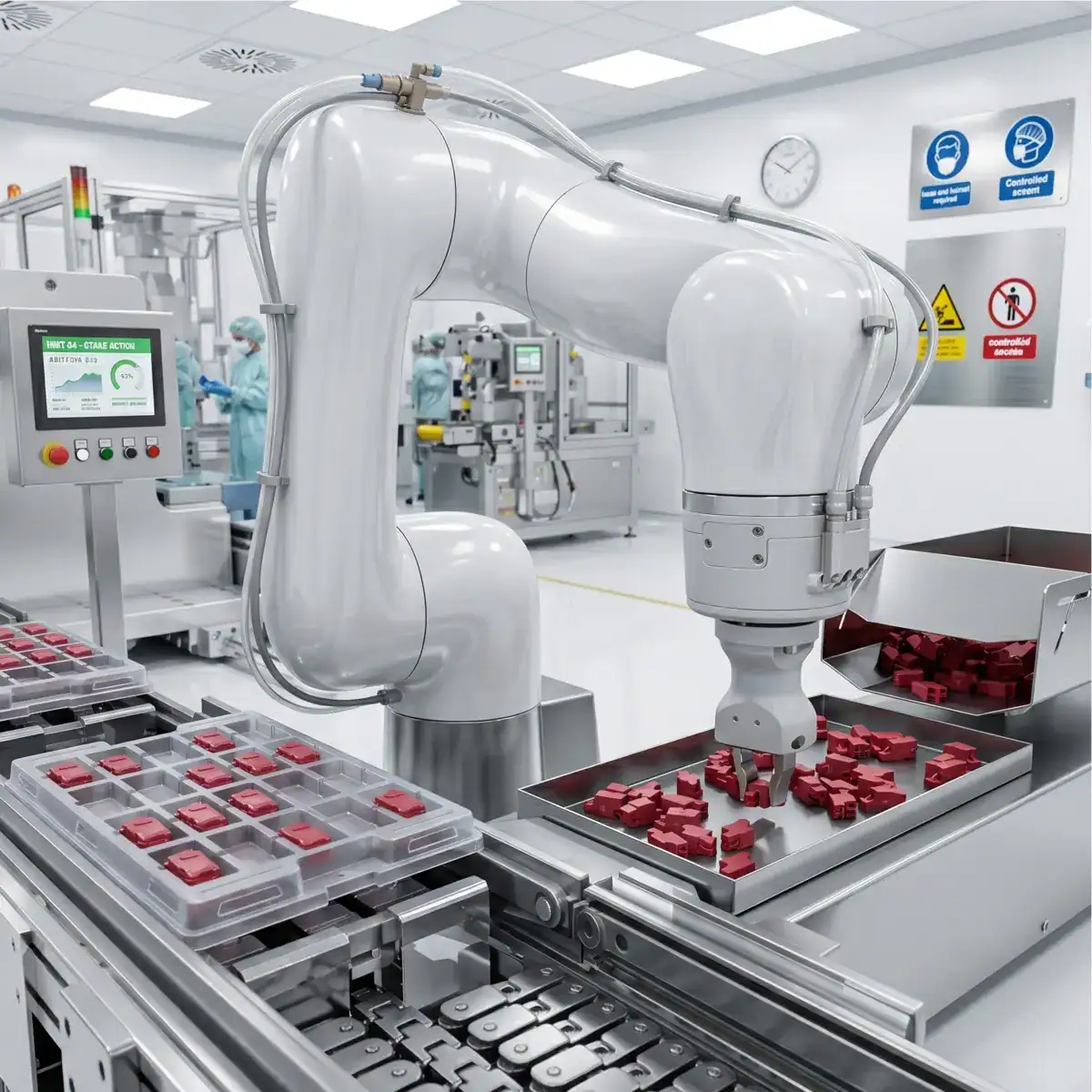
As manufacturing shifts toward complete autonomy, the „hand-off“ between raw material storage and the processing unit has become a primary focus for optimization. Machine loading, whether for CNC centers, plastic injection molding, or assembly presses, increasingly relies on vision-guided robotics to replace rigid mechanical fixtures. However, the success of these vision systems for machine loading depends on one variable that is often overlooked during the machine’s design phase: the lighting environment.
Inside an automatic machine, space is at a premium, and ambient light is often blocked by safety guarding or interrupted by moving mechanical arms. Without a dedicated, high-performance light source, the vision system faces a constant battle with shadows and fluctuating contrast. The RODER DL8 series was designed specifically as an „embedded“ solution for these challenges. By integrating these high-density LED matrices directly into the machine’s loading zone, OEMs can guarantee a stable optical environment. This ensures that the robot identifies and picks every part with 100% reliability, regardless of the factory’s external lighting or the machine’s internal geometry.

Möchten Sie Hilfe bei der Auswahl des richtigen Produkts?
Die entscheidende Rolle der Bildverarbeitung bei der Maschinenbeladung
The goal of modern machine loading is to handle a high variety of parts with minimal changeover time. Vision systems provide the flexibility to „see“ different components, but they require high-contrast images to calculate the exact grip points. If the lighting is inconsistent, the vision system may struggle to find the part’s orientation, leading to „no-pick“ errors or, worse, a collision between the robotic gripper and the machine tool.
The DL8 series provides a powerful, uniform light field that eliminates the „dark spots“ common in large machine enclosures. This allows the camera to work with lower gain settings and faster shutter speeds, reducing image noise and increasing the overall speed of the loading cycle.
OEM-Integration: Auslegung für Bauraum und Stabilität
For machine builders (OEMs), adding a vision system often feels like trying to fit a square peg in a round hole. Space is limited, and bulky lighting enclosures are difficult to mount. The RODER DL8 series addresses this with an ultra-slim profile and standardized industrial mounting points.
Beyond its physical dimensions, automatic machine lighting must be electrically stable. The DL8 series is engineered to be powered directly from the machine’s PLC or vision controller, supporting both continuous and strobe modes. This integration allows the lighting to be synchronized perfectly with the camera’s trigger, extending the lifespan of the LEDs and ensuring that the light is only „on“ when needed, reducing energy consumption and heat buildup.
Gebaut für die rauen Realitäten des Shop Floor
The interior of an automatic machine is a hostile environment. Between coolant mist, metal shavings, and constant mechanical vibration, standard LED solutions often fail prematurely. RODER has built the DL8 series with industrial-grade materials to ensure it survives these conditions.
The robust housing protects the LED matrix from physical impact and environmental contaminants. For OEMs, this means fewer service calls and a higher perceived quality for their customers. When you integrate a DL8 illuminator, you are installing a „fit and forget“ component that will maintain its intensity and uniformity for tens of thousands of operating hours.
Präzision mit Silhouette und Frontbeleuchtung erreichen
Depending on the part being loaded, the DL8 can be configured for either backlighting (to create a silhouette) or front-lighting (to highlight surface features like holes or engravings). For vision systems for machine loading, this versatility is invaluable.
For instance, when loading a CNC lathe with cylindrical billets, a DL8 backlight provides a perfect profile for the robot to calculate the center axis. Conversely, when loading complex electronic components, a front-lit DL8 setup highlights the connectors and orientation marks. By standardizing on the DL8 series, machine builders can provide a universal lighting solution that handles any part their customers might throw at it.
Produkte und Technologien


Häufig gestellte Fragen
LED-Ringleuchten sind die Standardlösung für die Bildverarbeitung von Pick-and-Place-Robotern. Sie werden koaxial zum Kameraobjektiv montiert und bieten eine gleichmäßige direktionale Beleuchtung zur Erkennung von Kanten und Merkmalen. Niedrigwinkel-Ringleuchten betonen das Oberflächenrelief. Hochintensive Stroboskop-Ringleuchten werden bei Hochgeschwindigkeits-Greifzyklen eingesetzt.
Verwenden Sie hochintensive LED-Stroboskopbeleuchter, die das Umgebungslicht während der Kamerabelichtung dominieren; schließen Sie den Aufnahmebereich mit einer Darkfield-Haube ein; setzen Sie schmalbandige LEDs und einen Bandpassfilter am Kameraobjektiv ein; oder wählen Sie NIR-Beleuchtung bei 850-940 nm, wo das Umgebungslicht in der Fabrik geringer ist.
Systeme mit strukturiertem Licht benötigen hochintensive LED-Projektoren für die Projektion kontrastreicher Muster. Aktive Stereo- und ToF-Sensoren verwenden NIR-LED-Beleuchter. Diffuse oder dome-förmige Beleuchtung reduziert Spiegelreflexe auf metallischen Teilen. Bevorzugt werden Hochleistungs-Matrix-Beleuchter mit einstellbarer Intensität.
LED-Beleuchter müssen die photobiologischen Sicherheitsgrenzwerte der IEC 62471 erfüllen. Beleuchter der Risikogruppe 0 oder 1 sind für Cobot-Anwendungen mit menschlichen Bedienern geeignet. PWM oberhalb von 1 kHz oder echter Gleichstrombetrieb vermeidet sichtbares Flackern für Personen im Nahbereich.
Die EOAT-Montage gewährleistet eine konstante Beleuchtungsgeometrie, erfordert jedoch kompakte und leichte Beleuchter innerhalb der Traglastgrenzen. Die feste Montage erlaubt größere und leistungsstärkere Beleuchter, setzt aber definierte Greifpositionen voraus. Die feste Variante ist einfacher für Einzonen-Operationen; EOAT eignet sich für flexible Multi-Positions-Führung.
Kontakte & Informationen
Kontakt für allgemeine Informationen : info@roder.it
Partner für System- und Sensorintegration : www.roder.it
RODER Bildverarbeitungs-Abteilung : www.rodervision.com
RODER Abteilung Messinstrumente : www.innovacheck.com
Mehr Informationen über RODER VISION : about us
Die Informationen auf dieser Website dienen ausschließlich Informationszwecken. Obwohl sie mit größter Sorgfalt erstellt wurden, stellen sie kein vertragliches Angebot und keine verbindliche Lieferverpflichtung dar. Sie können Übertragungs-, Übersetzungs- oder Tippfehler enthalten. Für präzise und aktuelle Informationen wenden Sie sich bitte direkt an unser Unternehmen.
Bitte beachten Sie: Einige Bilder auf dieser Website wurden absichtlich mittels Künstlicher Intelligenz (KI) generiert. Dies liegt daran, dass es bei vielen Anwendungen und Projekten aufgrund von Vertraulichkeitsvereinbarungen, Vertragsklauseln und Geheimhaltungsvereinbarungen (NDAs) nicht möglich ist, Fotografien der tatsächlichen Anlage oder des Systems zu veröffentlichen.
Related topics :
 Bildverarbeitungs-Beleuchtung für die Inspektion von Glas und transparenten Materialien
 Maximierung der Pick-&-Place-Genauigkeit: die Schlüsselrolle des Backlights.
 High-Speed Vision on Conveyor Belts: Achieving Uniformity with RODER LED Illuminators.
 SCARA Robotics and Shape Recognition: Simplifying Complex Silhouette Detection with LED backlight.
 Dimensional Inspection and Quality Control: Multi-Illuminator Setups for Pallet Lines.