


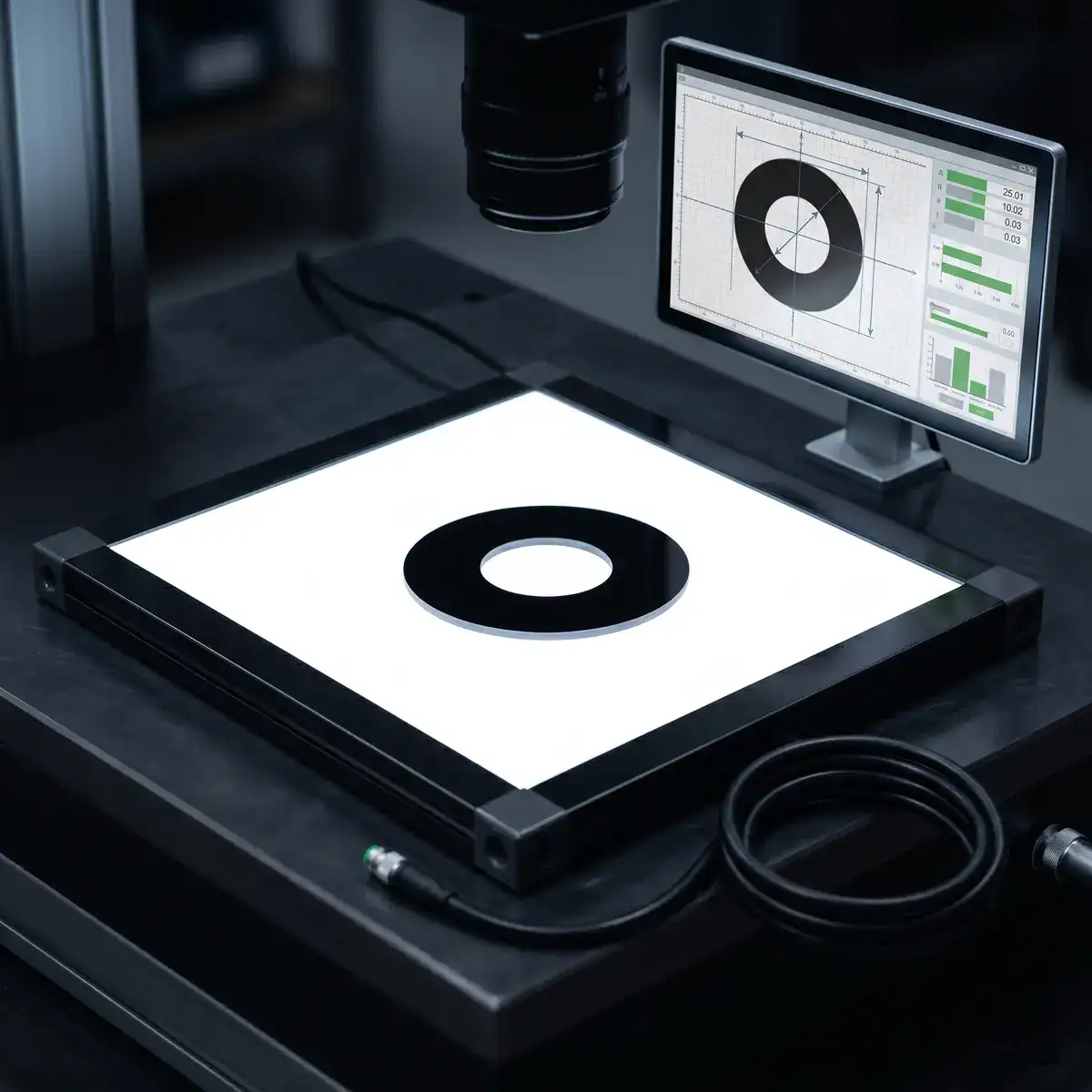
In the field of industrial automation, achieving sub-millimeter accuracy depends entirely on the quality of the raw image data. For engineers and system integrators, LED Backlighting is the primary method used to create the necessary contrast for high-level metrology. By placing the illumination source directly behind the object, LED Backlighting generates a clear boundary between the part and its background. This technique, often referred to as Silhouette Lighting, is fundamental for any Precision Inspection system that requires repeatable and stable results.
When the goal is Dimensional Measurement, the challenge is often found in the details of the edges. Front lighting can cause reflections that „blur“ the physical limits of a part. Conversely, LED Backlighting eliminates these surface distractions, allowing the vision software to focus exclusively on the geometry of the object.

Möchten Sie Hilfe bei der Auswahl des richtigen Produkts?
Warum LED-Backlight der Standard für Präzisionsinspektion ist
The effectiveness of LED Backlighting in a vision system is based on its ability to produce a high-contrast environment. In a typical Dimensional Measurement application, the camera sensor must distinguish between the „dark“ pixels of the object and the „bright“ pixels of the light source. Because LED Backlighting provides a uniform field of light, the transition at the edge of the part is extremely sharp.
This sharp transition is the foundation of Precision Inspection. Without the stability provided by LED Backlighting, edge-detection algorithms may suffer from pixel jitter, where the perceived edge of the part shifts slightly from one frame to the next. For high-precision industries like aerospace or medical device manufacturing, such fluctuations are unacceptable.
Präzise Dimensionsmessungen mit Silhouettenbeleuchtung erzielen
The concept of Silhouette Lighting is simple but requires high-quality hardware to execute correctly. To perform a reliable Dimensional Measurement, the light source must be perfectly uniform. If the LED Backlighting panel has „hotspots“ or dim areas, the vision software might interpret these variations as changes in the part’s dimensions.
Advanced LED Backlighting solutions utilize specialized diffusion layers to ensure that every point on the surface emits the same intensity of light. This uniformity is what allows Silhouette Lighting to be used for measuring complex shapes, such as gear teeth, micro-screws, or electronic connectors, with micron-level repeatability.
Technische Überlegungen zur Auswahl von LED-Backlight
Selecting the right LED Backlighting involves more than just choosing a size that fits the application. Several technical factors influence how the light interacts with the camera lens and the object.
Wellenlänge und Auflösung
The color of the light matters. While white light is common, many Precision Inspection systems use specific wavelengths to improve resolution. Blue LED Backlighting (around 470nm) is often preferred for metrology. Because blue light has a shorter wavelength than red or infrared, it suffers less from diffraction at the edges of the part. This physical property of blue LED Backlighting results in a crisp silhouette that is essential for accurate Dimensional Measurement.
Kollimation und Kantenschärfe
One common issue in Dimensional Measurement is „light creep,“ where light rays from a diffuse source wrap around the edges of a thick or cylindrical object. This makes the object appear smaller than its actual size. To solve this, collimated LED Backlighting uses optics to align light rays so they travel in a parallel path. Using collimated LED Backlighting is the best way to ensure that Silhouette Lighting remains accurate even when inspecting deep or rounded parts.
Integration von LED-Backlight in die Hochgeschwindigkeitsproduktion
In modern manufacturing, speed is just as important as accuracy. LED Backlighting is uniquely suited for high-speed lines because of its ability to be strobed. By overdriving the LEDs for a few microseconds, LED Backlighting can provide a massive amount of light in a very short time. This „freezes“ the motion of the object on the conveyor, allowing for Precise Dimensional Measurement without the blur that usually accompanies moving parts.
Furthermore, the longevity of LED Backlighting units makes them ideal for 24/7 operations. Unlike traditional light sources, industrial-grade LED Backlighting panels maintain consistent brightness over tens of thousands of hours, ensuring that the Precision Inspection system does not require frequent recalibration.
Fallstudien: LED-Backlight in der Industrie
Inspektion von Automotive-Verbindungselementen
In the automotive sector, every bolt and screw must meet strict tolerances. LED Backlighting is used to capture the thread profile of fasteners. By using Silhouette Lighting, the system can measure the pitch, major diameter, and minor diameter of the threads simultaneously. This type of Dimensional Measurement ensures that only perfect parts reach the assembly line.
Metrologie pharmazeutischer Vials
For glass vials used in the medical industry, measuring the outer diameter and neck height is critical for ensuring a proper seal. LED Backlighting allows the camera to see through the transparent glass, focusing only on the outer silhouette. This application of Precision Inspection prevents leaks and contamination in safety-critical products.
Elektronikmontage und Pin-Ausrichtung
Microchips and connectors require perfectly aligned leads. LED Backlighting provides the high-contrast background needed to check the spacing (pitch) between pins. Because Silhouette Lighting ignores the reflective nature of the metal pins, it provides the most stable data for high-speed Dimensional Measurement.
Umgebungsfaktoren und Thermomanagement
To maintain the accuracy of a Precision Inspection system, the environment must be controlled. Heat can cause mechanical components to expand, which introduces errors in Dimensional Measurement. High-quality LED Backlighting units are designed with aluminum housings that act as heat sinks. Proper thermal management ensures that the LED Backlighting does not heat up the surrounding inspection area, preserving the integrity of the metrology data.
Additionally, in industries like food processing, LED Backlighting must be able to withstand washdown procedures. Using IP67-rated LED Backlighting ensures that the system remains functional even in harsh, wet, or dusty conditions, providing consistent Silhouette Lighting regardless of the environment.
Die Zukunft der Metrologie: LED-Backlight und KI
As machine vision moves toward Deep Learning and Artificial Intelligence, the need for high-quality lighting remains. AI models for Precision Inspection require clean, consistent training data. LED Backlighting provides the perfect input for these models by removing unnecessary surface variables. Whether it is for traditional rule-based algorithms or advanced neural networks, LED Backlighting is the most reliable way to feed accurate data into a Dimensional Measurement system.
Zusammenfassung der Best Practices für LED-Backlight
Um den Erfolg eines Präzisionsinspektions-Projekts sicherzustellen, sollten Ingenieure diese Richtlinien befolgen:
- Setzen Sie ein LED-Backlight ein, das mindestens 20 % größer als das Bildfeld ist, um eine kantenübergreifende Gleichmäßigkeit sicherzustellen.
- Wählen Sie blaues LED-Backlight, wenn die höchstmögliche Auflösung für die Dimensionsmessung erforderlich ist.
- Integrieren Sie kollimierte Optiken beim Einsatz von Silhouettenbeleuchtung auf zylindrischen oder dicken Teilen, um Light Wrap-Around zu vermeiden.
- Synchronisieren Sie das LED-Backlight mit dem Kameraverschluss über einen hochwertigen Strobe-Controller, um den Kontrast zu maximieren und Bewegungsunschärfe zu eliminieren.
By focusing on these technical details, manufacturers can leverage the full power of LED Backlighting to achieve zero-defect production through Precise Dimensional Measurement.
Fazit: Warum Roder Vision als Partner wählen?
Achieving Precise Dimensional Measurement is a science that requires the perfect harmony of optics, cameras, and, most importantly, lighting. LED Backlighting remains the most effective way to provide the „clean“ data that vision algorithms need to succeed.
At Roder Vision, we specialize in designing high-performance illumination solutions tailored to the rigors of industrial environments. Whether you are dealing with high-speed automotive lines or delicate pharmaceutical inspections, our range of Silhouette Lighting products provides the uniformity, intensity, and reliability required for world-class Precision Inspection.
Produkte und Technologien


Häufig gestellte Fragen (FAQ)
LED Backlighting creates a high-contrast silhouette of an object by placing the light source behind the target. This technique, known as silhouette lighting, allows vision systems to capture clean edge profiles, which are essential for precise dimensional measurement and shape verification without interference from surface reflections or internal shadows.
By eliminating surface details and distracting textures, backlighting provides a binary-like image with sharp, well-defined edges. This high contrast significantly reduces the complexity of edge-detection algorithms and minimizes data „jitter,“ allowing the system to achieve sub-pixel accuracy during automated quality control processes.
Blue LED Backlighting is preferred for high-resolution dimensional measurement because shorter wavelengths suffer less from light diffraction at the object’s edges. This results in a sharper silhouette compared to longer wavelengths, which is critical when inspecting micro-components or parts with extremely tight tolerances.
Collimated backlighting uses specialized optics to produce parallel light rays. Unlike standard diffuse backlights, it prevents light from „wrapping around“ the edges of thick or cylindrical objects (light creep). This technique is vital for measuring objects with significant depth or curved profiles while maintaining maximum optical precision.
Yes. Modern LED backlights support high-intensity strobing, which synchronizes a powerful light pulse with the camera shutter. This capability effectively „freezes“ the motion of the part, allowing for accurate dimensional measurement even at high throughput speeds without any motion blur.
Kontakte & Informationen
Kontakt für allgemeine Informationen : info@roder.it
Partner für System- und Sensorintegration : www.roder.it
RODER Bildverarbeitungs-Abteilung : www.rodervision.com
RODER Abteilung Messinstrumente : www.innovacheck.com
Mehr Informationen über RODER VISION : about us
Die Informationen auf dieser Website dienen ausschließlich Informationszwecken. Obwohl sie mit größter Sorgfalt erstellt wurden, stellen sie kein vertragliches Angebot und keine verbindliche Lieferverpflichtung dar. Sie können Übertragungs-, Übersetzungs- oder Tippfehler enthalten. Für präzise und aktuelle Informationen wenden Sie sich bitte direkt an unser Unternehmen.
Bitte beachten Sie: Einige Bilder auf dieser Website wurden absichtlich mittels Künstlicher Intelligenz (KI) generiert. Dies liegt daran, dass es bei vielen Anwendungen und Projekten aufgrund von Vertraulichkeitsvereinbarungen, Vertragsklauseln und Geheimhaltungsvereinbarungen (NDAs) nicht möglich ist, Fotografien der tatsächlichen Anlage oder des Systems zu veröffentlichen.
Related topics :
 Integration von LED-Beleuchtung in automatische Maschinen: Lösungen für die Teilebeladung.
 Bildverarbeitungs-Beleuchtung für die Inspektion von Glas und transparenten Materialien
 Integrität von Glasflaschen: Risse mit diffuser Hintergrundbeleuchtung erkennen
 Maximierung der Pick-&-Place-Genauigkeit: die Schlüsselrolle des Backlights.
 Dimensionsprüfung von Verbindungselementen: Einsatz telezentrischer Beleuchtungen für hochpräzise Schrauben