


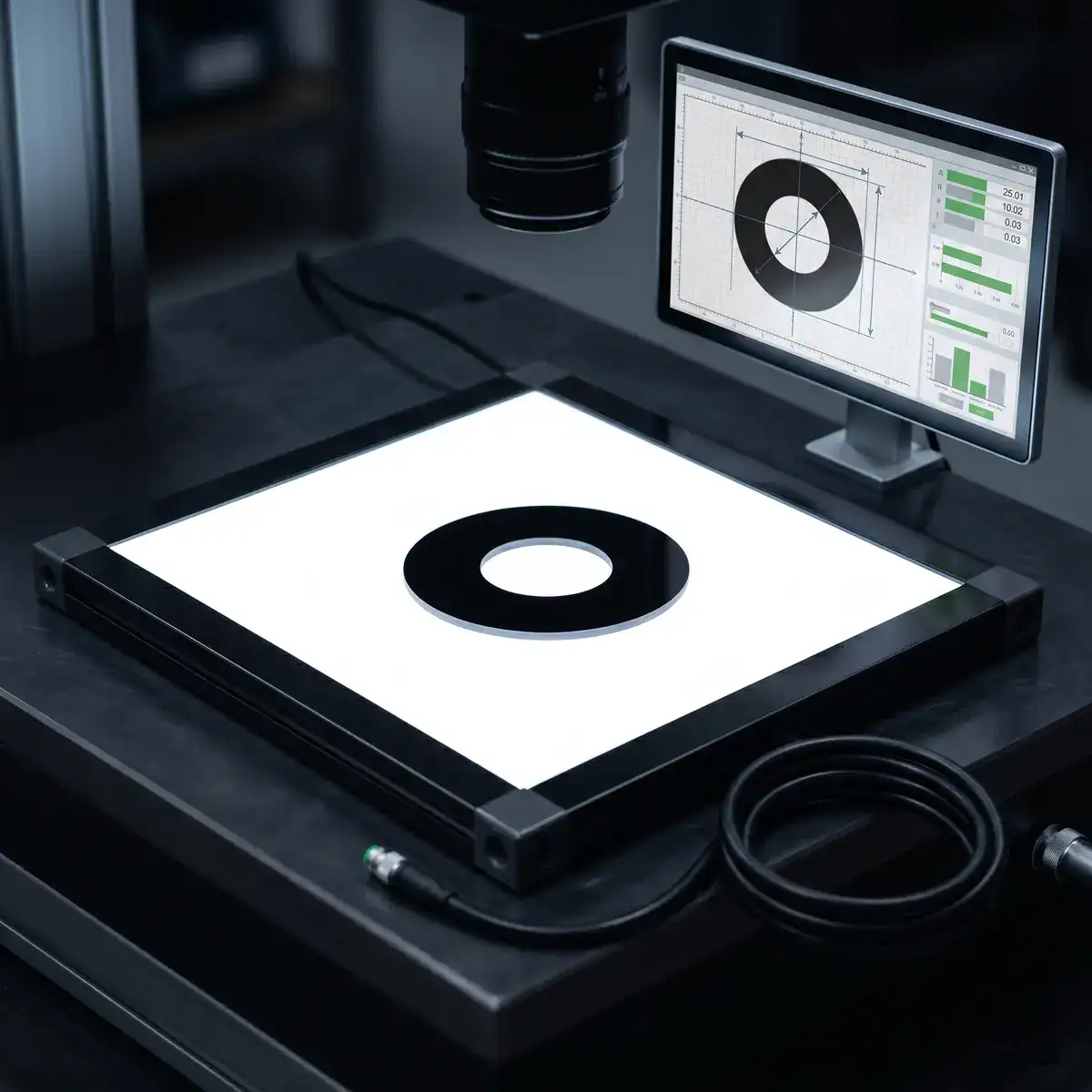
In industrial automation, reaching sub-millimeter accuracy rests entirely on how good the raw image data is. For engineers and system integrators, LED Backlighting is the primary route to building the contrast that high-level metrology needs. By sitting the light source straight behind the object, LED Backlighting draws a clean boundary between the part and its background. This approach, commonly called Silhouette Lighting, underpins any Precision Inspection system that depends on repeatable, stable results.
When the aim is Dimensional Measurement, the difficulty usually hides in the edges. Front lighting can throw reflections that “blur” the physical limits of a part. LED Backlighting, on the other hand, wipes out these surface distractions and frees the vision software to concentrate purely on the object’s geometry.

Do you want help choosing the right product?
Why LED Backlighting Sets the Standard for Precision Inspection
What makes LED Backlighting so effective in a vision system is its knack for creating a high-contrast scene. In a typical Dimensional Measurement job, the camera sensor has to separate the “dark” pixels of the object from the “bright” pixels of the light source. Since LED Backlighting lays down a uniform field of light, the transition at the part’s edge comes out extremely sharp.
That sharp transition is the bedrock of Precision Inspection. Without the stability LED Backlighting brings, edge-detection algorithms can suffer pixel jitter, where the part’s perceived edge drifts a little from one frame to the next. For exacting industries such as aerospace or medical device manufacturing, swings like that are simply not acceptable.
Reaching Accurate Dimensional Measurement with Silhouette Lighting
The idea behind Silhouette Lighting is simple, yet pulling it off correctly takes high-quality hardware. To run a reliable Dimensional Measurement, the light source has to be perfectly uniform. If the LED Backlighting panel shows “hotspots” or dim patches, the vision software may read those variations as changes in the part’s dimensions.
Advanced LED Backlighting solutions use purpose-built diffusion layers so that every point on the surface gives off the same light intensity. That uniformity is what lets Silhouette Lighting measure complex shapes, such as gear teeth, micro-screws, or electronic connectors, with micron-level repeatability.
Technical Factors in Choosing LED Backlighting
Picking the right LED Backlighting takes more than finding a size that fits the application. Several technical factors shape how the light works with the camera lens and the object.
Wavelength and Resolution
The colour of the light counts. White light is common, but many Precision Inspection systems pick specific wavelengths to sharpen resolution. Blue LED Backlighting (around 470nm) is often the choice for metrology. Because blue light has a shorter wavelength than red or infrared, it suffers less diffraction at the part’s edges. This trait of blue LED Backlighting yields a crisp silhouette that accurate Dimensional Measurement relies on.
Collimation and Edge Sharpness
A frequent headache in Dimensional Measurement is “light creep,” where rays from a diffuse source curl around the edges of a thick or cylindrical object, making it look smaller than it really is. The fix is collimated LED Backlighting, which uses optics to line up the light rays on a parallel path. Reaching for collimated LED Backlighting is the surest way to keep Silhouette Lighting accurate even on deep or rounded parts.
Bringing LED Backlighting Into High-Speed Production
In modern manufacturing, speed weighs as heavily as accuracy. LED Backlighting is a natural fit for fast lines thanks to its ability to be strobed. By overdriving the LEDs for a few microseconds, LED Backlighting can pour out a huge amount of light in a very short time. That “freezes” the object’s motion on the conveyor and opens the way to Precise Dimensional Measurement without the blur that usually tags along with moving parts.
On top of that, the long life of LED Backlighting units makes them ideal for 24/7 operations. Unlike older light sources, industrial-grade LED Backlighting panels hold steady brightness across tens of thousands of hours, so the Precision Inspection system rarely needs recalibrating.
Case Studies: LED Backlighting in Industry
Automotive Fastener Inspection
In the automotive world, every bolt and screw has to hit tight tolerances. LED Backlighting captures the thread profile of fasteners, and through Silhouette Lighting the system measures thread pitch, major diameter, and minor diameter all at once. This kind of Dimensional Measurement makes sure only flawless parts ever reach the assembly line.
Pharmaceutical Vial Metrology
With glass vials used in medicine, measuring the outer diameter and neck height is vital for a proper seal. LED Backlighting lets the camera look past the transparent glass and lock onto the outer silhouette alone. This use of Precision Inspection heads off leaks and contamination in safety-critical products.
Electronics Assembly and Lead Alignment
Microchips and connectors need their leads perfectly aligned. LED Backlighting supplies the high-contrast background required to check the spacing (pitch) between pins. Because Silhouette Lighting ignores the shiny nature of the metal pins, it hands over the most stable data for high-speed Dimensional Measurement.
Environmental Factors and Thermal Management
Keeping a Precision Inspection system accurate means controlling its surroundings. Heat can make mechanical parts expand, which feeds errors into Dimensional Measurement. High-quality LED Backlighting units come with aluminium housings that double as heat sinks. Sound thermal management keeps the LED Backlighting from warming the inspection area and protects the integrity of the metrology data.
What is more, in fields like food processing, LED Backlighting has to survive washdown routines. Choosing IP67-rated LED Backlighting keeps the system working even in harsh, wet, or dusty conditions, delivering steady Silhouette Lighting whatever the environment.
The Future of Metrology: LED Backlighting and AI
As machine vision shifts toward Deep Learning and Artificial Intelligence, the call for high-quality lighting holds firm. AI models for Precision Inspection need clean, consistent training data, and LED Backlighting serves up the perfect input by stripping out needless surface variables. Whether the job runs on traditional rule-based algorithms or advanced neural networks, LED Backlighting is the most dependable way to feed accurate data into a Dimensional Measurement system.
Best Practices for LED Backlighting at a Glance
To set a Precision Inspection project up for success, engineers should keep to these guidelines:
- Pick LED Backlighting at least 20% larger than the field of view to keep uniformity edge to edge.
- Go with Blue LED Backlighting whenever the highest possible resolution is needed for Dimensional Measurement.
- Add collimated optics when using Silhouette Lighting on cylindrical or thick parts to stop light wrap-around.
- Sync the LED Backlighting with the camera shutter via a high-quality strobe controller to push contrast up and clear motion blur.
By minding these technical details, manufacturers can tap the full strength of LED Backlighting and reach zero-defect production through Precise Dimensional Measurement.
Conclusion: Why Partner with Roder Vision?
Reaching Precise Dimensional Measurement is a science that needs optics, cameras, and above all lighting working in perfect harmony. LED Backlighting stays the most effective way to supply the “clean” data that vision algorithms need to succeed.
At Roder Vision, we focus on designing high-performance illumination tailored to the demands of industrial settings. Whether you face high-speed automotive lines or delicate pharmaceutical checks, our range of Silhouette Lighting products brings the uniformity, intensity, and reliability that world-class Precision Inspection calls for.
Products and Technologies


Frequently Asked Questions (FAQ)
LED Backlighting forms a high-contrast silhouette of an object by setting the light source behind the target. Known as silhouette lighting, this approach lets vision systems capture clean edge profiles, which are essential for precise dimensional measurement and shape verification with no interference from surface reflections or internal shadows.
By stripping out surface detail and distracting texture, backlighting hands over a near-binary image with sharp, well-defined edges. That high contrast cuts the complexity of edge-detection algorithms and reduces edge jitter in the data, so the system can reach sub-pixel accuracy during automated quality control.
Blue LED Backlighting is the pick for high-resolution dimensional measurement because shorter wavelengths suffer less light diffraction at the object edges. The result is a sharper silhouette than longer wavelengths give, which matters when inspecting micro-components or parts held to extremely tight tolerances.
Collimated backlighting uses purpose-built optics to send out parallel light rays. Unlike standard diffuse backlights, it stops light from wrapping around the edges of thick or cylindrical objects (light creep). The technique is vital for measuring objects with real depth or curved profiles while holding maximum optical precision.
Yes. Modern LED backlights handle high-intensity strobing, syncing a powerful light pulse to the camera shutter. That capability effectively freezes the part motion, allowing accurate dimensional measurement even at high throughput with no motion blur.
Contacts & Information
Contact for general information : info@roder.it
Systems and Sensor Integration Partner : www.roder.it
RODER Artificial Vision Division : www.rodervision.com
RODER Instruments Division : www.innovacheck.com
More information about RODER VISION : about us
The information on this website is provided for informational purposes only. Although it has been prepared with the utmost care, it does not constitute a contractual offer or a binding commitment to supply. It may contain transcription, translation, or typographical errors. For precise and up-to-date information, please contact our company directly.
Please note: Some images on this website have been intentionally generated using Artificial Intelligence (AI). This is due to the fact that, for many applications and projects, it is not possible to disclose photographs of the actual installation or system due to confidentiality agreements, contractual clauses, and Non-Disclosure Agreements (NDAs).


