


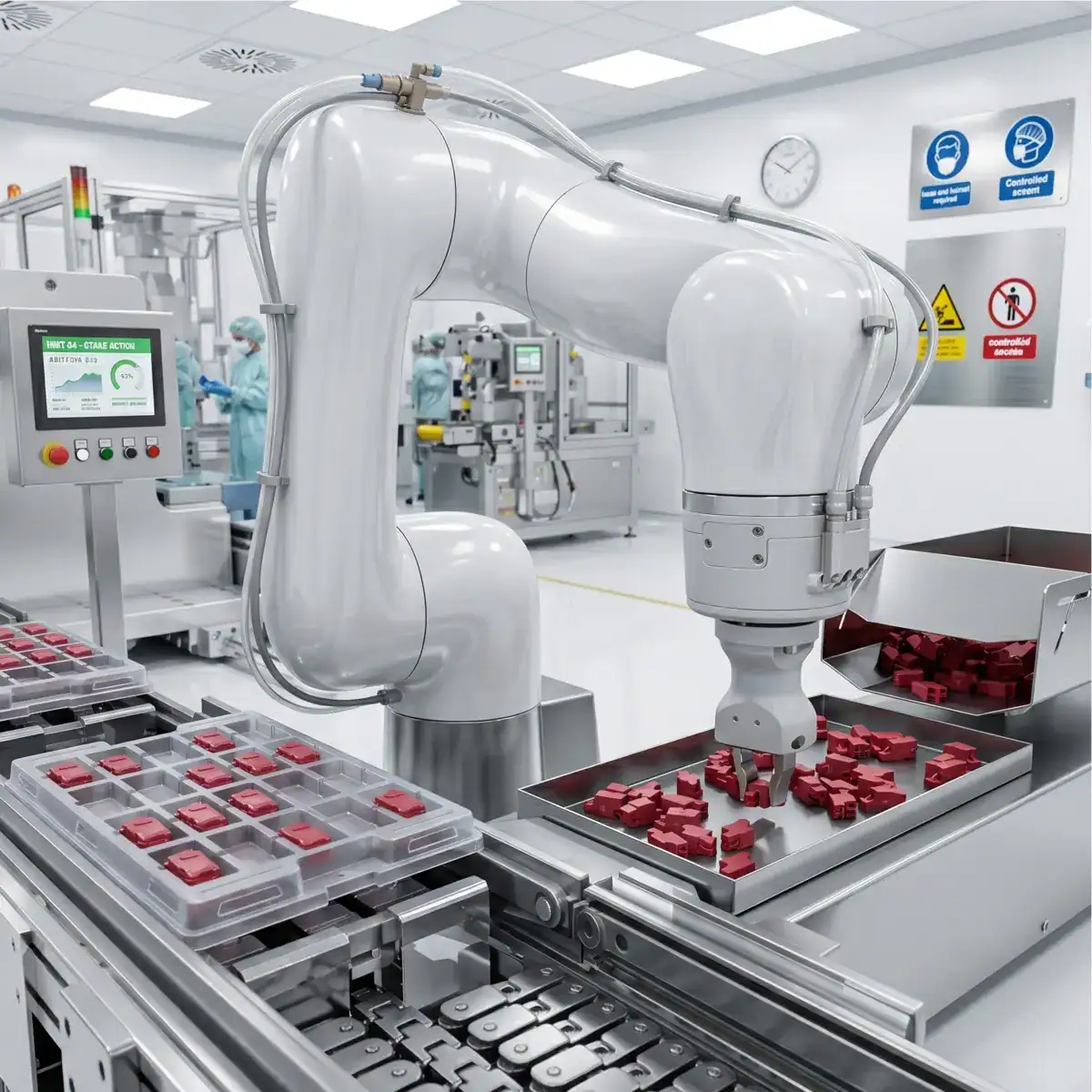
As manufacturing shifts toward complete autonomy, the “hand-off” between raw material storage and the processing unit has become a primary focus for optimization. Machine loading, whether for CNC centers, plastic injection molding, or assembly presses, increasingly relies on vision-guided robotics to replace rigid mechanical fixtures. However, the success of these vision systems for machine loading depends on one variable that is often overlooked during the machine’s design phase: the lighting environment.
Inside an automatic machine, space is at a premium, and ambient light is often blocked by safety guarding or interrupted by moving mechanical arms. Without a dedicated, high-performance light source, the vision system faces a constant battle with shadows and fluctuating contrast. The RODER DL8 series was designed specifically as an “embedded” solution for these challenges. By integrating these high-density LED matrices directly into the machine’s loading zone, OEMs can guarantee a stable optical environment. This ensures that the robot identifies and picks every part with 100% reliability, regardless of the factory’s external lighting or the machine’s internal geometry.

Vuoi essere aiutato a scegliere il prodotto giusto?
Il ruolo critico della visione nel carico macchina
The goal of modern machine loading is to handle a high variety of parts with minimal changeover time. Vision systems provide the flexibility to “see” different components, but they require high-contrast images to calculate the exact grip points. If the lighting is inconsistent, the vision system may struggle to find the part’s orientation, leading to “no-pick” errors or, worse, a collision between the robotic gripper and the machine tool.
The DL8 series provides a powerful, uniform light field that eliminates the “dark spots” common in large machine enclosures. This allows the camera to work with lower gain settings and faster shutter speeds, reducing image noise and increasing the overall speed of the loading cycle.
Integrazione OEM: progettare per spazio e stabilità
For machine builders (OEMs), adding a vision system often feels like trying to fit a square peg in a round hole. Space is limited, and bulky lighting enclosures are difficult to mount. The RODER DL8 series addresses this with an ultra-slim profile and standardized industrial mounting points.
Beyond its physical dimensions, automatic machine lighting must be electrically stable. The DL8 series is engineered to be powered directly from the machine’s PLC or vision controller, supporting both continuous and strobe modes. This integration allows the lighting to be synchronized perfectly with the camera’s trigger, extending the lifespan of the LEDs and ensuring that the light is only “on” when needed, reducing energy consumption and heat buildup.
Progettato per le condizioni reali dello shop floor
The interior of an automatic machine is a hostile environment. Between coolant mist, metal shavings, and constant mechanical vibration, standard LED solutions often fail prematurely. RODER has built the DL8 series with industrial-grade materials to ensure it survives these conditions.
The robust housing protects the LED matrix from physical impact and environmental contaminants. For OEMs, this means fewer service calls and a higher perceived quality for their customers. When you integrate a DL8 illuminator, you are installing a “fit and forget” component that will maintain its intensity and uniformity for tens of thousands of operating hours.
Ottenere precisione con silhouette e illuminazione frontale
Depending on the part being loaded, the DL8 can be configured for either backlighting (to create a silhouette) or front-lighting (to highlight surface features like holes or engravings). For vision systems for machine loading, this versatility is invaluable.
For instance, when loading a CNC lathe with cylindrical billets, a DL8 backlight provides a perfect profile for the robot to calculate the center axis. Conversely, when loading complex electronic components, a front-lit DL8 setup highlights the connectors and orientation marks. By standardizing on the DL8 series, machine builders can provide a universal lighting solution that handles any part their customers might throw at it.
Prodotti e tecnologie


Domande frequenti
Le luci ad anello LED sono la soluzione standard per la visione dei robot pick-and-place. Si montano coassialmente all’obiettivo della telecamera e forniscono un’illuminazione direzionale uniforme per il rilevamento di bordi e feature dei pezzi. Le ring light a basso angolo accentuano il rilievo superficiale. Le ring light stroboscopiche ad alta intensità si usano nei cicli di prelievo ad alta velocità.
Utilizzare illuminatori LED stroboscopici ad alta intensità che sovrastino la luce ambiente durante l’esposizione della telecamera; racchiudere la zona di acquisizione con una cuffia darkfield; impiegare LED a banda stretta e filtro bandpass sull’obiettivo della telecamera; oppure scegliere l’illuminazione NIR a 850-940 nm, dove la luce ambientale di fabbrica è più bassa.
I sistemi a luce strutturata richiedono proiettori LED ad alta intensità per la proiezione di pattern ad alto contrasto. I sensori a stereo attivo e ToF utilizzano illuminatori LED NIR. L’illuminazione diffusa o a dome riduce le riflessioni speculari sui pezzi metallici. Sono da preferire illuminatori a matrice ad alta potenza con intensità regolabile.
Gli illuminatori LED devono rispettare i limiti di sicurezza fotobiologica della norma IEC 62471. Gli illuminatori del Gruppo di Rischio 0 o 1 sono adatti alle applicazioni con cobot in presenza di operatori. Il funzionamento PWM al di sopra di 1 kHz o in vera DC evita il flicker visibile per i lavoratori vicini.
Il montaggio EOAT mantiene una geometria di illuminazione costante, ma richiede illuminatori compatti e leggeri entro i limiti di payload. Il montaggio fisso consente illuminatori più grandi e potenti, ma impone posizioni di prelievo definite. Il fisso è più semplice per operazioni in zona singola; l’EOAT è adatto alla guida flessibile multi-posizione.
Contatti e informazioni
Contatto per informazioni generali : info@roder.it
Partner per l’Integrazione di Sistemi e Sensori : www.roder.it
Divisione Roder Artificial Vision : www.rodervision.com
Divisione RODER Instruments : www.innovacheck.com
Ulteriori informazioni su RODER VISIONE : chi siamo
Le informazioni contenute in questo sito web sono fornite solo a scopo informativo. Sebbene siano state preparate con la massima cura, non costituiscono un’offerta contrattuale o un impegno vincolante alla fornitura. Possono contenere errori di trascrizione, traduzione o tipografici. Per informazioni precise e aggiornate, ti invitiamo a contattare direttamente la nostra azienda.
Nota bene: alcune immagini presenti in questo sito web sono state intenzionalmente generate utilizzando l’Intelligenza Artificiale (AI). Ciò è dovuto al fatto che, per molte applicazioni e progetti, non è possibile divulgare fotografie dell’installazione o del sistema reale a causa di accordi di riservatezza, clausole contrattuali e accordi di non divulgazione (NDA).
Related topics :
 I vantaggi della retroilluminazione LED nelle misure dimensionali di precisione
 Ottimizzazione dell’orientamento dei pezzi nei dosatori vibranti con l’illuminazione di visione a LED.
 Illuminazione per visione: ispezione di vetro e materiali trasparenti
 Illuminatori LED per sistemi a telecamera lineare
 Verifica dimensionale di elementi di fissaggio: uso di luci telecentriche per viti di alta precisione