


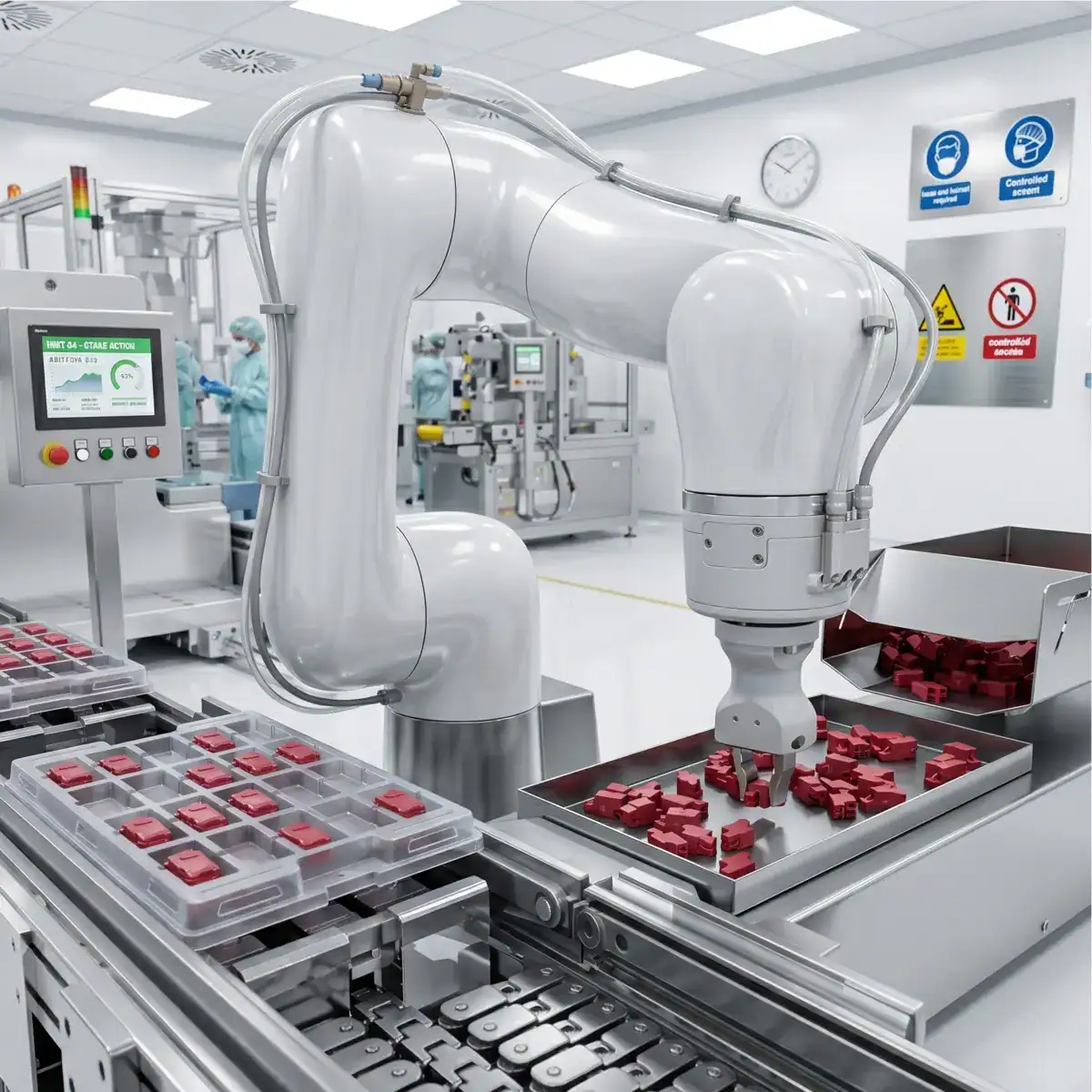
As manufacturing moves toward full autonomy, the hand-off between raw material storage and the processing unit has turned into a prime target for optimisation. Machine loading, whether for CNC centres, plastic injection moulding, or assembly presses, leans more and more on vision-guided robotics in place of rigid mechanical fixtures. Yet the success of these vision systems for machine loading hinges on one variable that frequently gets overlooked while the machine is being designed: the lighting environment.
Inside an automatic machine, space is scarce, and ambient light is often shut out by safety guarding or chopped up by moving mechanical arms. Without a dedicated, high-performance light source, the vision system fights a constant battle with shadows and shifting contrast. The RODER DL8 series was created specifically as an embedded answer to these problems. By building these high-density LED matrices straight into the machine’s loading zone, OEMs can lock in a stable optical environment. That guarantees the robot identifies and picks every part with 100% reliability, whatever the factory’s external lighting or the machine’s internal geometry.

Do you want help choosing the right product?
The Critical Role of Vision in Machine Loading
The aim of modern machine loading is to handle a wide variety of parts with as little changeover time as possible. Vision systems bring the flexibility to see different components, but they need high-contrast images to work out the exact grip points. When the lighting is inconsistent, the vision system can struggle to read the part’s orientation, which leads to no-pick errors or, worse, a collision between the robotic gripper and the machine tool.
The DL8 series lays down a powerful, uniform light field that clears the dark spots so common inside large machine enclosures. That lets the camera run with lower gain and faster shutter speeds, cutting image noise and speeding up the whole loading cycle.
OEM Integration: Designing for Space and Stability
For machine builders (OEMs), bolting on a vision system can feel like forcing a square peg into a round hole. Space is tight, and bulky lighting enclosures are awkward to mount. The RODER DL8 series tackles this with an ultra-slim profile and standardised industrial mounting points.
Beyond its footprint, automatic machine lighting has to be electrically stable. The DL8 series is built to run directly from the machine’s PLC or vision controller and supports both continuous and strobe modes. This lets the lighting sync perfectly with the camera trigger, which stretches LED lifespan and keeps the light on only when it is needed, trimming energy use and heat build-up.
Built for the Harsh Realities of the Shop Floor
The inside of an automatic machine is a punishing place. Between coolant mist, metal shavings, and non-stop mechanical vibration, ordinary LED solutions often fail early. RODER built the DL8 series from industrial-grade materials so it stands up to these conditions.
The rugged housing shields the LED matrix from physical knocks and environmental contaminants. For OEMs, that means fewer service calls and a higher perceived quality for their own customers. Fitting a DL8 illuminator means installing a fit-and-forget component that holds its intensity and uniformity across tens of thousands of operating hours.
Achieving Precision with Silhouette and Front-Lighting
Depending on the part being loaded, the DL8 can be set up for backlighting (to form a silhouette) or front-lighting (to bring out surface features such as holes or engravings). For vision systems for machine loading, that versatility is priceless.
For example, when loading a CNC lathe with cylindrical billets, a DL8 backlight hands the robot a clean profile to calculate the centre axis. When loading complex electronic components, on the other hand, a front-lit DL8 setup highlights the connectors and orientation marks. By standardising on the DL8 series, machine builders give their customers a universal lighting solution that copes with whatever part comes its way.
Products and Technologies


Frequently Asked Questions
High-density LED matrix illuminators such as the RODER DL8 series are the standard choice for vision-guided machine loading. They deliver a uniform, high-intensity field across the loading zone for reliable part edge and feature detection, can be front-lit or used as a backlight for silhouettes, and support strobe mode for fast loading cycles.
Use high-intensity strobed LED matrices that overpower ambient light during the camera exposure, enclose the loading zone within the machine guarding, fit a narrowband LED and a matching bandpass filter on the camera, or choose NIR illumination at 850-940 nm where factory ambient light is weaker.
Yes. The DL8 series has an ultra-slim profile and standardised industrial mounting points so it fits inside tight machine enclosures. It runs directly from the machine PLC or vision controller, supports continuous and strobe modes, and synchronises with the camera trigger to extend LED life and reduce heat.
The DL8 series is built from industrial-grade materials with a rugged housing that protects the LED matrix from coolant mist, metal shavings, impact and constant vibration. This fit-and-forget design holds stable intensity and uniformity across tens of thousands of operating hours, reducing service calls.
It depends on the part. A DL8 backlight forms a clean silhouette that helps the robot find the centre axis of cylindrical billets, while a front-lit DL8 setup highlights surface features such as holes, engravings, connectors and orientation marks on complex components. The DL8 series can be configured for either.
Contacts & Information
Contact for general information : info@roder.it
Systems and Sensor Integration Partner : www.roder.it
RODER Artificial Vision Division : www.rodervision.com
RODER Instruments Division : www.innovacheck.com
More information about RODER VISION : about us
The information on this website is provided for informational purposes only. Although it has been prepared with the utmost care, it does not constitute a contractual offer or a binding commitment to supply. It may contain transcription, translation, or typographical errors. For precise and up-to-date information, please contact our company directly.
Please note: Some images on this website have been intentionally generated using Artificial Intelligence (AI). This is due to the fact that, for many applications and projects, it is not possible to disclose photographs of the actual installation or system due to confidentiality agreements, contractual clauses, and Non-Disclosure Agreements (NDAs).
Related topics :
 High-Speed Conveyor Vision: Uniform Lighting for Delta Robots with RODER LED Illuminators
 SCARA Shape Recognition: Simplifying Silhouette Detection with LED Backlight
 Improving Part Orientation in Vibratory Feeders with LED Vision Lighting
 Multi-Illuminator Setups for Dimensional Inspection and Quality Control on Pallet Lines