


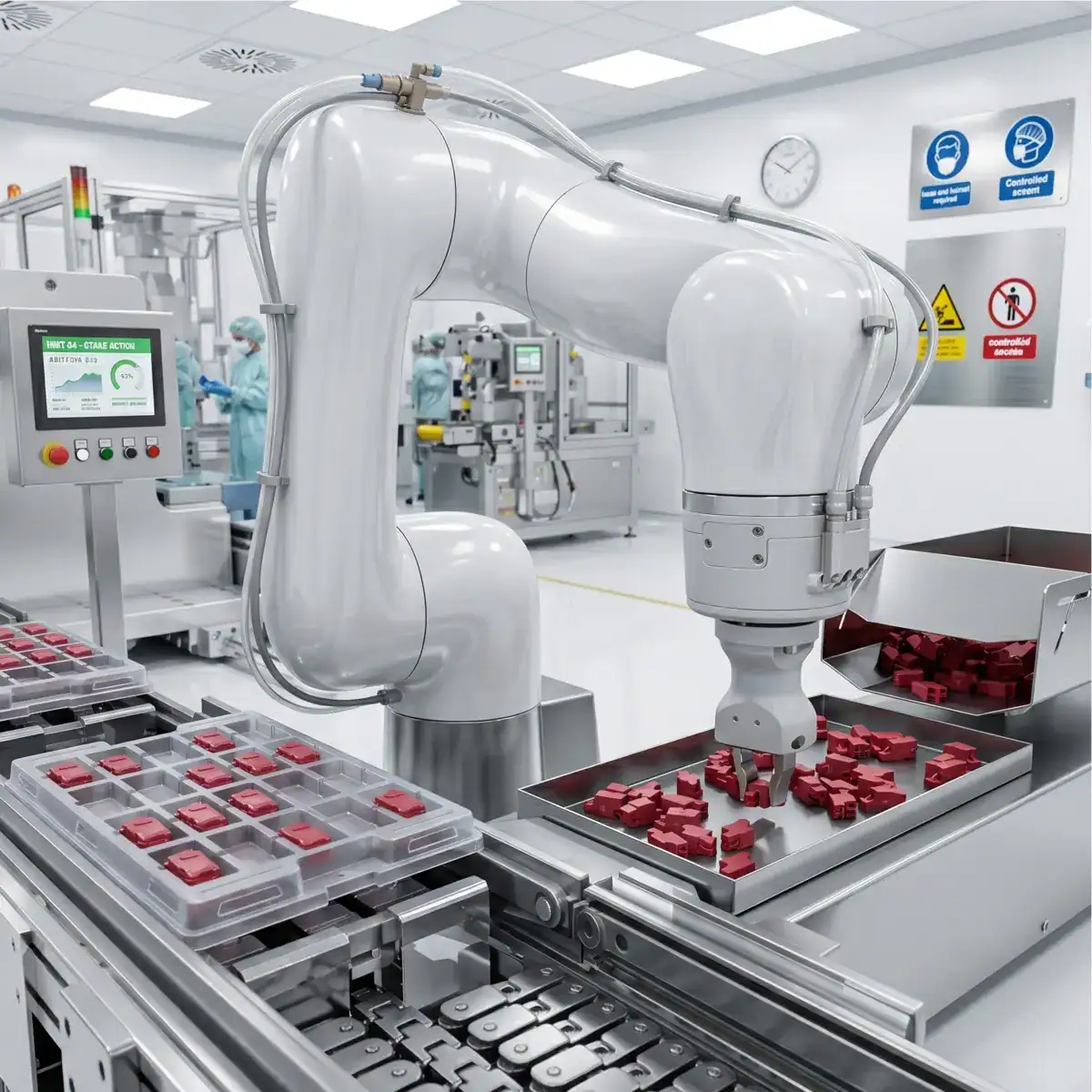
As manufacturing shifts toward complete autonomy, the « hand-off » between raw material storage and the processing unit has become a primary focus for optimization. Machine loading, whether for CNC centers, plastic injection molding, or assembly presses, increasingly relies on vision-guided robotics to replace rigid mechanical fixtures. However, the success of these vision systems for machine loading depends on one variable that is often overlooked during the machine’s design phase: the lighting environment.
Inside an automatic machine, space is at a premium, and ambient light is often blocked by safety guarding or interrupted by moving mechanical arms. Without a dedicated, high-performance light source, the vision system faces a constant battle with shadows and fluctuating contrast. The RODER DL8 series was designed specifically as an « embedded » solution for these challenges. By integrating these high-density LED matrices directly into the machine’s loading zone, OEMs can guarantee a stable optical environment. This ensures that the robot identifies and picks every part with 100% reliability, regardless of the factory’s external lighting or the machine’s internal geometry.

Vous souhaitez obtenir de l’aide pour choisir le bon produit ?
Le rôle critique de la vision dans le chargement machine
The goal of modern machine loading is to handle a high variety of parts with minimal changeover time. Vision systems provide the flexibility to « see » different components, but they require high-contrast images to calculate the exact grip points. If the lighting is inconsistent, the vision system may struggle to find the part’s orientation, leading to « no-pick » errors or, worse, a collision between the robotic gripper and the machine tool.
The DL8 series provides a powerful, uniform light field that eliminates the « dark spots » common in large machine enclosures. This allows the camera to work with lower gain settings and faster shutter speeds, reducing image noise and increasing the overall speed of the loading cycle.
Intégration OEM : concevoir pour l’espace et la stabilité
For machine builders (OEMs), adding a vision system often feels like trying to fit a square peg in a round hole. Space is limited, and bulky lighting enclosures are difficult to mount. The RODER DL8 series addresses this with an ultra-slim profile and standardized industrial mounting points.
Beyond its physical dimensions, automatic machine lighting must be electrically stable. The DL8 series is engineered to be powered directly from the machine’s PLC or vision controller, supporting both continuous and strobe modes. This integration allows the lighting to be synchronized perfectly with the camera’s trigger, extending the lifespan of the LEDs and ensuring that the light is only « on » when needed, reducing energy consumption and heat buildup.
Conçu pour les réalités exigeantes du shop floor
The interior of an automatic machine is a hostile environment. Between coolant mist, metal shavings, and constant mechanical vibration, standard LED solutions often fail prematurely. RODER has built the DL8 series with industrial-grade materials to ensure it survives these conditions.
The robust housing protects the LED matrix from physical impact and environmental contaminants. For OEMs, this means fewer service calls and a higher perceived quality for their customers. When you integrate a DL8 illuminator, you are installing a « fit and forget » component that will maintain its intensity and uniformity for tens of thousands of operating hours.
Obtenir la précision avec silhouette et éclairage frontal
Depending on the part being loaded, the DL8 can be configured for either backlighting (to create a silhouette) or front-lighting (to highlight surface features like holes or engravings). For vision systems for machine loading, this versatility is invaluable.
For instance, when loading a CNC lathe with cylindrical billets, a DL8 backlight provides a perfect profile for the robot to calculate the center axis. Conversely, when loading complex electronic components, a front-lit DL8 setup highlights the connectors and orientation marks. By standardizing on the DL8 series, machine builders can provide a universal lighting solution that handles any part their customers might throw at it.
Produits et technologies


Questions fréquemment posées
Les anneaux LED constituent la solution standard pour la vision des robots pick-and-place. Ils se montent coaxialement à l’objectif de la caméra et offrent un éclairage directionnel constant pour la détection des bords et caractéristiques des pièces. Les anneaux à faible angle accentuent le relief de surface. Les anneaux stroboscopiques à haute intensité s’utilisent sur les cycles de prise à haute vitesse.
Utilisez des illuminateurs LED stroboscopiques à haute intensité qui dominent la lumière ambiante pendant l’exposition de la caméra ; enfermez la zone de capture dans un capot darkfield ; employez des LED à bande étroite et un filtre passe-bande sur l’objectif ; ou choisissez l’éclairage NIR à 850-940 nm, là où la lumière ambiante en usine est plus faible.
Les systèmes à lumière structurée nécessitent des projecteurs LED à haute intensité pour projeter des motifs à fort contraste. Les capteurs stéréo actifs et ToF utilisent des illuminateurs LED NIR. L’éclairage diffus ou en dôme réduit les reflets spéculaires sur les pièces métalliques. Les illuminateurs matriciels haute puissance à intensité réglable sont à privilégier.
Les illuminateurs LED doivent respecter les limites de sécurité photobiologique de la norme IEC 62471. Les illuminateurs des Groupes de Risque 0 ou 1 conviennent aux applications cobot en présence d’opérateurs. Un fonctionnement PWM au-dessus de 1 kHz ou en véritable courant continu évite le scintillement visible pour les opérateurs à proximité.
Le montage EOAT conserve une géométrie d’éclairage constante, mais nécessite des illuminateurs compacts et légers dans les limites de la charge utile. Le montage fixe permet d’installer des illuminateurs plus grands et plus puissants mais impose des positions de prise définies. Le fixe est plus simple pour les opérations en zone unique ; l’EOAT convient au guidage flexible multi-positions.
Contacts et informations
Contact pour informations générales : info@roder.it
Partenaire d’intégration de systèmes et de capteurs : www.roder.it
Division Vision Artificielle de RODER : www.rodervision.com
Division Instruments de RODER : www.innovacheck.com
Plus d’informations sur RODER VISION : about us
Les informations contenues sur ce site web sont fournies uniquement à des fins d’information. Bien qu’elles aient été préparées avec le plus grand soin, elles ne constituent pas une offre contractuelle ni un engagement contraignant de fourniture. Elles peuvent contenir des erreurs de transcription, de traduction ou des erreurs typographiques. Pour obtenir des informations précises et à jour, veuillez contacter directement notre entreprise.
Veuillez noter: Certaines images de ce site web ont été intentionnellement générées par Intelligence Artificielle (IA). Cela est dû au fait que, pour de nombreuses applications et de nombreux projets, il n’est pas possible de divulguer des photographies de l’installation ou du système réel en raison d’accords de confidentialité, de clauses contractuelles et d’accords de non-divulgation (NDA).
Related topics :
 Optimisation de l’orientation des pièces dans les alimentateurs vibrants grâce à l’éclairage LED Vision.
 Les avantages du rétroéclairage LED dans la mesure dimensionnelle de précision
 Éclairage de vision pour l’inspection du verre et des matériaux transparents
 Intégrité des bouteilles en verre : Détection de Fissures avec Rétroclairage Diffuseur
 Inspection des profils et des bords sur les produits en bois avec rétroéclairage LED