


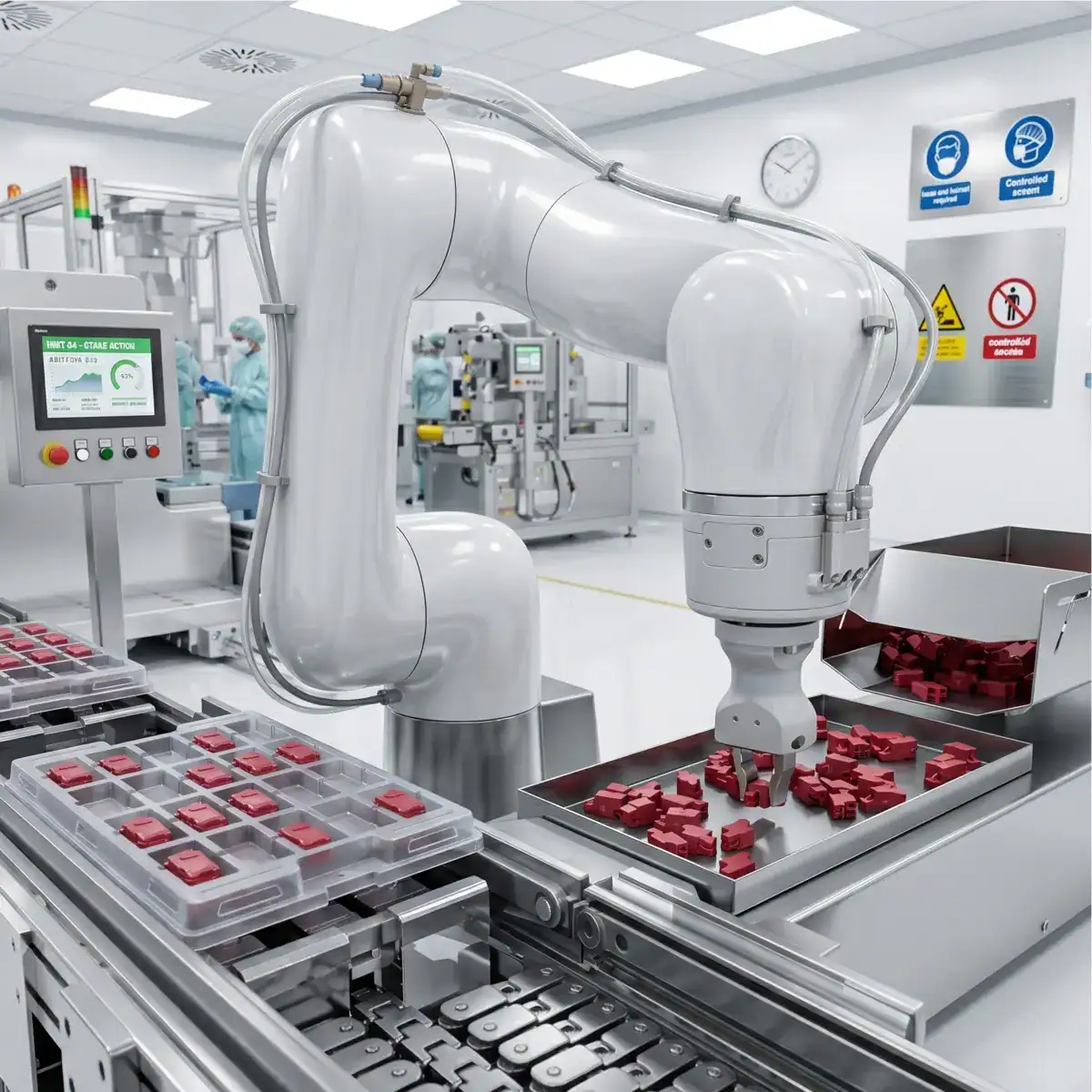
As manufacturing shifts toward complete autonomy, the «hand-off» between raw material storage and the processing unit has become a primary focus for optimization. Machine loading, whether for CNC centers, plastic injection molding, or assembly presses, increasingly relies on vision-guided robotics to replace rigid mechanical fixtures. However, the success of these vision systems for machine loading depends on one variable that is often overlooked during the machine’s design phase: the lighting environment.
Inside an automatic machine, space is at a premium, and ambient light is often blocked by safety guarding or interrupted by moving mechanical arms. Without a dedicated, high-performance light source, the vision system faces a constant battle with shadows and fluctuating contrast. The RODER DL8 series was designed specifically as an «embedded» solution for these challenges. By integrating these high-density LED matrices directly into the machine’s loading zone, OEMs can guarantee a stable optical environment. This ensures that the robot identifies and picks every part with 100% reliability, regardless of the factory’s external lighting or the machine’s internal geometry.

¿Quieres ayuda para elegir el producto adecuado?
El papel crítico de la visión en la carga de máquina
The goal of modern machine loading is to handle a high variety of parts with minimal changeover time. Vision systems provide the flexibility to «see» different components, but they require high-contrast images to calculate the exact grip points. If the lighting is inconsistent, the vision system may struggle to find the part’s orientation, leading to «no-pick» errors or, worse, a collision between the robotic gripper and the machine tool.
The DL8 series provides a powerful, uniform light field that eliminates the «dark spots» common in large machine enclosures. This allows the camera to work with lower gain settings and faster shutter speeds, reducing image noise and increasing the overall speed of the loading cycle.
Integración OEM: diseñar para espacio y estabilidad
For machine builders (OEMs), adding a vision system often feels like trying to fit a square peg in a round hole. Space is limited, and bulky lighting enclosures are difficult to mount. The RODER DL8 series addresses this with an ultra-slim profile and standardized industrial mounting points.
Beyond its physical dimensions, automatic machine lighting must be electrically stable. The DL8 series is engineered to be powered directly from the machine’s PLC or vision controller, supporting both continuous and strobe modes. This integration allows the lighting to be synchronized perfectly with the camera’s trigger, extending the lifespan of the LEDs and ensuring that the light is only «on» when needed, reducing energy consumption and heat buildup.
Diseñado para las duras realidades del shop floor
The interior of an automatic machine is a hostile environment. Between coolant mist, metal shavings, and constant mechanical vibration, standard LED solutions often fail prematurely. RODER has built the DL8 series with industrial-grade materials to ensure it survives these conditions.
The robust housing protects the LED matrix from physical impact and environmental contaminants. For OEMs, this means fewer service calls and a higher perceived quality for their customers. When you integrate a DL8 illuminator, you are installing a «fit and forget» component that will maintain its intensity and uniformity for tens of thousands of operating hours.
Lograr precisión con silueta e iluminación frontal
Depending on the part being loaded, the DL8 can be configured for either backlighting (to create a silhouette) or front-lighting (to highlight surface features like holes or engravings). For vision systems for machine loading, this versatility is invaluable.
For instance, when loading a CNC lathe with cylindrical billets, a DL8 backlight provides a perfect profile for the robot to calculate the center axis. Conversely, when loading complex electronic components, a front-lit DL8 setup highlights the connectors and orientation marks. By standardizing on the DL8 series, machine builders can provide a universal lighting solution that handles any part their customers might throw at it.
Productos y tecnologías


Preguntas frecuentes
Las luces de anillo LED son la solución estándar para la visión de robots pick-and-place. Se montan coaxialmente al objetivo de la cámara y proporcionan iluminación direccional uniforme para la detección de bordes y características de las piezas. Los anillos de bajo ángulo acentúan el relieve superficial. Los anillos estroboscópicos de alta intensidad se utilizan en ciclos de recogida a alta velocidad.
Utilice iluminadores LED estroboscópicos de alta intensidad que dominen la luz ambiente durante la exposición de la cámara; rodee la zona de captura con una cubierta darkfield; emplee LED de banda estrecha y un filtro pasabanda en el objetivo de la cámara; o elija iluminación NIR a 850-940 nm, donde la luz ambiente de la fábrica es menor.
Los sistemas de luz estructurada requieren proyectores LED de alta intensidad para la proyección de patrones de alto contraste. Los sensores estéreo activos y ToF utilizan iluminadores LED NIR. La iluminación difusa o tipo dome reduce los reflejos especulares en piezas metálicas. Se prefieren iluminadores matriciales de alta potencia con intensidad ajustable.
Los iluminadores LED deben cumplir los límites de seguridad fotobiológica de la norma IEC 62471. Los iluminadores del Grupo de Riesgo 0 o 1 son adecuados para aplicaciones de cobots con operadores humanos. El funcionamiento PWM por encima de 1 kHz o en corriente continua real evita el parpadeo visible para los trabajadores cercanos.
El montaje EOAT mantiene una geometría de iluminación constante pero requiere iluminadores compactos y ligeros dentro de los límites de carga útil. El montaje fijo permite iluminadores más grandes y potentes, pero exige posiciones de recogida definidas. El fijo es más sencillo para operaciones de una sola zona; el EOAT se adapta a la guía flexible multiposición.
Contactos e información
Contacto para información general : info@roder.it
Partner de integración de sistemas y sensores : www.roder.it
División de Visión Artificial de RODER : www.rodervision.com
División de Instrumentos de RODER : www.innovacheck.com
Más información sobre RODER VISION : about us
La información de este sitio web se proporciona únicamente con fines informativos. Aunque ha sido preparada con el mayor cuidado, no constituye una oferta contractual ni un compromiso vinculante de suministro. Puede contener errores de transcripción, traducción o tipográficos. Para obtener información precisa y actualizada, póngase en contacto directamente con nuestra empresa.
Tenga en cuenta: Algunas imágenes de este sitio web han sido generadas intencionadamente mediante Inteligencia Artificial (IA). Esto se debe al hecho de que, para muchas aplicaciones y proyectos, no es posible divulgar fotografías de la instalación o sistema real debido a acuerdos de confidencialidad, cláusulas contractuales y acuerdos de no divulgación (NDA).
Related topics :
 Optimización de la Orientación de las Piezas en Alimentadores Vibratorios con Iluminación de Visión LED.
 High-Speed Vision on Conveyor Belts: Achieving Uniformity with RODER LED Illuminators.
 SCARA Robotics and Shape Recognition: Simplifying Complex Silhouette Detection with LED backlight.
 Dimensional Inspection and Quality Control: Multi-Illuminator Setups for Pallet Lines.
 Colocación de componentes electrónicos: estrategias de iluminación para robots pick-and-place