


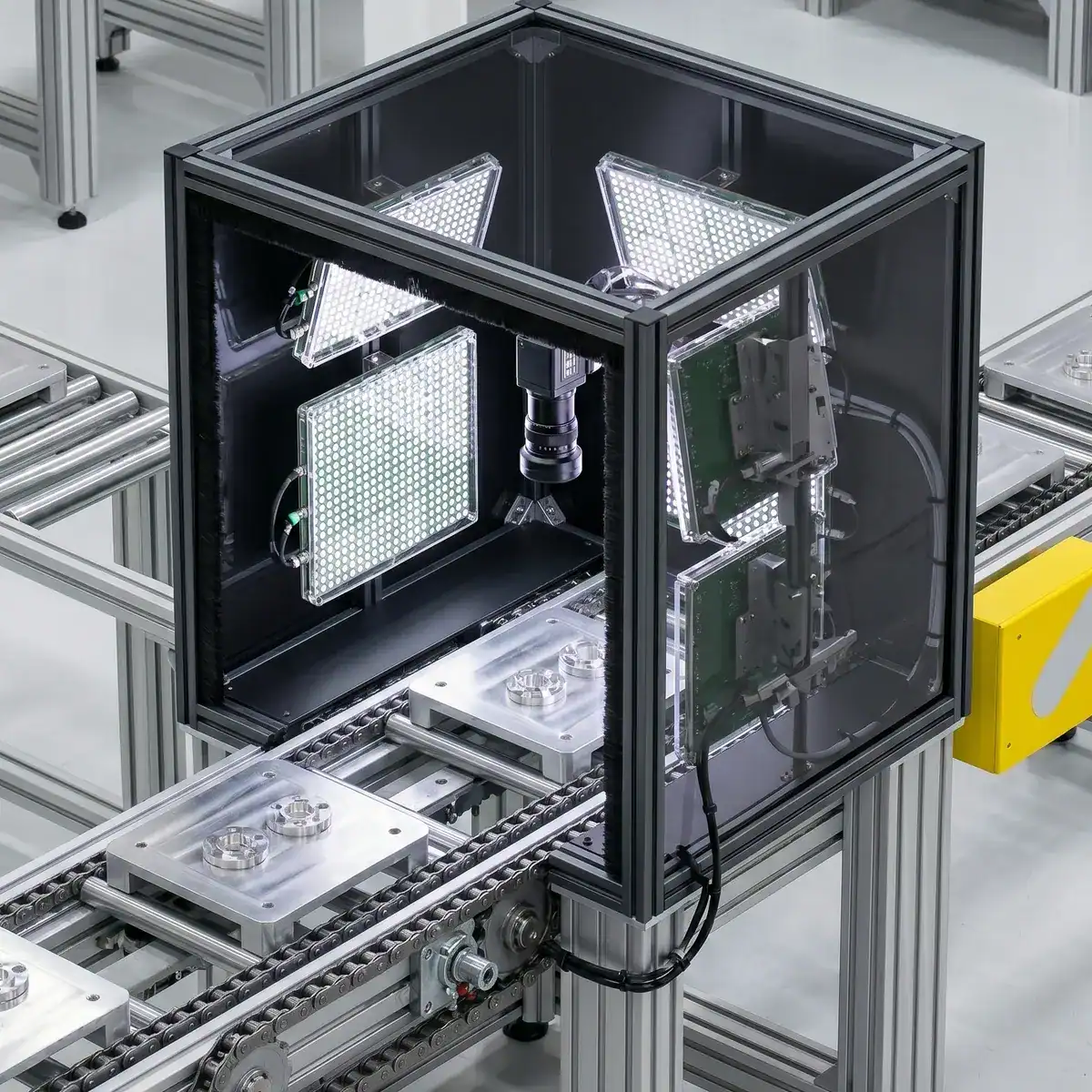
In the high-stakes world of mechanical manufacturing, «close enough» is never enough. When parts travel down a pallet line, they aren’t just moving; they are heading toward a trial of precision. Machine vision dimensional inspection has become the gold standard for verifying tolerances that the human eye simply cannot perceive. However, the biggest hurdle to achieving sub-millimeter accuracy isn’t usually the camera sensor—it’s the physics of light.
On a pallet line, components often feature complex geometries, reflective surfaces, and deep recesses that create deceptive shadows. A single light source often fails to illuminate the critical edges needed for measurement. This is where the RODER DL8 series shines, quite literally. By utilizing multi-illuminator setups—often surrounding the part in a «light box» configuration—manufacturers can eliminate the optical noise that leads to measurement drift. Proper lighting for mechanical quality control ensures that every edge is crisp and every hole is perfectly defined. With the DL8’s ultra-uniform output, your vision system can stop «guessing» where an edge begins and start measuring with the centesimal confidence your customers demand.

¿Quieres ayuda para elegir el producto adecuado?
El imperativo de precisión en las líneas modernas de paletizado
Palletized systems are designed for stability, making them the ideal environment for high-precision inspection. However, because parts are often oily or metallic, they behave like mirrors. In machine vision dimensional inspection, a «hotspot» or a stray reflection can be interpreted by the software as a physical edge, leading to a false reject or, worse, an out-of-tolerance part being shipped.
To combat this, the DL8 series is frequently deployed in multi-panel arrays. By positioning four or more DL8 illuminators around a pallet station, you create a «diffuse dome» effect. This ensures that light hits the component from all angles, neutralizing the texture of the material and highlighting only the dimensional boundaries that matter.
Eliminar la distorsión óptica con iluminación multidireccional
When measuring diameters or distances between centers, the «shadow» cast by a single light can shift the perceived position of a feature. This is known as parallax or perspective error. High-quality lighting for mechanical quality control minimizes this by providing a flat, telecentric-like illumination profile.
The DL8 matrix is particularly effective here because of its high LED density. Unlike standard backlights that might show individual «points» of light, the DL8 acts as a solid luminous surface. When multiple DL8 panels work in tandem, they fill in the shadows of complex parts (like engine valves or gear housings), allowing the vision system to extract a perfect 2D profile for metrology.
La ventaja DL8: estabilidad y repetibilidad
In quality control, repeatability is everything. If your light intensity fluctuates even by 5%, your measurement results will drift. RODER has engineered the DL8 series with advanced thermal management and high-stability drivers to ensure that the light output remains constant from the first shift to the last.
This stability is critical for systems that perform automatic inspection of mechanical samples. On a pallet line, where cycle times are measured in seconds, the DL8 supports high-intensity strobing. This allows the camera to capture ultra-high-resolution images without the risk of thermal degradation to the LEDs, ensuring that your «Golden Image» remains the standard for months of continuous operation.
Integrar la metrología en el flujo de producción
The compact and robust design of the DL8 series allows it to be integrated directly into the pallet conveyor’s aluminum framing. It transforms a standard transit point into a sophisticated metrology cell. By using RODER’s standardized mounting systems, OEM integrators can quickly set up multi-angle lighting environments that are protected from the harsh conditions of the factory floor.
Ultimately, investing in a multi-illuminator DL8 setup is an investment in your brand’s reputation. By providing the clearest possible data to your vision system, you ensure that your quality control is not just a checkbox, but a competitive advantage.
Productos y tecnologías


Preguntas frecuentes
Las luces de anillo LED son la solución estándar para la visión de robots pick-and-place. Se montan coaxialmente al objetivo de la cámara y proporcionan iluminación direccional uniforme para la detección de bordes y características de las piezas. Los anillos de bajo ángulo acentúan el relieve superficial. Los anillos estroboscópicos de alta intensidad se utilizan en ciclos de recogida a alta velocidad.
Utilice iluminadores LED estroboscópicos de alta intensidad que dominen la luz ambiente durante la exposición de la cámara; rodee la zona de captura con una cubierta darkfield; emplee LED de banda estrecha y un filtro pasabanda en el objetivo de la cámara; o elija iluminación NIR a 850-940 nm, donde la luz ambiente de la fábrica es menor.
Los sistemas de luz estructurada requieren proyectores LED de alta intensidad para la proyección de patrones de alto contraste. Los sensores estéreo activos y ToF utilizan iluminadores LED NIR. La iluminación difusa o tipo dome reduce los reflejos especulares en piezas metálicas. Se prefieren iluminadores matriciales de alta potencia con intensidad ajustable.
Los iluminadores LED deben cumplir los límites de seguridad fotobiológica de la norma IEC 62471. Los iluminadores del Grupo de Riesgo 0 o 1 son adecuados para aplicaciones de cobots con operadores humanos. El funcionamiento PWM por encima de 1 kHz o en corriente continua real evita el parpadeo visible para los trabajadores cercanos.
El montaje EOAT mantiene una geometría de iluminación constante pero requiere iluminadores compactos y ligeros dentro de los límites de carga útil. El montaje fijo permite iluminadores más grandes y potentes, pero exige posiciones de recogida definidas. El fijo es más sencillo para operaciones de una sola zona; el EOAT se adapta a la guía flexible multiposición.
Contactos e información
Contacto para información general : info@roder.it
Partner de integración de sistemas y sensores : www.roder.it
División de Visión Artificial de RODER : www.rodervision.com
División de Instrumentos de RODER : www.innovacheck.com
Más información sobre RODER VISION : about us
La información de este sitio web se proporciona únicamente con fines informativos. Aunque ha sido preparada con el mayor cuidado, no constituye una oferta contractual ni un compromiso vinculante de suministro. Puede contener errores de transcripción, traducción o tipográficos. Para obtener información precisa y actualizada, póngase en contacto directamente con nuestra empresa.
Tenga en cuenta: Algunas imágenes de este sitio web han sido generadas intencionadamente mediante Inteligencia Artificial (IA). Esto se debe al hecho de que, para muchas aplicaciones y proyectos, no es posible divulgar fotografías de la instalación o sistema real debido a acuerdos de confidencialidad, cláusulas contractuales y acuerdos de no divulgación (NDA).
