


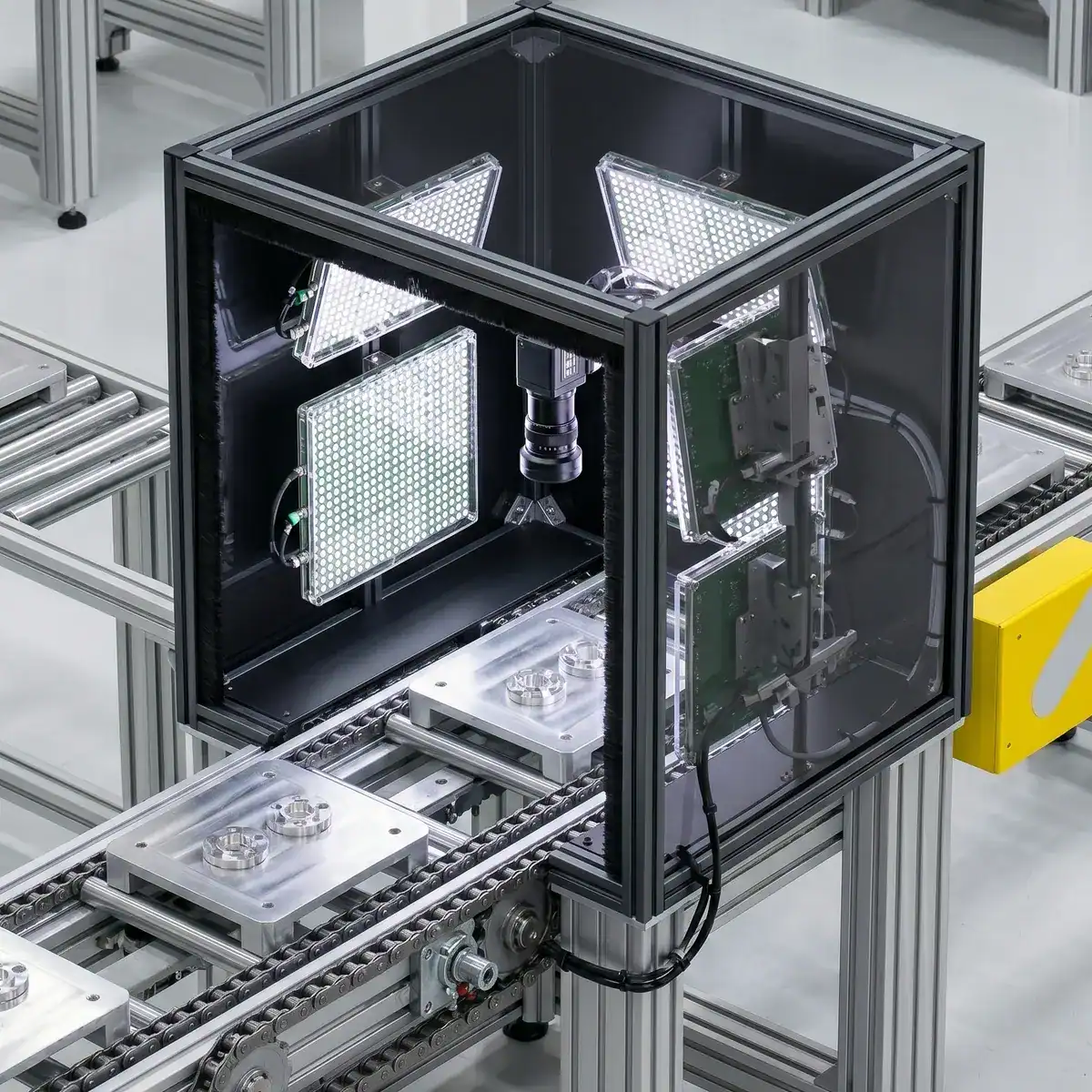
In the high-stakes world of mechanical manufacturing, « close enough » is never enough. When parts travel down a pallet line, they aren’t just moving; they are heading toward a trial of precision. Machine vision dimensional inspection has become the gold standard for verifying tolerances that the human eye simply cannot perceive. However, the biggest hurdle to achieving sub-millimeter accuracy isn’t usually the camera sensor—it’s the physics of light.
On a pallet line, components often feature complex geometries, reflective surfaces, and deep recesses that create deceptive shadows. A single light source often fails to illuminate the critical edges needed for measurement. This is where the RODER DL8 series shines, quite literally. By utilizing multi-illuminator setups—often surrounding the part in a « light box » configuration—manufacturers can eliminate the optical noise that leads to measurement drift. Proper lighting for mechanical quality control ensures that every edge is crisp and every hole is perfectly defined. With the DL8’s ultra-uniform output, your vision system can stop « guessing » where an edge begins and start measuring with the centesimal confidence your customers demand.

Vous souhaitez obtenir de l’aide pour choisir le bon produit ?
L’impératif de précision sur les lignes de palettisation modernes
Palletized systems are designed for stability, making them the ideal environment for high-precision inspection. However, because parts are often oily or metallic, they behave like mirrors. In machine vision dimensional inspection, a « hotspot » or a stray reflection can be interpreted by the software as a physical edge, leading to a false reject or, worse, an out-of-tolerance part being shipped.
To combat this, the DL8 series is frequently deployed in multi-panel arrays. By positioning four or more DL8 illuminators around a pallet station, you create a « diffuse dome » effect. This ensures that light hits the component from all angles, neutralizing the texture of the material and highlighting only the dimensional boundaries that matter.
Éliminer la distorsion optique avec un éclairage multidirectionnel
When measuring diameters or distances between centers, the « shadow » cast by a single light can shift the perceived position of a feature. This is known as parallax or perspective error. High-quality lighting for mechanical quality control minimizes this by providing a flat, telecentric-like illumination profile.
The DL8 matrix is particularly effective here because of its high LED density. Unlike standard backlights that might show individual « points » of light, the DL8 acts as a solid luminous surface. When multiple DL8 panels work in tandem, they fill in the shadows of complex parts (like engine valves or gear housings), allowing the vision system to extract a perfect 2D profile for metrology.
L’avantage DL8 : stabilité et répétabilité
In quality control, repeatability is everything. If your light intensity fluctuates even by 5%, your measurement results will drift. RODER has engineered the DL8 series with advanced thermal management and high-stability drivers to ensure that the light output remains constant from the first shift to the last.
This stability is critical for systems that perform automatic inspection of mechanical samples. On a pallet line, where cycle times are measured in seconds, the DL8 supports high-intensity strobing. This allows the camera to capture ultra-high-resolution images without the risk of thermal degradation to the LEDs, ensuring that your « Golden Image » remains the standard for months of continuous operation.
Intégrer la métrologie dans le flux de production
The compact and robust design of the DL8 series allows it to be integrated directly into the pallet conveyor’s aluminum framing. It transforms a standard transit point into a sophisticated metrology cell. By using RODER’s standardized mounting systems, OEM integrators can quickly set up multi-angle lighting environments that are protected from the harsh conditions of the factory floor.
Ultimately, investing in a multi-illuminator DL8 setup is an investment in your brand’s reputation. By providing the clearest possible data to your vision system, you ensure that your quality control is not just a checkbox, but a competitive advantage.
Produits et technologies


Questions fréquemment posées
Les anneaux LED constituent la solution standard pour la vision des robots pick-and-place. Ils se montent coaxialement à l’objectif de la caméra et offrent un éclairage directionnel constant pour la détection des bords et caractéristiques des pièces. Les anneaux à faible angle accentuent le relief de surface. Les anneaux stroboscopiques à haute intensité s’utilisent sur les cycles de prise à haute vitesse.
Utilisez des illuminateurs LED stroboscopiques à haute intensité qui dominent la lumière ambiante pendant l’exposition de la caméra ; enfermez la zone de capture dans un capot darkfield ; employez des LED à bande étroite et un filtre passe-bande sur l’objectif ; ou choisissez l’éclairage NIR à 850-940 nm, là où la lumière ambiante en usine est plus faible.
Les systèmes à lumière structurée nécessitent des projecteurs LED à haute intensité pour projeter des motifs à fort contraste. Les capteurs stéréo actifs et ToF utilisent des illuminateurs LED NIR. L’éclairage diffus ou en dôme réduit les reflets spéculaires sur les pièces métalliques. Les illuminateurs matriciels haute puissance à intensité réglable sont à privilégier.
Les illuminateurs LED doivent respecter les limites de sécurité photobiologique de la norme IEC 62471. Les illuminateurs des Groupes de Risque 0 ou 1 conviennent aux applications cobot en présence d’opérateurs. Un fonctionnement PWM au-dessus de 1 kHz ou en véritable courant continu évite le scintillement visible pour les opérateurs à proximité.
Le montage EOAT conserve une géométrie d’éclairage constante, mais nécessite des illuminateurs compacts et légers dans les limites de la charge utile. Le montage fixe permet d’installer des illuminateurs plus grands et plus puissants mais impose des positions de prise définies. Le fixe est plus simple pour les opérations en zone unique ; l’EOAT convient au guidage flexible multi-positions.
Contacts et informations
Contact pour informations générales : info@roder.it
Partenaire d’intégration de systèmes et de capteurs : www.roder.it
Division Vision Artificielle de RODER : www.rodervision.com
Division Instruments de RODER : www.innovacheck.com
Plus d’informations sur RODER VISION : about us
Les informations contenues sur ce site web sont fournies uniquement à des fins d’information. Bien qu’elles aient été préparées avec le plus grand soin, elles ne constituent pas une offre contractuelle ni un engagement contraignant de fourniture. Elles peuvent contenir des erreurs de transcription, de traduction ou des erreurs typographiques. Pour obtenir des informations précises et à jour, veuillez contacter directement notre entreprise.
Veuillez noter: Certaines images de ce site web ont été intentionnellement générées par Intelligence Artificielle (IA). Cela est dû au fait que, pour de nombreuses applications et de nombreux projets, il n’est pas possible de divulguer des photographies de l’installation ou du système réel en raison d’accords de confidentialité, de clauses contractuelles et d’accords de non-divulgation (NDA).