


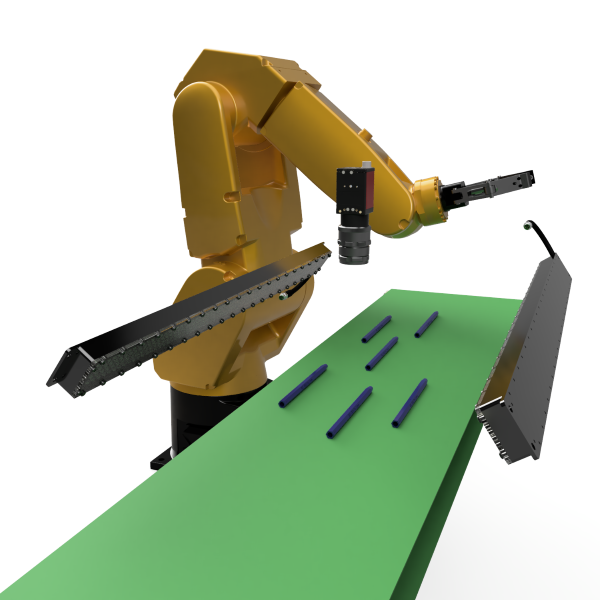
In automated production lines, robot guidance on conveyor belts hinges entirely on the quality of the image delivered to the vision system. RODER Vision designs and manufactures LED illuminators engineered specifically for conveyor-integrated machine vision—pairing direct illumination for surface inspection with backlight solutions for edge detection and dimensional measurement. Whether the task involves pick & place robotics, defect detection, or dimensional verification, the right LED illuminator is the critical variable that sets system accuracy and uptime.
RODER Vision illuminators support strobe synchronisation with camera triggers, run across multiple wavelengths (white, red, blue, infrared), and are built for 24/7 industrial environments. Their uniform, stable output clears the lighting variability that causes vision algorithms to fail—keeping robot guidance on conveyor belts reliable even at high conveyor speeds and under variable ambient light.

Do you want help choosing the product?
LED Illuminators for Conveyor Belt Automation
In modern industrial automation, lighting plays a critical role in reliable image acquisition and precise robotic operations. On conveyor belt systems, the choice and positioning of LED illuminators directly shape the accuracy of inspections, pick & place tasks, and robotic guidance. Both direct illumination and backlight solutions bring their own advantages depending on the application requirements.
Direct Illumination for Surface Inspection and Pick & Place
Direct LED illumination is widely used when the goal is to bring out objects on the surface of the conveyor belt. By giving uniform lighting from above, direct illuminators let cameras and vision systems capture high-contrast images. This is essential for:
- Detecting shape, orientation, and defects of products.
- Supporting robots and manipulators during pick & place operations.
- Cutting errors caused by shadows or insufficient lighting.
In this configuration, the illuminator is usually mounted above the conveyor belt to keep lighting conditions consistent across the moving surface. This method sharpens the ability of vision-guided systems to make rapid, precise decisions, which is crucial for robot guidance on conveyor belts.
Backlight Illumination for Transparency and Edge Detection

In some cases, the most effective approach is to light the conveyor belt from below. This technique, known as backlighting, forms a silhouette of the object being transported. The resulting high-contrast image is particularly useful for:
- Detecting edges, profiles, and contours.
- Inspecting transparent or semi-transparent materials.
- Measuring dimensions with higher precision.
By placing LED illuminators beneath the conveyor surface, engineers can analyse features that would be hard to catch with direct lighting. This approach markedly improves reliability in automated quality control and in robotic guidance tasks.
Backlighting also simplifies image processing algorithms by holding down background noise and keeping sharper contrast between objects and the conveyor. That cut in visual ambiguity lets vision systems work faster and more reliably, even at high conveyor speeds, supporting consistent robot guidance on conveyor belts in demanding industrial environments.
Choosing the Right Lighting for Robotic Guidance
The decision between direct illumination and backlighting comes down to the specific process, the type of materials handled, and the required level of accuracy. For tasks such as robotic picking, surface illumination is often preferred. For dimensional analysis or contour detection, backlight illumination gives clearer, more robust image data.
In both cases, LED technology brings long life, energy efficiency, and stable performance, making it a fundamental tool in industrial automation. By integrating tailored lighting solutions, engineers can improve the consistency and accuracy of robot guidance on conveyor belts, ultimately lifting productivity and cutting downtime.
Products used in this application

LED Matrix Illuminators DL1 Series

LED Matrix illuminators DL2 Series

Large format LED Matrix illuminators DL7 Series

High Intensity LED Matrix Illuminators DL5 Series

New Generation LED Matrix Illuminators DL11 Series
LED Bar Lights for Robot Guidance on Conveyor Belts
LED bar lights have become a fundamental element in modern automation systems where precision and reliability are crucial. In applications involving robot guidance on conveyor belts, bar lights give uniform, powerful illumination across wide areas, so vision systems and cameras capture consistent, high-quality images. Their linear design suits them especially well to covering the full width of conveyor belts, cutting shadows and holding down variations in brightness.
Advantages of Using LED Bar Lights in Automation
The main benefit of LED bar lights is their ability to deliver stable, homogeneous illumination that sharpens the detection of objects in motion. For robots working on conveyor belts, that translates into:
- Better accuracy in object recognition and positioning.
- Lower error rates in pick & place operations.
- Stronger performance of machine vision algorithms, even under variable environmental conditions.
- Flexibility to adapt to different conveyor widths and materials.
These advantages feed directly into higher productivity and reliability in industrial automation, where robot guidance on conveyor belts demands precision at every stage.
Direct Illumination vs. Backlight Configurations

Used as direct illumination, LED bar lights mounted above the conveyor give excellent visibility of object surfaces, including textures, labels, or defects. In backlight mode, set below a transparent conveyor, they form sharp silhouettes that allow precise contour detection and dimensional measurements. The choice between the two configurations comes down to whether the process needs surface inspection or high-contrast edge detection.
Practical Considerations for Engineers
For the best results, engineers have to weigh carefully:
- The angle and distance of the LED bar lights relative to the conveyor.
- The spectral characteristics of the light, especially when working with reflective or transparent materials.
- The synchronisation of illumination with camera acquisition and conveyor speed.
By folding in these design considerations, LED bar lights become a reliable tool that supports efficient, accurate robot guidance on conveyor belts, helping industries reach higher standards of automation and quality control.
Frequently Asked Questions
The best choice depends on the inspection task. For surface inspection and pick & place operations, direct LED illuminators such as matrix bar lights mounted above the conveyor give uniform, high-contrast images of object surfaces, textures, and defects. For edge detection, dimensional measurement, or inspection of transparent materials, backlight LED illuminators placed beneath a translucent conveyor surface form sharp silhouettes with minimal background noise. In many production lines, both configurations are used together to cover all inspection requirements.
Lighting quality directly sets the reliability of every decision a vision-guided robot makes. Inconsistent or insufficient illumination causes edge detection errors, false positives in defect inspection, and positioning inaccuracies during pick & place tasks. Stable, uniform LED illumination clears shadows, cuts ambient light interference, and makes sure the camera captures high-contrast images at every production cycle, whatever the conveyor speed. Even minor swings in brightness can make the vision algorithm misread an object position or orientation, leading to robot errors and production downtime.
Yes. Industrial LED illuminators support strobe (pulsed) operation, which syncs the light pulse with the camera shutter trigger. By overdriving the LEDs for a few microseconds, the system delivers an extremely bright, short flash that effectively freezes the motion of objects on the conveyor belt. This lets cameras capture sharp, blur-free images even at conveyor speeds beyond several metres per second. Strobe synchronisation also extends LED lifetime markedly compared with continuous operation, making it the preferred mode for 24/7 production environments.
Wavelength selection depends on the material and inspection objective. White light (broadband) is the most versatile and the most common for general surface inspection. Blue light (around 450-470 nm) gives higher spatial resolution and is preferred for catching fine surface defects or measuring small components thanks to its shorter wavelength. Red light (620-660 nm) reaches into certain materials more effectively and tones down surface texture, which can help when inspecting food products or organic materials. Infrared (850 nm or 940 nm) is used for inspecting dark or opaque materials where visible light falls short. In all cases, pairing the LED wavelength with a matching bandpass filter on the camera lens markedly improves contrast and cuts ambient light interference.
Direct illumination places the LED light source on the same side as the camera, lighting the surface of the object. It suits the detection of surface features such as colour, texture, labels, and visible defects. Backlighting sets the LED source behind or below the object, forming a high-contrast silhouette image. It suits dimensional measurement, edge and profile detection, and inspecting transparent or semi-transparent materials such as bottles, films, or glass. Direct illumination reveals what is on the surface; backlighting reveals the shape and geometry of the object. Many conveyor systems use both techniques at different inspection stations along the same line.
Contacts & Information
Contact for general information : info@roder.it
Systems and Sensor Integration Partner : www.roder.it
RODER Artificial Vision Division : www.rodervision.com
RODER Instruments Division : www.innovacheck.com
More information about RODER VISION : about us
The information on this website is provided for informational purposes only. Although it has been prepared with the utmost care, it does not constitute a contractual offer or a binding commitment to supply. It may contain transcription, translation, or typographical errors. For precise and up-to-date information, please contact our company directly.
Please note: Some images on this website have been intentionally generated using Artificial Intelligence (AI). This is due to the fact that, for many applications and projects, it is not possible to disclose photographs of the actual installation or system due to confidentiality agreements, contractual clauses, and Non-Disclosure Agreements (NDAs).
Copyright by RODER SRL – Oglianico (TO) – Italy
Sito web : www.roder.it
Divisione visione artificiale : www.rodervision.com
Divisione strumenti di misura : www.innovacheck.com
