


Optical filters are key components in machine vision applications. They serve to maximise contrast, enhance colour, sharpen subject recognition, and control the light reflected from the inspected object. Not every machine vision filter is alike. Here is what to weigh when picking a filter for your machine vision system:
A complete line of filters—single substrate, high-hardness coated—engineered specifically for industrial machine vision applications.

Do you want help choosing the product?
Vision system filters raise the contrast of the object under inspection, improving the system’s ability to single out the features of interest.
Higher contrast translates into greater inspection accuracy and faster inspection cycles. The influence of ambient light—and any drift in it over time—is held down through the use of filters, creating the conditions for stable operating behaviour of the vision system over the long term.
When paired with correct lighting, the optical filter ranks among the most decisive factors in keeping any vision system reliable throughout its life cycle.
A broad range of filters is available, designed for quick, secure mounting on the lenses of CCD and CMOS cameras.
The filters offered are protected by a coating that ensures long life even in the presence of humidity, heat, and vibration. They are also built to withstand repeated cleaning cycles, even with mildly aggressive solvents.
Filters come in both standard sizes, which fit most commercial lenses, and in special sizes and configurations.
Typical applications:
Selection of a predetermined colour
Suppression of a colour
Suppression of ambient light
Selection of light from infrared sources
Polarisation of light
Selection of light from UV sources
Reduction of light from unwanted sources
Filters for Infrared LED Illuminators

A series of optical filters for selecting infrared wavelengths.
Used across all near-infrared applications to block visible wavelengths.
Typical uses are removing or attenuating unwanted ambient-light effects, or analysing specific features of objects brought out by infrared illumination.
This series of filters is to be paired with the INF series of illuminators, whose emission wavelength is 880 nm.
Available with standard M25.5 and M27 threads and with special threads up to M105.

Example of use.
On the left, a monochrome image taken with a white illuminator and no filter.
On the right, the same scene lit with an infrared source and a BP880 filter that brings out only the useful information.

Example of use.
Image on the left with clear influence from ambient light.
On the right, the same scene obtained with infrared illumination and a BP880 filter that removes the ambient-light influence.

Transmission curve of the 880 nm infrared filters.
The filter passes all wavelengths around 880 nm and fully blocks the visible band.
Available with standard M25.5 and M27 threads and with special threads up to M105.
Filters for Red LED Illuminators

A series of optical filters for selecting wavelengths around 625-635 nm.
Used wherever a red illuminator is present or where specific chromatic features of an object lit with white light need to be isolated. Typical uses are removing or attenuating unwanted ambient-light effects, or analysing particular object features brought out by red illumination.
This series of filters is to be paired with the RED series of illuminators, with emission wavelengths of 625 and 635 nm.
Available with standard M25.5 and M27 threads and with special threads up to M105.

Transmission curve of the 625-635 nm red filters.
The filter passes all wavelengths around 625-635 nm and fully blocks the others.

Example of use.
On the left, a monochrome image taken with a white illuminator and no filter.
In the centre, the same scene captured with a commercial photographic filter.
On the right, the same scene lit with a red source and a BP635 filter that brings out only the useful information relating to the product code.
Filters for Green LED Illuminators

A series of optical filters for selecting wavelengths around 525 nm.
Used wherever a green illuminator is present or where specific chromatic features of an object lit with white light need to be isolated. Typical uses are removing or attenuating unwanted ambient-light effects, or analysing particular object features brought out by green illumination.
This series of filters is to be paired with GRE-type illuminators, whose emission wavelength is 525 nm.
Available with standard M25.5 and M27 threads and with special threads up to M105.

Transmission curve of the 525 nm green filters.
The filter passes all wavelengths around 525 nm and fully blocks the rest of the visible band.
Available with standard M25.5 and M27 threads and with special threads up to M105.

Example of use.
Pairing green filters with green LED illuminators delivers strong suppression of ambient light.

Example of use.
Green filters let you isolate specific object colours or boost image contrast.
Filters for Blue LED illuminators

A series of optical filters for selecting wavelengths around 470 nm.
Used wherever a blue illuminator is present or where specific chromatic features of an object lit with white light need to be isolated. Typical uses are removing or attenuating unwanted ambient-light effects, or analysing particular object features brought out by blue illumination (fluorescence effect).
This series of filters is to be paired with BLUE-type illuminators, whose emission wavelength is 470 nm.
Available with standard M25.5 and M27 threads and with special threads up to M105.

Transmission curve of the 470 nm blue filters.
The filter passes all wavelengths around 470 nm and fully blocks the others.

Example of use.
Blue filters raise the contrast of written and printed codes, bringing out only the useful information related to the product code.
Filters for Ultraviolet LED illuminators

A series of optical filters for selecting wavelengths around 365 nm.
Used wherever an ultraviolet illuminator is required. Typical uses are removing or attenuating unwanted ambient-light effects, or analysing particular object features brought out by UV illumination (fluorescence effect).
This series of filters is to be paired with the ULV series of illuminators, whose emission wavelength is 365 nm.
Available with standard M25.5 and M27 threads and with special threads up to M105.

Transmission curve of the 365 nm ultraviolet filters.
The filter passes all wavelengths around 365 nm and fully blocks the others.

Example of use.
Ultraviolet illumination lets you identify materials that fluoresce.
Polarising filters for visible LED illuminators

A series of polarising optical filters for visible light.
Typical uses are removing or attenuating unwanted effects caused by reflective or particularly shiny objects.
The filter is mounted on a rotating ring so it can be set to the correct polarisation angle.
Available with standard M25.5 and M27 threads and with special threads up to M105.

Transmission curve of the polarising filters.
The filter works across the entire visible spectrum.
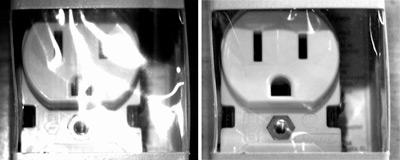
Example of use.
Polarising filters remove the reflective effect of protective films.

Another example of using the polarising filter.
Filters to block infrared radiation

A series of optical filters for blocking infrared radiation.
Used wherever there is a strong presence of unwanted infrared radiation (high-temperature objects).
Typical uses are removing or attenuating unwanted effects caused by strong infrared emissions, often present in high-temperature applications.
Available with standard M25.5 and M27 threads and with special threads up to M105.

Transmission curve of the IR-blocking filters.
The filter works across the entire visible spectrum.

Example of use.
IR-blocking filters let you observe phenomena that would otherwise stay hidden because they would drive the camera into overexposure.
Do you want help choosing the product?
Copyright by RODER SRL – Oglianico (TO) – Italy
Sito web : www.roder.it
Divisione visione artificiale : www.rodervision.com
Divisione strumenti di misura : www.innovacheck.com

