


Automated sortation facilities move millions of shipments in a single week, and every one has to be recognised, weighed, measured, and steered toward the right outbound destination. That recognition hinges on consistently decoding the barcodes and shipping labels stuck to each package. Since parcels turn up in an enormous range of dimensions, shapes, and surface finishes, with labels placed at all manner of spots and angles, the vision gear reading them has to reach decode rates of almost 100% even though conveyors race by and leave only a sliver of a second to image and decode each item.
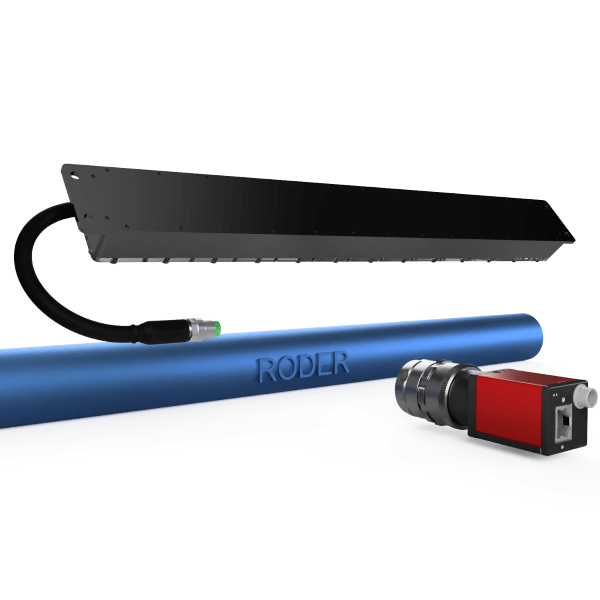
Everything dependable about parcel scanning starts with the lighting. Across the wide conveyors used for oversized packages, LED bar lights are the established lighting answer. Each bar light throws a bright, uniform band of light over the whole conveyor width and fires in strobe mode so that moving parcels look perfectly still. Setting several bar lights at deliberately chosen angles lights the package from directions that lift barcode contrast and suppress mirror-like glare bouncing off shiny label stock.
The Tricky Side of Scanning Oversized Parcels
Oversized packages raise lighting hurdles that never come up when inspecting tiny components. A scanner looking at a big parcel may have to cover a field 600 mm to 1200 mm wide and 400 mm to 800 mm tall. Lighting that span evenly from a working distance of 500 mm to 1500 mm demands illuminators that pair strong output with a balanced beam and carefully controlled beam angles.
Package surfaces are seldom dead flat. Cardboard cartons curve a little inward or outward from internal pressure or soaked-up moisture, and polybags and flexible wrap mould themselves to whatever sits inside. Barcodes and labels sitting on these uneven faces are never square to the lens. The lighting has to hold enough brightness and contrast right across the whole spread of surface angles the line throws up.

Do you want help choosing the product?
Belt Speed and Blurred Images
At high-throughput sites, sorting belts move between 1.5 m/s and 3.5 m/s. Running at 2 m/s, a barcode with a 0.5 mm narrowest bar needs the exposure held below 250 microseconds or blur starts to show. Plain continuous illuminators simply cannot lay down enough light on the surface inside such a tiny window. The answer is powerful strobe lighting driven at peak currents far above the continuous rating, so plenty of light lands on the sensor during that short exposure.
Laying Out LED Bar Lights for Parcel Reading
For reading oversized parcels, LED bar lights go overhead, along the sides, and now and then under the belt so that every face that might carry a label is covered. The layout is worked out to drive label contrast as high as it will go while keeping hotspots and shadows off the package surface.
Reading From Above: Overhead Bar Light Layout
By far the most common layout sets one or more cameras above the belt to capture the package’s top face. One bar light sits on either side of the camera’s field, angled down between 30° and 45° off the horizontal. This paired layout erases the shadow the package edges cast and spreads light evenly over the entire top face. The 30° to 45° angle is picked so flat labels do not bounce back a mirror reflection at straight-on incidence while the surface still stays brightly lit.
Across especially wide belts, three or four bar lights hold the coverage steady all the way to the edges with no fade in brightness. RODER Vision bar illuminators come in modular lengths and bolt together to suit the exact belt width in the field. Neighbouring segments are matched for brightness and colour temperature so no visible seam appears in the captured frame.
Reading Side Labels and Wrap-Around Labels
A great many packages wear their shipping label on a side face instead of on top. Side-mounted cameras, each teamed with its own bar light, capture those labels as the package rolls through the scanning tunnel. A complete scanning tunnel might bring together top, left, right, and sometimes front and rear cameras, each one with its own dedicated bar light. Every camera position is triggered on its own and synced to that camera’s exposure.
Timing the Strobes in Multi-Camera Tunnels
A scanning tunnel running five or six camera positions needs its strobe firing order managed carefully. If every illuminator fires at the same instant, light from one position can bounce off the package into a neighbouring camera’s field and sap contrast there. The fix is to fire each illuminator only while its own camera is exposing, keeping a wide enough gap between flashes to head off cross-illumination.
RODER Vision bar illuminators accept external trigger inputs and respond in under 2 microseconds. The central vision controller runs the firing order, flashing each illuminator at the right point relative to its camera’s exposure. The trigger input takes both 5V and 24V logic and connects directly to the output formats of the standard machine vision controllers and PLC systems used across logistics automation.
Picking the Wavelength for Reading Parcel Labels
Parcel labels carry every kind of printed barcode, QR code, and text. The vast majority of shipping barcodes are black ink on a white or light grey ground. For monochrome cameras, red light at 625 nm to 660 nm delivers high contrast on those labels and rides the peak sensitivity of silicon sensors in that band. Red light also softens the look of surface texture on cardboard, which can otherwise upset decoding if it produces visible density swings in the frame.
White Light for Verifying Coloured Labels
Some logistics jobs need coloured labels verified on top of plain barcode reading. White light handles these by rendering colour faithfully in the captured frame. RODER Vision bar illuminators can be ordered with high-CRI white LEDs for colour-accurate lighting. The illuminator’s colour temperature ought to match the white-balance calibration of the colour camera doing the label verification.
Managing Heat in Non-Stop Logistics Operations
Logistics sorting hubs run 24 hours a day, 365 days a year, so the lighting has to keep its output steady through that unbroken duty cycle. LED illuminators pushed continuously at high duty cycles put out a lot of heat. Where heat management falls short, the LED junction temperature climbs, optical output drops, and service life shortens.
RODER Vision bar illuminators carry built-in HTTM thermal management. The HTTM system governs the thermal resistance between the LED junction and the illuminator housing to keep the junction temperature inside its rated band across every ambient temperature and duty cycle a logistics site presents. That keeps optical output consistent and pushes LED service life to the maximum, lengthening maintenance intervals and cutting unplanned downtime in busy sorting plants.
IP Rating and Protection From the Environment
Logistics settings can be tough on hardware. Conveyors raise dust from cardboard, packaging, and tape residue, and food distribution hubs call for the odd wet clean of conveyor surfaces. Parcel scanning illuminators have to be rated for whatever conditions they sit in.
RODER Vision bar illuminators come in IP65 and IP67 rated versions for settings where dust and water have to be shut out. The IP65 rating covers dusty conveyor areas and the occasional water spray. The IP67 rating brings immersion protection for food distribution and cold storage sites where high-pressure cleaning is the norm. Settling on the right IP rating early on removes any need for extra protective housings around the illuminator, which cuts both installation effort and cost.
Products and Technologies
RODER Vision Illuminator Families for Logistics and Parcel Scanning
The RODER Vision product families set out below suit oversized parcel scanning, barcode reading, and label verification on logistics conveyor systems.

DL5 — High Intensity LED Matrix
Peak output in strobe mode for fast-conveyor barcode reading. Supplied in extended bar form for wide-field parcel scanning. Red and white wavelengths.

DL6 — High Density LED Matrix
HTTM heat control for non-stop logistics duty. Several wavelengths including red and white. Strobe compatible. Large format for wide conveyor coverage.

BL3 — LED Backlights
Backlight illumination for parcel dimensioning and silhouette profiling. Even output. Strobe compatible for fast-conveyor integration. Several format sizes available.

DC6 — High Density LED Ring
Ring illumination for small parcel and label reading stations. Compact fit above the conveyor. Several wavelengths. Strobe compatible for fast reading applications.
Frequently Asked Questions
Each bar light throws a bright, uniform band of light across the full width of wide conveyors, and modular lengths let it match any conveyor size. In strobe mode it hits peak intensities high enough to freeze package motion at conveyor speeds of 2-3.5 m/s. Several bar lights set at chosen angles give paired lighting that erases edge shadows and reaches labels sitting at all kinds of orientations.
The standard layout places two bar lights on opposite sides of the camera field, angled between 30 and 45 degrees off the horizontal. That paired geometry erases package edge shadows and dodges the mirror reflection flat labels throw back at straight-on incidence. You may have to fine-tune the angle for the label finish and the spread of package heights on the line.
Fire each illuminator only while its paired camera is exposing, leaving a wide enough gap between flashes so light from one position never reaches a neighbouring camera’s field. The central vision controller runs the firing order. RODER Vision illuminators accept external triggers and respond in under 2 microseconds for tight timing.
Red light at 625-660 nm delivers high contrast for black-ink barcodes on white or light grey labels, and silicon sensors peak in that band for the best signal-to-noise. Red also softens cardboard texture that could otherwise upset decoding. White light steps in when coloured labels need verifying alongside barcode reading.
IP65 suits most logistics conveyor settings, guarding against dust from cardboard and packaging and shrugging off water spray during cleaning. IP67 is the one for food distribution and cold storage sites where high-pressure washing is routine on conveyor surfaces. Settling on the right rating removes any need for extra protective housings around the illuminator.
Contacts & Information
Contact for general information : info@roder.it
Systems and Sensor Integration Partner : www.roder.it
RODER Artificial Vision Division : www.rodervision.com
RODER Instruments Division : www.innovacheck.com
More information about RODER VISION : about us
The information on this website is provided for informational purposes only. Although it has been prepared with the utmost care, it does not constitute a contractual offer or a binding commitment to supply. It may contain transcription, translation, or typographical errors. For precise and up-to-date information, please contact our company directly.
Please note: Some images on this website have been intentionally generated using Artificial Intelligence (AI). This is due to the fact that, for many applications and projects, it is not possible to disclose photographs of the actual installation or system due to confidentiality agreements, contractual clauses, and Non-Disclosure Agreements (NDAs).

