


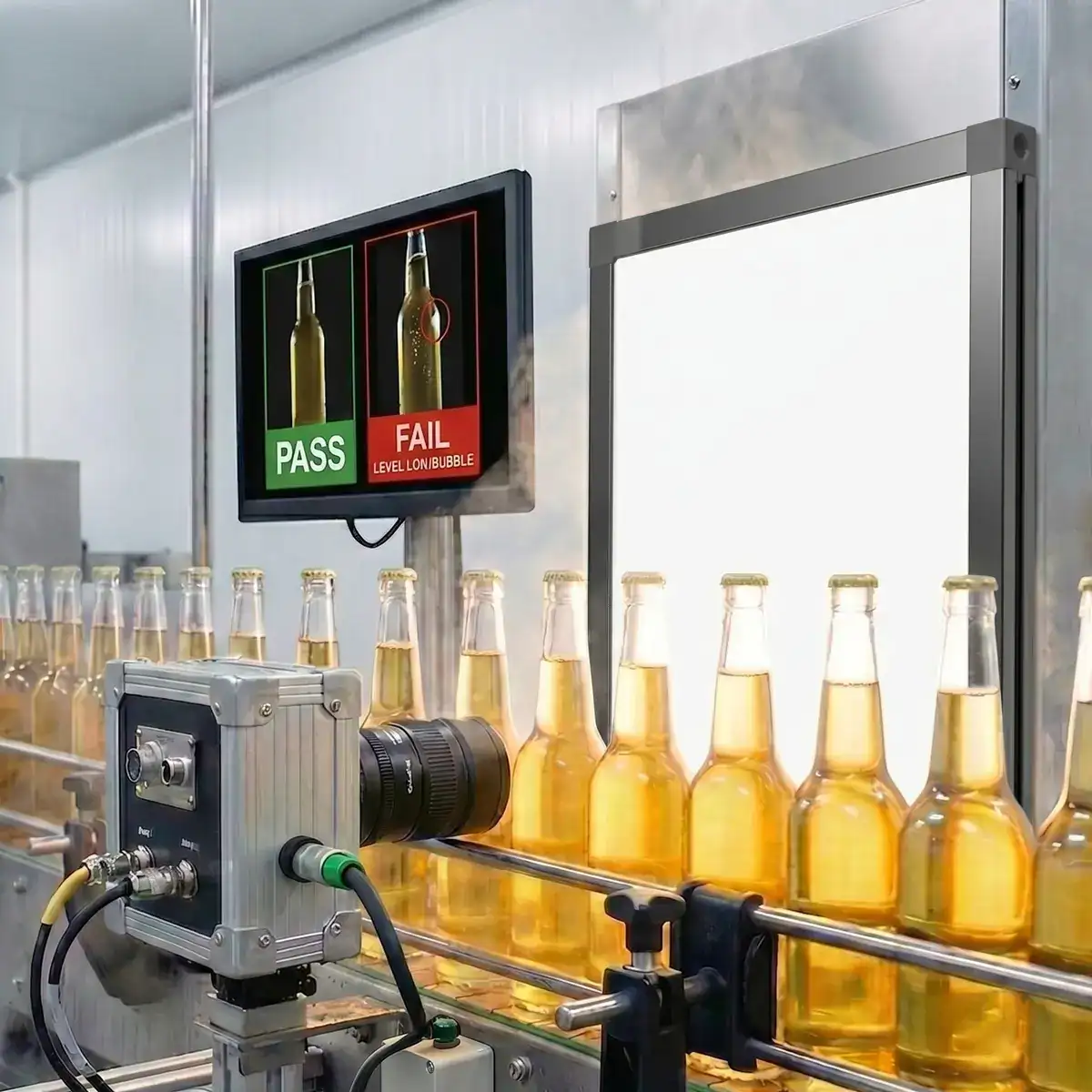
Preserving Glass Bottle Integrity ranks among the top priorities for the pharmaceutical, beverage and cosmetic sectors. Since glass is transparent and strongly reflective, spotting structural faults such as cracks, chips, or inclusions is a real test for automated vision systems. The technique that answers this best is Diffuse Backlighting. By sending light through the glass and building a high-contrast scene, this lighting method lets vision sensors reveal internal defects that simply do not show up under ordinary front lighting, bringing irregularities into view.
The whole point of Detecting Cracks in glass is to turn an invisible defect into a signal the camera can read. With Diffuse Backlighting, light leaves the area behind the bottle evenly and forms a uniform white field. Wherever the glass is compromised, whether by a stress crack or a “birdswing” defect, the light rays bend or are blocked, so the fault stands out as a dark or warped shape against the bright backdrop.

Do you want help choosing the right product?
The Optics Behind Inspecting Transparent Materials
Inspecting glass means knowing how light behaves. Conventional lighting tends to throw specular reflections or glare, and that wash-out hides the very defects the system is hunting for. Diffuse Backlighting clears this up by delivering a scattered, non-directional light source.
That evenness matters for Glass Bottle Integrity, since it keeps the whole bottle profile lit with no hotspots. An internal crack forms a boundary between the glass and a thin sliver of air. Light from the Diffuse Backlighting source strikes that boundary, and the change in refractive index makes the light bend or scatter.
This bit of physics is what makes Detecting Cracks so much simpler for vision algorithms. The defect breaks up the uniform light field, and the software then reads a high-contrast edge it can measure quickly and accurately.
Why Diffuse Backlighting Is Key to Crack Detection
The chief reason Diffuse Backlighting is favoured on bottling lines is how well it copes with the awkward geometry of glass containers. Bottles are hardly ever flat; their curves, shoulders, and embossed logos can throw shadows or reflections. Diffuse Backlighting tames these optical artifacts by wrapping the object in soft, even light.
When it comes to Detecting Cracks, and above all micro-fissures only a few microns across, the background quality is decisive. A light source that is not truly diffuse can leave the camera unable to tell a genuine crack from a swing in light intensity. That is why professional-grade Diffuse Backlighting panels rely on advanced holographic diffusers to push out light at every angle, giving the consistency that demanding Glass Bottle Integrity checks require.
Sustaining Glass Bottle Integrity on Fast Lines
Today’s bottling plants run at remarkable speeds, often handling hundreds of units a minute. Holding Glass Bottle Integrity at those rates means the vision system has to grab images with no motion blur at all. Diffuse Backlighting rigs fitted with high-speed strobe controllers can pulse the light in step with the camera shutter.
By overdriving the Diffuse Backlighting during each pulse, the rig puts out enough intensity to allow very brief exposure times. That is essential for Detecting Cracks on a moving conveyor. A crisp, high-contrast silhouette captured in microseconds lets the software run complex inspections without holding back production, so every bottle leaving the site meets safety standards.
Why Uniformity Counts in Large-Field Inspections
Inspecting large bottles or gallon-sized containers makes keeping uniformity across the whole area harder. A large-area Diffuse Backlighting panel makes sure the bottle edges get just as much light as the centre. That evenness heads off the “vignetting” that could trigger false rejects during Glass Bottle Integrity assessments.
Finding Subsurface Defects and Inclusions
Beyond surface cracks, glass can hold internal faults such as “stones” (unmelted raw material) or “bubbles” (trapped gas). These subsurface problems can undermine structural Glass Bottle Integrity and lead to breakages during carbonation or pasteurization.
Diffuse Backlighting is especially good at bringing these internal flaws to light. Because the light has to cross the full thickness of the glass to reach the lens, any inclusion casts a shadow. For Detecting Cracks hidden inside the glass wall, the high-contrast silhouette that Diffuse Backlighting produces is frequently the only reliable way to confirm the part is structurally sound.
Infrared versus Visible Light in Diffuse Backlighting
White or blue light is the usual pick, but some jobs gain from Infrared (IR) Diffuse Backlighting. Infrared passes through certain coloured glasses, like amber or green, more readily than visible light. When checking the Glass Bottle Integrity of wine or beer bottles, IR Diffuse Backlighting helps the camera “see through” the dark tint to pick out cracks or contaminants inside the container.
Blue Diffuse Backlighting, by contrast, comes into play when the finest resolution is needed. Its shorter wavelength reveals finer detail when Detecting Cracks on the surface of clear pharmaceutical vials, where even a tiny scratch can become a foothold for bacterial growth.
Thermal Stability and Service Life on the Production Floor
Bottling plants are often humid and prone to temperature swings. Industrial Diffuse Backlighting units have to be rugged enough to run around the clock without fading. LEDs are the natural light source here, since they last extremely long and hold their output steady.
Keeping the temperature steady also matters for Glass Bottle Integrity systems. Too much heat from a light source could in principle set up thermal stress in the glass or throw off the camera’s calibration. Well-made Diffuse Backlighting panels build in thermal management that pulls heat away from the inspection zone, so the Detecting Cracks process stays accurate through years of service.
Integration Best Practices for Vision Systems
To bring Diffuse Backlighting into a production line for Glass Bottle Integrity successfully, keep several factors in mind:
- Distance: Set the Diffuse Backlighting as near the bottle as you can to get the most light intensity and uniformity.
- Size: The backlight should be a touch larger than the bottle so the edges, where chips appear most often, are fully lit.
- Filtering: Fit bandpass filters on the camera lens matched to the wavelength of the Diffuse Backlighting to shut out ambient light from the factory ceiling.
- Synchronization: Always run a strobe controller to extend LED life and deliver the brightest possible flash for Detecting Cracks.
Products and Technologies


Conclusion
Chasing flawless Glass Bottle Integrity is an ongoing challenge for manufacturers, yet the right optical strategy can crack it. Diffuse Backlighting stays the most dependable and efficient route to Detecting Cracks and internal defects in transparent containers. By laying down a uniform, high-contrast background, Diffuse Backlighting lets vision systems catch flaws that would otherwise put product safety and brand reputation at risk. Putting money into high-quality illumination is the most direct way to reach a zero-defect production line in the glass industry.
Diffuse Backlighting casts a uniform light field that travels through transparent objects. It is chosen because it wipes out glare and reflections on the glass surface, so the camera can see internal and structural defects such as cracks and bubbles as high-contrast dark shapes.
A crack in glass has a refractive index unlike the glass around it. As light from a Diffuse Backlighting source crosses the bottle, the crack refracts or scatters that light, so the defect shows up as a dark line on a bright background that software detects with ease.
Yes. For coloured glass such as amber or green, Infrared (IR) Diffuse Backlighting is the common choice. IR light gets through dark-coloured glass more easily than visible light, letting the system check the Glass Bottle Integrity of tinted containers.
LEDs bring longer life, better thermal management, and the option to strobe at high intensity. That makes them ideal for fast bottling lines, where steady, pulsed Diffuse Backlighting is needed to “freeze” motion and capture sharp images.
Contacts & Information
Contact for general information : info@roder.it
Systems and Sensor Integration Partner : www.roder.it
RODER Artificial Vision Division : www.rodervision.com
RODER Instruments Division : www.innovacheck.com
More information about RODER VISION : about us
The information on this website is provided for informational purposes only. Although it has been prepared with the utmost care, it does not constitute a contractual offer or a binding commitment to supply. It may contain transcription, translation, or typographical errors. For precise and up-to-date information, please contact our company directly.
Please note: Some images on this website have been intentionally generated using Artificial Intelligence (AI). This is due to the fact that, for many applications and projects, it is not possible to disclose photographs of the actual installation or system due to confidentiality agreements, contractual clauses, and Non-Disclosure Agreements (NDAs).

