


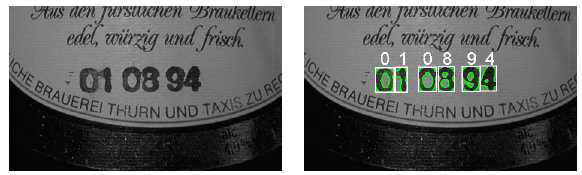
Label inspection is a critical quality control step on virtually every consumer product packaging line. Labels carry mandatory product information including ingredient lists, allergen declarations, batch numbers, expiry dates, and regulatory markings. Any error in the label—missing text, transposed digits, wrong barcode, crease, wrinkle, bubble, or misalignment—can set off product recalls, regulatory non-compliance, or consumer safety issues.
Machine vision systems deliver 100% inline label inspection at full production speed. How well these systems perform comes down entirely to the quality of the image the illumination produces. Diffuse illumination is the starting point for most label inspection tasks because it clears the specular reflections and shadows that make label surfaces hard to image under direct lighting. Choosing the right combination of illumination geometry and wavelength is the key to reliable detection across the wide range of label materials, finishes, and defect types met in production.
Why Label Surfaces Are Hard to Illuminate
Labels are applied to curved, cylindrical, or irregular surfaces. The label material itself may be paper, film, foil, or a laminate of several materials. The print may be flexographic, offset, digital, or thermal transfer. The finish may be matt, gloss, satin, or metallised. Each combination of surface, material, and finish carries different optical properties that shape how the label responds to illumination.
Gloss labels throw strong specular reflections under direct illumination. Those reflections create bright hotspots in the camera image that saturate the sensor and make it impossible to read the text or verify the print in the affected area. Foil and metallised labels are even more troublesome: the whole label surface acts as a mirror under direct illumination, producing an image that holds almost no usable information about the label content.

Do you want help choosing the product?
Matt and uncoated paper labels throw less specular reflection but are hit by shadows and gradients under non-uniform illumination. Any variation in illumination intensity across the field of view creates apparent density variations in the image that can be misread as print defects by image processing algorithms.
Diffuse Illumination for Label Inspection
Diffuse illumination spreads light over a large solid angle, lighting the label surface from many directions at once. That sharply cuts the intensity of any single specular reflection because the reflected energy is spread over many directions rather than concentrated at one specular angle. The result is a far more uniform image of the label surface, independent of minor surface tilt or curvature variations.
Flat Dome Illumination for Flat and Slightly Curved Labels
Flat dome illuminators give diffuse illumination from a large-area source. The light exits through a diffusing panel that produces a uniform, omnidirectional illumination field. For flat labels and labels on low-curvature surfaces, flat dome illumination delivers the most uniform background illumination available from a front-facing source. The uniformity figures of RODER Vision FD-series flat dome illuminators top 90% across the active area, keeping image quality consistent across the entire label.
Ring Illumination for Cylindrical Containers
Labels on cylindrical containers such as bottles, cans, and tubes are inspected with a ring illuminator centred on the container axis. The ring geometry supplies illumination from all azimuthal directions at once, which makes up for the curvature of the label surface. Each point on the cylindrical label surface receives light from at least some of the ring LEDs at an angle close to normal incidence, giving a relatively uniform image across the curvature of the container.
For labels on bottles, a ring illuminator with a large inner diameter is used so the bottle fits within the ring. The ring is set at a height that centres it on the label zone. For high-speed rotary inspection of cylindrical containers, several ring illuminators are placed around the circumference of a star wheel or rotary table to inspect all faces of the label in a single pass.
Detecting Print Errors and Missing Text
Print error detection compares the camera image of the label against a reference image or a parametric description of the expected content. The inspection tasks include confirming the presence and position of all printed elements, reading variable data such as batch numbers and expiry dates, verifying barcode symbology and readability, and catching print quality defects such as streaks, voids, smears, and colour shifts.
Wavelength Selection for Print Contrast
The wavelength of the illumination sets the contrast between different ink colours and the label background. For black ink on white or light-coloured labels, any visible wavelength gives adequate contrast. For coloured inks, the contrast hinges on the relationship between the ink colour and the illumination wavelength.
A red illuminator suppresses red ink and lifts the contrast of blue and green ink on a white background. A blue illuminator suppresses blue ink and lifts red and yellow ink contrast. Where the same camera has to read black ink, coloured ink, and barcodes on one label, white illumination gives a reasonable baseline contrast for all colours. Where one specific ink colour has to be inspected at the highest possible contrast, a single-wavelength illuminator matched to the complementary colour of the ink is preferred.
UV Illumination for Security and Authentication Features
Many labels carry UV-fluorescent security features that stay invisible under white light. These include UV-reactive inks, fibres, and coatings that fluoresce strongly under ultraviolet illumination at 365 nm or 395 nm. Vision inspection with UV illumination can confirm the presence and position of these security features. It is used in pharmaceutical label inspection, high-value product authentication, and brand protection.
Crease and Wrinkle Detection
Label creases and wrinkles are mechanical defects caused by wrong label application, wrong label tension during application, or label material defects. They distort the look of the label and can make printed information hard or impossible to read. In pharmaceutical and food applications, a creased label may fail regulatory requirements for legibility of mandatory information.
Shadow-Based Crease Detection
Creases and wrinkles are three-dimensional surface deformations. They cast shadows under directional illumination and show up as bright lines under grazing-incidence darkfield illumination. The most effective approach for crease detection pairs two illumination modes: diffuse illumination for print verification and low-angle directional illumination for crease and wrinkle detection. The two images are captured separately using strobe triggering and analysed by different inspection algorithms.
Under low-angle illumination at 10° to 20° from horizontal, a crease only 0.1 mm high on a flat label casts a shadow 0.3 to 0.6 mm long. That shadow is easily caught by the inspection algorithm. The minimum detectable crease height depends on the illumination angle and the pixel size of the camera system. For high-resolution label inspection, creases as small as 50 micrometres in height are detectable with the right low-angle illumination.
Label Presence and Position Verification
Before print content can be verified, the system has to confirm a label is present and correctly positioned on the product. Label presence detection is usually done with a ring illuminator or matrix illuminator giving front illumination. The unlabelled surface of the container has a different reflectance or colour from the labelled area, and that difference is caught by a brightness or colour threshold in the image.
Label position measurement checks the label is applied within the allowed positional tolerance. It is measured from the image coordinates of the label edges. Any systematic offset in the label position points to a problem with the label applicator or the web feed tension. The inspection system generates a correction signal that can feed back to the label applicator controller for automatic adjustment.
Barcode and Datamatrix Verification
Every label inspection system for serialised products has to verify the readability and content of barcodes and datamatrix codes. The readability of a barcode depends on the print quality, the contrast between bars and spaces, the bar width accuracy, and the absence of voids, smears, or bleed.
Diffuse illumination from a ring or flat dome illuminator is generally enough for barcode verification on paper and film labels. For foil or metallised labels where the barcode is embossed or hot-stamped, a combination of diffuse and directional illumination may be needed to build sufficient contrast for reliable barcode reading. RODER Vision DL6 series illuminators with adjustable angle settings let the illumination geometry be tuned to the specific barcode substrate material.
Products and Technologies
RODER Vision Illuminator Families for Label Inspection
The RODER Vision product families below suit label presence, print verification, crease detection, and barcode reading on packaging lines.

FD2 — Flat Dome LED Illuminators
Diffuse illumination for flat and low-curvature labels. Clears gloss hotspots on film and foil labels. Uniform background for print verification and colour inspection.

DC6 — High Density LED Ring
Ring illumination for cylindrical container label inspection. Makes up for surface curvature. Multi-wavelength for ink colour contrast optimisation. Strobe compatible.

DL6 — High Density LED Matrix
Direct matrix illumination for barcode and datamatrix reading on embossed or foil labels. HTTM thermal stability. UV option for fluorescent security feature verification.

DL5 — High Intensity LED Matrix
High peak intensity at low angles for label crease and wrinkle detection. Grazing-incidence illumination reveals surface deformations invisible under diffuse lighting.
Frequently Asked Questions
Diffuse illumination spreads light over a large solid angle, clearing the specular hotspots on gloss, film, and foil label surfaces. It gives a uniform image background independent of minor surface curvature or tilt, so print content, text, and barcodes stay uniformly visible across the full label area whatever the finish or the curvature of the container.
For black ink on light backgrounds, any visible wavelength works. For coloured inks, use a wavelength complementary to the ink colour for the highest contrast: red illumination for blue and green ink, blue illumination for red and yellow ink. White illumination is used when one camera has to verify several ink colours on the same label. UV illumination at 365-395 nm reveals fluorescent security features invisible under white light.
Low-angle directional illumination at 10 to 20 degrees from horizontal is the most effective technique for crease and wrinkle detection. The crease casts a long shadow under grazing-incidence light that is easy to catch. Most label inspection systems use a separate strobe-triggered low-angle illuminator for crease detection and a diffuse illuminator for print content verification, with the two images captured in sequence.
A ring illuminator centred on the container axis supplies illumination from all azimuthal directions at once, making up for the curvature of the label surface. For high-speed rotary inspection, several ring illuminators placed around a star wheel or rotary table inspect all faces of the cylindrical label in a single pass. Strobe triggering syncs the exposure with the container position.
In most cases yes. A flat dome or ring illuminator giving diffuse illumination suits both print content verification and barcode reading on paper and film labels. For foil or embossed labels where the barcode is hard to read under purely diffuse illumination, an extra directional illuminator may be needed to lift barcode contrast, triggered separately from the diffuse source.
Contacts & Information
Contact for general information : info@roder.it
Systems and Sensor Integration Partner : www.roder.it
RODER Artificial Vision Division : www.rodervision.com
RODER Instruments Division : www.innovacheck.com
More information about RODER VISION : about us
The information on this website is provided for informational purposes only. Although it has been prepared with the utmost care, it does not constitute a contractual offer or a binding commitment to supply. It may contain transcription, translation, or typographical errors. For precise and up-to-date information, please contact our company directly.
Please note: Some images on this website have been intentionally generated using Artificial Intelligence (AI). This is due to the fact that, for many applications and projects, it is not possible to disclose photographs of the actual installation or system due to confidentiality agreements, contractual clauses, and Non-Disclosure Agreements (NDAs).
