


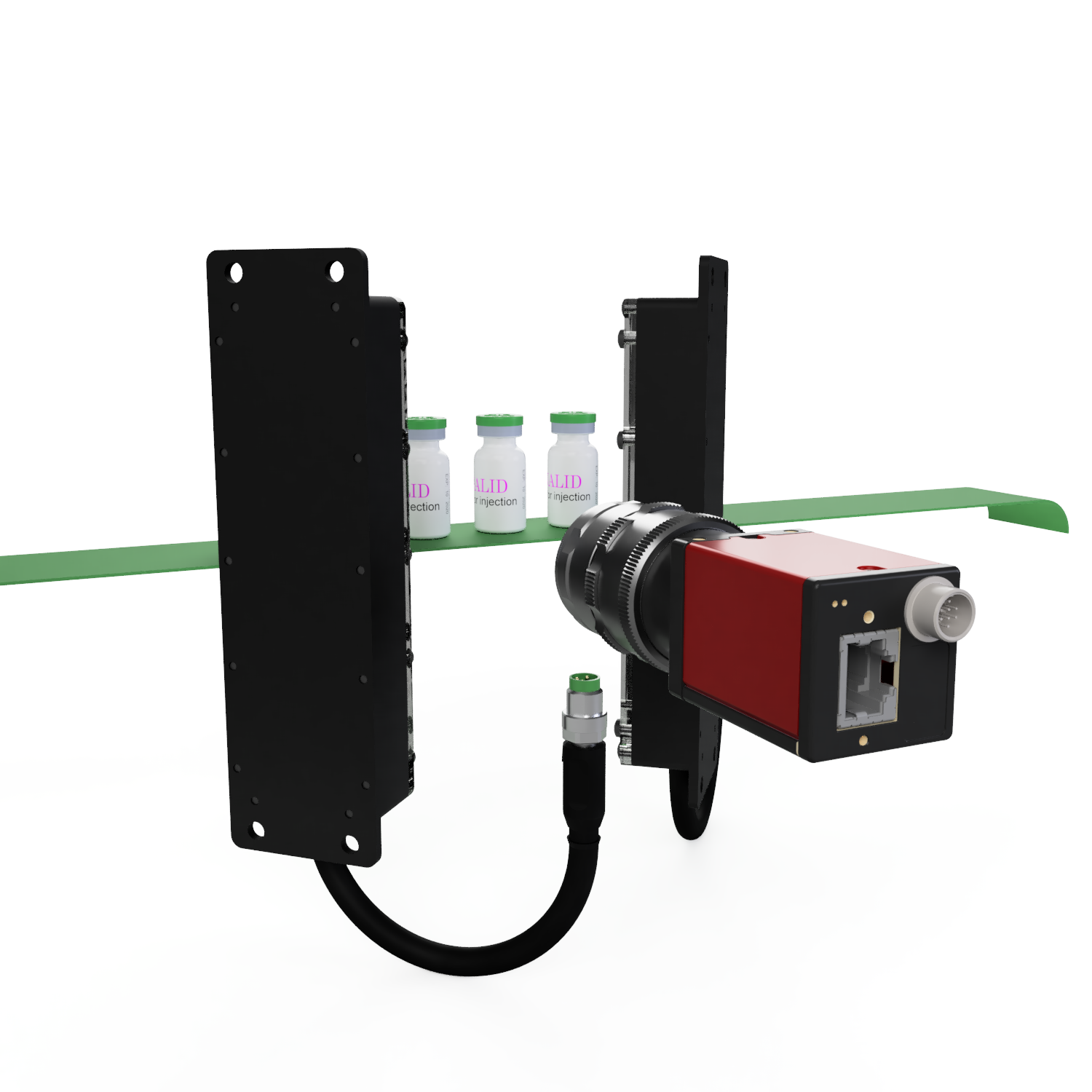
Barcode and datamatrix reading on moving parts is one of the toughest illumination problems in industrial machine vision. The core issue is motion blur: when a barcode moves during the camera exposure, the image of its bars and spaces smears in the direction of motion. That smearing cuts the edge contrast between bars and spaces. Below a critical contrast level, the barcode decoder cannot read the symbol, and the result is a missed read that halts production or forces manual recovery.
The fix is to freeze the motion optically, not mechanically. Cutting the camera exposure time to the point where the barcode moves less than a small fraction of a bar width during the exposure clears visible motion blur. For a barcode moving at typical conveyor speed with typical bar widths, that calls for exposure times of 50 to 500 microseconds. At these short exposures, the illumination has to deliver enough photons to the sensor in the available time. Standard continuous-mode illuminators cannot provide adequate intensity for such short exposures. Pulsed strobe illumination is the engineering answer.
The Physics of Motion Blur in Barcode Reading
Motion blur is directly proportional to the product of the object velocity and the exposure duration. A barcode moving at 1 m/s with an exposure time of 1 ms travels 1 mm during the exposure. If the narrowest bar width in the symbol is 0.5 mm, the barcode has shifted by two bar widths during the exposure. That produces severe smearing and a guaranteed read failure.
The acceptable blur limit for barcode reading is usually defined as a fraction of the minimum bar width, known as the X-dimension. ISO barcode quality standards set bar edge contrast requirements that a symbol has to meet for a given quality grade. Motion blur cuts bar edge contrast in proportion to the ratio of the blur distance to the bar width. For reliable reading, the motion blur has to stay below 10% to 20% of the X-dimension.

Do you want help choosing the product?
Calculating the Required Exposure Time
The required exposure time follows from the object velocity, the barcode X-dimension, and the allowed blur fraction. For a barcode with a 0.33 mm X-dimension moving at 0.5 m/s, the allowable blur is 0.033 to 0.066 mm (10-20% of the X-dimension). The required exposure time is 0.033 mm divided by 500 mm/s, which equals 66 microseconds maximum. For a barcode on a high-speed conveyor running at 2 m/s with the same X-dimension, the required exposure time drops to 16 microseconds.
These exposure times sit well within the reach of modern machine vision cameras with global shutter sensors. The challenge is entirely on the illumination side: providing enough light for a correct exposure in 16 to 66 microseconds calls for illumination intensities one to two orders of magnitude higher than what standard continuous-mode LED illuminators provide.
Strobe Illumination: How Peak Intensity Offsets Short Exposure
LED illuminators can run in two fundamentally different modes: continuous mode and strobe mode. In continuous mode, the LEDs are driven at a constant current and the illuminator produces a steady, constant output. The maximum continuous current is set by the thermal capacity of the illuminator and its heatsink. Push past that current and the LED junction temperature rises to levels that permanently degrade LED performance.
In strobe mode, the LEDs are driven at a much higher peak current for a very short burst, then switched off so the junction can cool before the next pulse. The peak optical output during the pulse scales with the peak drive current and can run many times higher than the continuous-mode output. The duty cycle—the fraction of time the illuminator is on—sets the average power dissipated in the LEDs. With a low duty cycle of 1% to 5%, the peak current can be 10 to 50 times the continuous current without passing the average thermal rating.
Pulse Duration and Synchronisation
The strobe pulse has to be synced with the camera exposure. The standard approach uses the camera’s trigger output to fire the strobe pulse, with the pulse duration set to match the camera exposure time. The illuminator has to react fast to the trigger signal: the rise time from trigger input to full optical output has to be shorter than the exposure time. For 50-microsecond exposures, the rise time has to be under a few microseconds.
RODER Vision DL5 and DL6 series illuminators are built for strobe operation with very short pulse durations. The electronic driver circuits reach rise times under 2 microseconds to full peak output. The strobe trigger input takes both 5V and 24V logic signals and plugs directly into the output formats of standard machine vision cameras and frame grabbers.
Illumination Geometry for Barcode Reading on Moving Parts
The geometry of the illumination shapes barcode readability in several ways beyond raw intensity. The illumination angle, the uniformity across the barcode area, and the relationship between the illumination direction and the barcode orientation all influence the decoded image quality.
Direct Illumination for Flat Barcodes on Matt Surfaces
For barcodes printed on matt or satin surfaces such as paper labels, cardboard cartons, and uncoated plastics, direct front illumination from a matrix or ring illuminator gives the highest intensity and the best contrast. The illumination angle should be 30° to 60° from the camera axis to dodge the specular reflection that occurs at normal incidence on slightly reflective surfaces. A ring illuminator centred on the camera axis gives omnidirectional front illumination that is independent of barcode orientation on the label.
Diffuse Illumination for Gloss and Reflective Surfaces
Barcodes on gloss labels, metallised substrates, and shrink-wrapped products need diffuse illumination to dodge the specular hotspots that saturate the sensor and mask the barcode bars. A flat dome illuminator gives diffuse illumination from a large solid angle, with the barcode imaged through the aperture in the dome. The diffuse geometry clears specular reflections and yields a uniform, readable image of the barcode even on highly reflective substrates.
The trade-off with diffuse illumination is intensity: flat dome illuminators spread their optical output over a large solid angle, leaving lower intensity at the product surface than a direct illuminator of the same electrical power. For high-speed work on reflective surfaces, a combination of moderate diffuse illumination for contrast and a very short strobe pulse for motion freezing is needed.
Bar Orientation and Illumination Direction
For linear barcodes, the illumination direction relative to the bar orientation shapes the edge contrast in the image. Illumination parallel to the bars (perpendicular to the scan direction) produces the maximum edge contrast at the bar boundaries. Illumination perpendicular to the bars (along the scan direction) minimises that edge contrast. In practice, the barcode orientation on the product is usually fixed, and the illumination geometry is designed to suit. Where the barcode orientation is variable, a ring illuminator or a diffuse source is preferred because both are independent of barcode orientation.
Datamatrix and 2D Codes: Extra Illumination Considerations
Datamatrix codes, QR codes, and other 2D symbologies are increasingly used in industrial traceability because they pack more information per unit area than linear barcodes and can be read even when partly damaged. The cell size of a datamatrix code printed at typical industrial densities runs from 0.25 mm to 1 mm per cell. The illumination requirements match linear barcodes in terms of intensity and motion freezing, but the 2D structure of the code adds further constraints.
Datamatrix codes are often marked straight onto the part surface by dot-peen marking, laser engraving, or chemical etching rather than printed on a label. These direct part marking (DPM) techniques produce codes read under illumination conditions very different from those used for printed barcodes. Dot-peen marked codes on metal surfaces need directional illumination at a specific angle to build contrast between the indented dots and the surrounding flat surface. Ring illumination at low angles or coaxial illumination are the techniques most used for DPM barcode reading.
Practical Guidelines for Strobe Illumination in Barcode Reading Systems
Designing a strobe illumination system for barcode reading means matching several parameters: exposure time, peak intensity, illuminator working distance, field of view, and trigger interface.
The exposure time is set first, from the line speed and barcode X-dimension calculation above. The required surface irradiance is worked out from the exposure time, the camera sensor sensitivity, the lens f-number, and the target grey level in the barcode white spaces. The illuminator is then chosen to deliver that irradiance at the required working distance and field size. RODER Vision product datasheets give peak irradiance figures in strobe mode at defined working distances, so the system designer can confirm the required irradiance is achievable before integration.
Products and Technologies
RODER Vision Illuminator Families for Barcode Reading
The RODER Vision product families below are tuned for high-speed barcode and datamatrix reading that calls for strobe illumination.

DL5 — High Intensity LED Matrix
Maximum peak intensity in strobe mode. Built for high-speed barcode reading with exposure times down to 10 microseconds. Fast rise time. Multi-wavelength including red and white.

DL6 — High Density LED Matrix
High-density matrix with HTTM thermal stability. Strobe compatible for barcode and datamatrix reading. Large format sizes for wide-field conveyor applications.

DC6 — High Density LED Ring
Ring illumination for barcode reading on labels of any orientation. Multi-wavelength. Strobe compatible. Low-angle option for DPM dot-peen barcode reading on metal parts.

FD2 — Flat Dome LED Illuminators
Diffuse dome illumination for barcode reading on gloss, metallised, and shrink-wrap labels. Clears specular hotspots. Strobe compatible for motion-freeze applications.
Frequently Asked Questions
Motion blur happens when a barcode moves during the camera exposure, smearing the bars and spaces in the direction of motion and cutting edge contrast below the decoder threshold. It is cleared by shortening the exposure so the barcode moves less than 10-20% of one bar width during the exposure. The shorter exposure needs proportionally higher illumination intensity, supplied by strobe LED illuminators.
Divide the allowable blur distance by the object velocity. The allowable blur is typically 10-20% of the barcode X-dimension (minimum bar width). For a barcode with 0.33 mm X-dimension moving at 1 m/s, the maximum exposure is 0.033-0.066 mm divided by 1000 mm/s, which is 33 to 66 microseconds. At higher line speeds the required exposure time drops in proportion.
Strobe illumination drives LEDs at peak currents 10 to 50 times higher than the continuous rating for very short bursts, producing peak optical intensities far beyond what continuous illuminators can sustain. The short pulse paired with the high peak intensity allows very short camera exposures that freeze motion while still giving enough light for correct sensor exposure.
Direct part marking (DPM) datamatrix codes on metal surfaces need directional illumination to build contrast between the indented dots and the surrounding flat surface. Ring illumination at shallow angles or coaxial illumination are the standard techniques. The best angle depends on the marking depth and the surface roughness of the part, so testing with different angles is usually needed to optimise contrast for the specific marking and substrate.
Yes, in many applications. A high-intensity strobe illuminator triggered for short-exposure barcode reading can also run at lower intensity or longer exposure for label print verification and presence detection in the same camera station. The illuminator is triggered differently for each task, and the vision system processes the two image types with separate algorithms, which cuts the number of illuminators and camera stations needed.
Contacts & Information
Contact for general information : info@roder.it
Systems and Sensor Integration Partner : www.roder.it
RODER Artificial Vision Division : www.rodervision.com
RODER Instruments Division : www.innovacheck.com
More information about RODER VISION : about us
The information on this website is provided for informational purposes only. Although it has been prepared with the utmost care, it does not constitute a contractual offer or a binding commitment to supply. It may contain transcription, translation, or typographical errors. For precise and up-to-date information, please contact our company directly.
Please note: Some images on this website have been intentionally generated using Artificial Intelligence (AI). This is due to the fact that, for many applications and projects, it is not possible to disclose photographs of the actual installation or system due to confidentiality agreements, contractual clauses, and Non-Disclosure Agreements (NDAs).

