
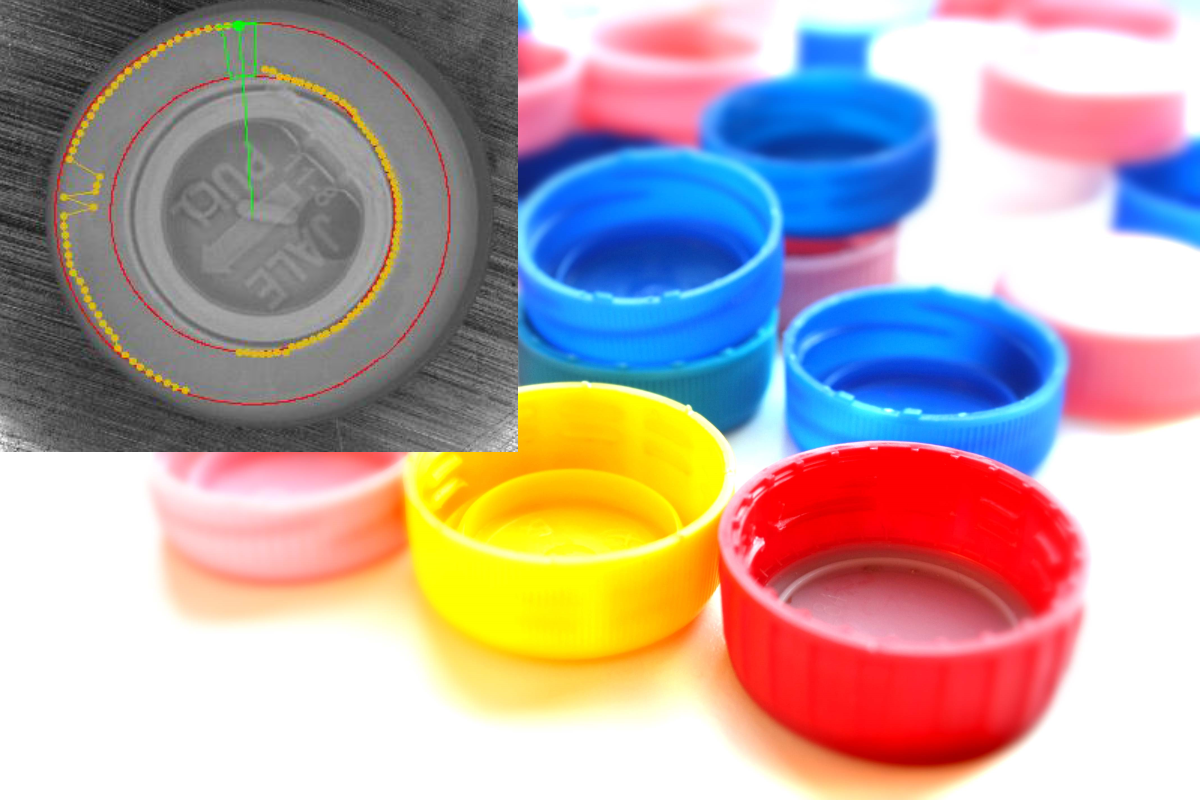
Bottle cap and closure inspection is one of the most widespread vision applications in the packaging industry. It spans food and beverage production, pharmaceutical filling lines, personal care product assembly, and chemical packaging. The inspection requirements vary significantly by closure type and product category. The fundamental challenge is consistent: the closure surface is often curved, reflective, and must be inspected at very high line speeds with zero tolerance for defective products reaching the consumer.
The choice of LED illumination technique is the single most important factor determining whether a cap inspection system achieves reliable detection or produces excessive false rejects. A wrong illumination geometry produces images where the defect is invisible, regardless of how sophisticated the image processing algorithm is. This guide covers the main inspection tasks on bottle closures and the illumination approaches that deliver reliable results for each.
Cap Presence and Absence Detection
The most basic closure inspection task is verifying that a cap is present on every bottle before the product leaves the filling station. Missing caps are a critical defect in food, beverage, and pharmaceutical production. The detection must be reliable at 100% throughput even at line speeds of several hundred containers per minute.
Backlight illumination is the most robust approach for cap presence detection when the bottle geometry allows. The bottle is illuminated from behind. A correctly capped bottle blocks the backlight in the cap zone. An uncapped bottle allows backlight to pass through the open neck. The contrast between presence and absence is very high and independent of cap colour, surface finish, or line speed variation.

Do you want help choosing the product?
When backlight is not feasible due to bottle geometry or conveyor configuration, a front-illuminated approach using a ring or matrix illuminator and brightness threshold detection is used. The cap surface produces a characteristic reflection pattern. An uncapped bottle neck produces a very different pattern. The illumination must maximise the brightness difference between capped and uncapped conditions.
Cap Alignment and Skew Detection
A cap that is present but misaligned — tilted, skewed, or cross-threaded — is a serious defect. It may cause product leakage, failed tamper evidence, or consumer complaints. Cap alignment inspection measures the angular position and tilt of the cap relative to the bottle axis.
Top-View Alignment Detection
For caps with a flat or slightly domed top surface, a top-view camera with ring illumination provides a clear image of the cap-to-bottle interface. Misalignment appears as an asymmetric gap or shadow around the cap perimeter. Shallow-angle ring illumination enhances the visibility of the gap shadow and makes small misalignment measurable.
Side-View Profile Inspection
Side-view inspection with backlight illumination provides the clearest image of cap tilt. A correctly applied cap shows a horizontal top edge. A tilted cap shows a slanted top edge. Backlight silhouette imaging is the most accurate technique for measuring cap tilt angle because the edge position is determined by the silhouette boundary rather than by the surface reflectance of the cap.
Tamper Evidence and Seal Integrity Inspection
Many closure types incorporate a tamper-evident band that breaks or separates from the cap body when the closure is first opened. Verifying the integrity of the tamper evidence before the product ships is a mandatory quality check in pharmaceutical and food applications.
Band Integrity Verification
The tamper-evident band on a closure is typically a narrow ring at the base of the cap. Dome illumination or low-angle ring illumination reveals the band profile with high contrast. A broken or partially separated band appears as a bright line or gap at the base of the cap. This is detectable as a brightness or geometry anomaly in the image.
Induction Seal Presence Verification
Products sealed with an induction foil require verification that the foil is present and intact. NIR illumination can penetrate certain cap materials and reveal the presence or absence of the foil seal below the cap. For transparent or semi-transparent cap materials, visible wavelength backlight illumination can show the foil outline through the cap body.
Cap Colour and Print Verification
In multi-SKU packaging lines, verifying that the correct cap colour and print are applied to each product variant is a critical inspection task. A wrong cap colour on a pharmaceutical product could cause a serious dispensing error. In food and beverage production, wrong cap colours or prints cause labelling non-conformances.
Colour cap verification requires illumination with stable spectral output. Any variation in the colour temperature or spectral distribution of the illumination changes the apparent colour of the cap in the camera image. RODER Vision DL6 and DC6 illuminators use HTTM thermal management technology to maintain stable LED junction temperature and consistent spectral output across different ambient temperatures and duty cycles.
For print verification on caps — lot numbers, expiry dates, or brand markings — direct front illumination at a moderate angle provides the best contrast for reading alphanumeric codes. UV illumination can enhance the contrast of certain ink types that have fluorescent properties under ultraviolet excitation.
Torque and Application Verification
Some closure inspection systems include a torque marking check. A torque arrow or indicator mark on the cap changes position relative to a reference mark on the bottle when the cap is correctly torqued. Vision inspection verifies that the torque indicator is in the correct angular position after the capping station.
This inspection requires illumination that provides high contrast for the torque marking against the cap surface. Dome or flat dome illumination is preferred for reflective caps where direct illumination would produce specular hotspots that mask the marking. For matt or textured cap surfaces, direct ring illumination from above is sufficient.
Illumination Geometry Selection for Cap Inspection
Dome Illumination for Reflective and Curved Caps
Dome illumination is the standard choice for highly reflective caps such as aluminium closures, metallic-finish plastic caps, and foil-topped bottles. The hemispherical illumination geometry eliminates specular hotspots from the curved cap surface and produces a uniform, even image that allows colour, marking, and geometry inspection without glare interference.
Ring Illumination for Top-Surface Inspection
Ring illuminators positioned above the cap provide uniform front illumination for presence detection, print reading, and colour verification on caps with a flat or low-profile top surface. A shallow-angle ring provides darkfield enhancement for detecting surface contamination, scratches, and alignment gaps at the cap perimeter.
Backlight for Side-View and Profile Inspection
Backlight illumination is used for side-view profile inspection of cap tilt, cap height, and tamper band integrity. The camera images the silhouette of the cap and bottle neck from the side. Cap geometry, tilt, and tamper band presence are all measurable from the silhouette image with high accuracy and independence from cap colour or surface finish.
Products and Technologies
RODER Vision Illuminator Families for Cap and Closure Inspection
The following RODER Vision product families cover the most common illumination requirements in bottle cap and closure inspection systems.

FD2 — Flat Dome LED Illuminators
Diffuse dome illumination for reflective and metallic caps. Eliminates specular hotspots. Ideal for colour verification and marking inspection on curved surfaces.

DC6 — High Density LED Ring
Ring illumination for top-view cap presence, alignment gap detection, and print verification. Multi-wavelength. Strobe compatible for high-speed lines.

BL3 — LED Backlight Series
Backlight for side-view cap tilt, height measurement, and tamper band silhouette inspection. High uniformity. Multiple sizes. Strobe trigger compatible.

DL6 — High Density LED Matrix
Direct matrix for cap print verification, lot code reading, and colour inspection. HTTM thermal stability ensures consistent spectral output. UV and NIR options.
Frequently Asked Questions
Backlight illumination provides the highest reliability for cap presence detection. A capped bottle blocks the backlight in the cap zone; an uncapped bottle allows light through the open neck. This produces very high contrast regardless of cap colour or surface finish. A front ring or matrix illuminator is used as alternative when backlight is not feasible.
Dome or flat dome illumination is the standard choice for highly reflective aluminium and metallic caps. The hemispherical illumination geometry eliminates specular hotspots from the curved cap surface and produces a uniform image suitable for colour, marking, and geometry inspection.
Low-angle ring illumination or dome illumination reveals the tamper-evident band profile at the base of the cap. A broken or separated band appears as a gap or bright line. Side-view backlight inspection also provides a clear silhouette of the band.
White or visible wavelength illumination with stable spectral output. RODER Vision HTTM technology maintains consistent LED colour temperature. NIR can be added for foil seal detection; UV for fluorescent ink verification.
Yes. A flat dome illuminator provides diffuse illumination for surface and marking inspection. A ring illuminator at shallow angle adds alignment gap detection. Both are triggered in sequence by the vision controller at full production speed.
More information and contacts
Systems and Sensor Integration Partners : www.roder.it
Artificial Vision Division : www.rodervision.com
More information about RODER VISION : about us
Contact for general information : info@roder.it
The information on this website is provided for information purposes only. Although it has been prepared with the utmost care, it does not constitute a contractual offer or a binding commitment to supply. It may contain transcription, translation or typographical errors. For precise and up-to-date information, please contact our company directly.
Related topics :
 Glass and PET bottle inspection: how to ensure compliance with LED backlights.
 RODER Vision Application Notes: Real-World Machine Vision Lighting Solutions
 Fastener Dimensional Checks: Using Telecentric Lights for High-Precision Screws
 Label Inspection: Detecting Creases and Print Errors with Diffuse Lighting
 Glass Bottle Integrity: Detecting Cracks with Diffuse Backlighting