


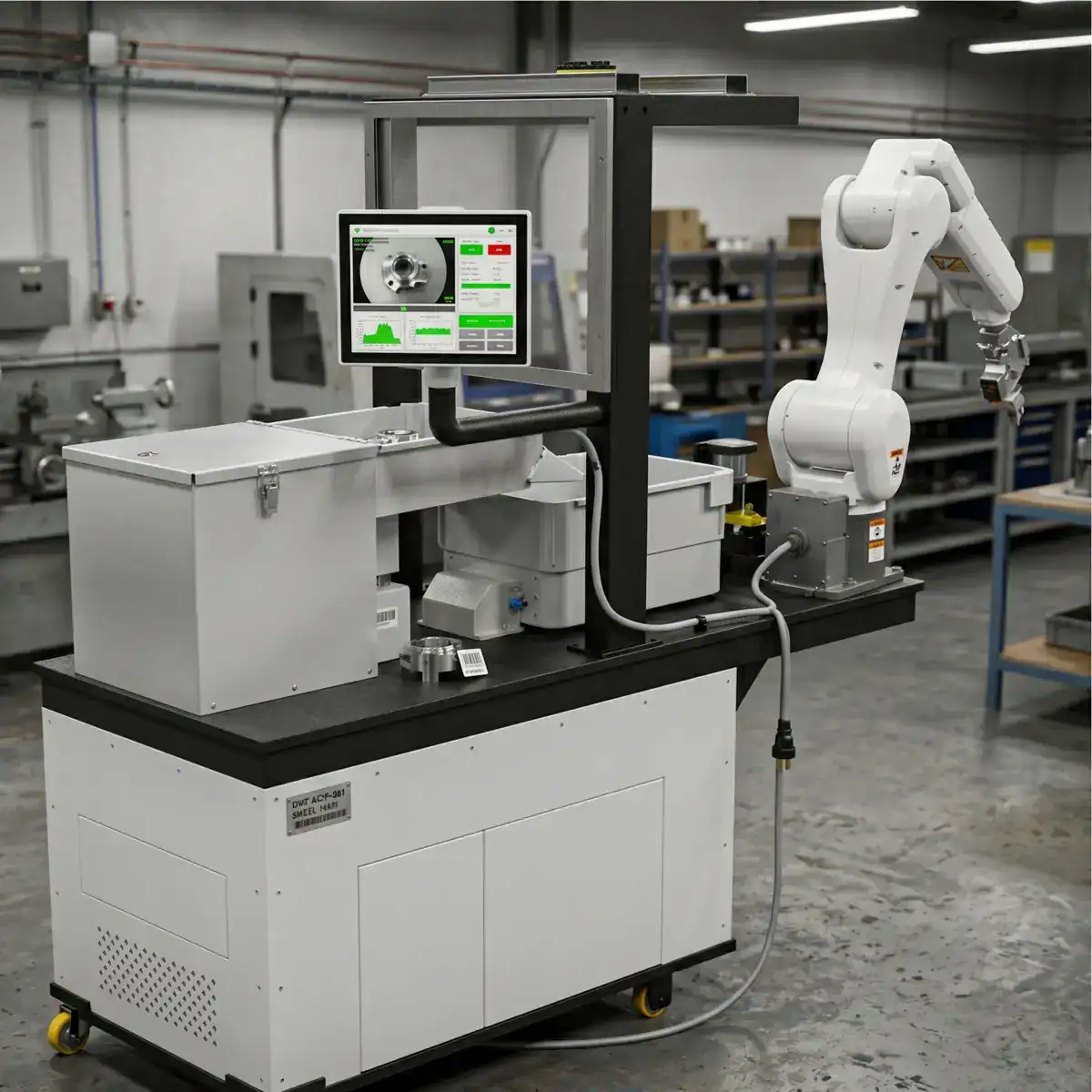
In high-speed industrial automation, the efficiency of a production line often comes down to one decisive moment: getting a component’s orientation right as it leaves the feeder. Vibratory bowl feeders are the workhorses of this stage, but as parts shrink and their geometries grow more intricate, mechanical tooling frequently hits its ceiling. That is the point where high-performance vision systems for vibratory feeders take over.
The real hurdle, though, is not just the software—it is the quality of the image handed to the camera. Without steady, high-contrast illumination, even the most advanced AI-driven vision system struggles to tell a part’s front from its back. The RODER DL8 series was engineered specifically to clear this bottleneck. By delivering an ultra-uniform LED matrix backlight, the DL8 produces a crisp, high-contrast silhouette that makes the part’s orientation unmistakable to the camera.

Do you want help choosing the right product?
The Challenge of Precise Part Orientation
Mechanical sorting in vibratory bowls is dependable but rigid. The moment a line has to juggle several part variants or components with subtle asymmetrical features, mechanical gates grow prone to jamming or demand frequent manual changeovers.
Modern vision systems for vibratory feeders bring the flexibility Industry 4.0 calls for, yet they are highly sensitive to ambient light and to hotspots on the feeder surface. When the lighting is uneven, the vision system can mistake a reflection for a structural feature, which leads to false rejects or, worse, a line stoppage when a wrongly oriented part reaches the assembly tool.
DL8 Matrix: High Uniformity for Complex Geometries
The DL8 LED matrix from Roder Vision is made to drop straight into the feeding track or at the discharge point of the vibratory bowl. Unlike ordinary LED strips, the DL8 carries a high-density matrix that casts a perfectly diffused light field.
That degree of uniformity is critical for silhouette detection. Set the DL8 beneath a translucent belt or glass track and the component is backlit, so its surface colour or texture drops out of the picture. The camera then sees only a high-contrast black shape against a pure white (or coloured) background. This trims the vision algorithm’s workload, opening the door to faster processing and a marked drop in inspection errors.
Reducing False Rejects and Improving Cycle Times
When you fine-tune your lighting for automatic feeder systems, the headline KPI you move is the First Pass Yield (FPY). A flickering or low-intensity light source forces the vision system to lengthen exposure time, which slows the whole feeder down.
The DL8 series puts out high-intensity light that supports ultra-short shutter speeds. That lets the feeder run at full vibration frequency without the images smearing. On top of that, the DL8’s rugged industrial housing makes sure the bowl’s constant vibration never leads to LED failure or drifting alignment—a frequent weakness of consumer-grade lighting.
Integration with Automatic Machines and OEM Systems
For machine builders (OEMs), the compact form factor of the DL8 makes it easy to embed into the machine chassis. It is not merely an add-on; it becomes a structural part of the feeding solution. By standardising on the DL8 series, manufacturers can promise their customers a vision-ready feeder that works out of the box, whatever the factory’s internal lighting. This stability is what turns an ordinary feeder into a high-performance automatic feeding solution.
Products and Technologies


Frequently Asked Questions
Mechanical sorting in vibratory bowls is reliable but rigid, and it struggles with multiple part variants or subtle asymmetrical features, where gates jam or need frequent changeovers. Vision systems add the flexibility for Industry 4.0, and an ultra-uniform DL8 backlight gives the high-contrast image they need to tell a part front from back reliably.
Placing the DL8 beneath a translucent belt or glass track backlights the component, so its surface colour and texture drop out and the camera sees only a high-contrast black shape on a pure white or coloured background. That simplifies the vision algorithm, speeding processing and cutting inspection errors.
A flickering or low-intensity light forces the vision system to lengthen exposure, which slows the feeder. The DL8 delivers high-intensity output that supports ultra-short shutter speeds, so the feeder can run at full vibration frequency with sharp images, lifting First Pass Yield and keeping cycle times short.
Yes. The DL8 uses a rugged industrial housing so the constant vibration of the bowl does not cause LED failure or drifting alignment, a common weakness of consumer-grade lighting. It holds stable output and position throughout continuous operation.
Yes. The compact form factor lets OEMs embed the DL8 into the machine chassis as a structural part of the feeding solution rather than a bolt-on. Standardising on the DL8 gives customers a vision-ready feeder that works out of the box regardless of the factory ambient lighting.
Contacts & Information
Contact for general information : info@roder.it
Systems and Sensor Integration Partner : www.roder.it
RODER Artificial Vision Division : www.rodervision.com
RODER Instruments Division : www.innovacheck.com
More information about RODER VISION : about us
The information on this website is provided for informational purposes only. Although it has been prepared with the utmost care, it does not constitute a contractual offer or a binding commitment to supply. It may contain transcription, translation, or typographical errors. For precise and up-to-date information, please contact our company directly.
Please note: Some images on this website have been intentionally generated using Artificial Intelligence (AI). This is due to the fact that, for many applications and projects, it is not possible to disclose photographs of the actual installation or system due to confidentiality agreements, contractual clauses, and Non-Disclosure Agreements (NDAs).
Related topics :
 High-Speed Conveyor Vision: Uniform Lighting for Delta Robots with RODER LED Illuminators
 SCARA Shape Recognition: Simplifying Silhouette Detection with LED Backlight
 Embedding LED Illuminators in Automatic Machines for Reliable Part Loading
 Multi-Illuminator Setups for Dimensional Inspection and Quality Control on Pallet Lines