


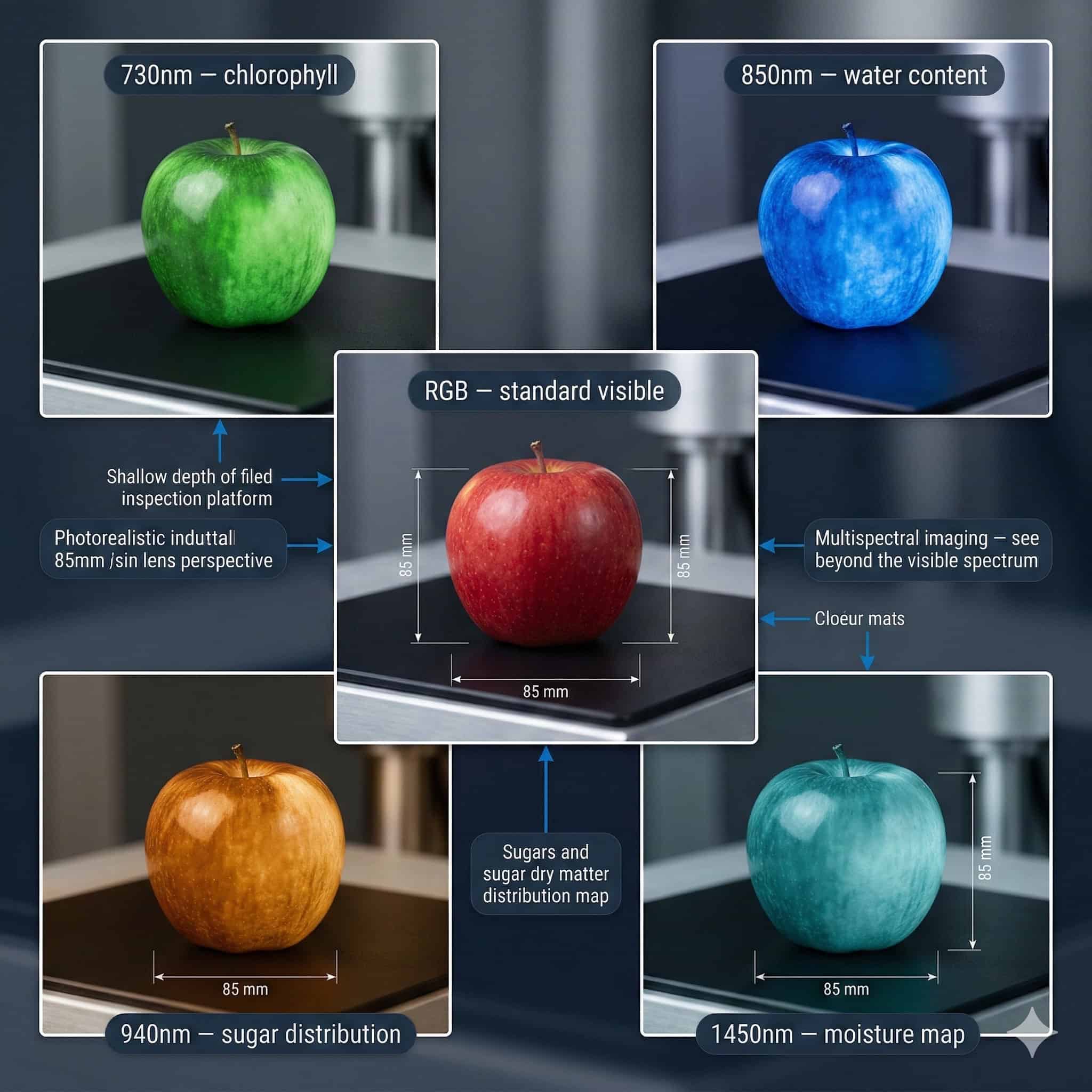
Standard machine vision systems operate in the visible spectrum. A monochrome camera captures intensity. A colour camera captures intensity across three broad spectral bands. Both approaches are well suited to detecting shape, dimension, surface texture, and print quality. They are not designed to detect material composition, chemical contamination, or subsurface properties.
Hyperspectral and multispectral imaging extend the spectral range of a vision system beyond the visible. They capture information about how a material interacts with light at many wavelengths simultaneously. This information can reveal properties that are completely invisible to conventional cameras, opening inspection capabilities that were previously only available in laboratory analytical instruments.
What Hyperspectral Imaging Is and How It Differs from RGB
A standard colour camera captures three broad spectral bands: red, green, and blue. Each pixel in the image stores three values. This is sufficient to distinguish colours that the human eye would perceive as different, but it provides very limited spectral resolution.
A hyperspectral camera captures hundreds of narrow spectral bands across a wide wavelength range. Each pixel stores a complete spectral signature — a curve describing how much light that point on the surface reflects or transmits at each wavelength. This spectral signature is characteristic of the material at that point. Different materials, even those that look identical to the human eye, typically have different spectral signatures.

Do you want help choosing the product?
The result is a three-dimensional data cube: two spatial dimensions and one spectral dimension. Processing this data cube allows the vision system to classify materials, identify contaminants, detect chemical changes, and measure composition — tasks that are impossible with conventional image data.
Multispectral vs. Hyperspectral: Practical Differences
Multispectral imaging uses a smaller number of spectral bands — typically between four and twenty — selected to be most informative for a specific application. The bands may cover visible, near-infrared (NIR), short-wave infrared (SWIR), or ultraviolet (UV) wavelength ranges depending on the inspection task.
Hyperspectral imaging uses hundreds of contiguous narrow bands covering a wide continuous spectral range. It captures more information but generates much larger data volumes and requires more processing power.
For industrial quality control, multispectral imaging is more commonly deployed in production environments. The reduced number of bands makes it more compatible with real-time processing requirements on production lines. Hyperspectral imaging is more commonly used in research and development, offline quality analysis, and applications where maximum spectral resolution is required.
Choosing Between Multispectral and Hyperspectral
The choice between multispectral and hyperspectral depends on the application requirements. If the spectral signature of the target material is already known and a small set of informative wavelengths can be identified, multispectral imaging with a fixed set of bands is more practical and cost-effective. If the spectral characteristics of the target are unknown or highly variable, hyperspectral imaging provides the full spectral data needed to develop a reliable detection algorithm.
Illumination Requirements for Spectral Imaging Systems
The illumination source is a critical component in any spectral imaging system. The camera can only measure wavelengths that are present in the illumination. If the light source does not emit in the spectral range of interest, the camera receives no signal at those wavelengths.
Three main illumination approaches are used in industrial spectral imaging systems.
Broadband Illumination
Broadband illumination covers a wide spectral range with a single source. Tungsten-halogen lamps are the traditional broadband source, providing continuous emission from UV through NIR. Modern high-power LED sources can approach broadband coverage by combining multiple wavelength emitters into a single housing. Broadband illumination is well suited to hyperspectral systems that require full spectral coverage.
Spectrally Matched LED Illumination
For multispectral systems using a fixed set of known wavelengths, LED illumination matched to those wavelengths is the preferred approach. LEDs provide narrow spectral emission peaks, high intensity, and long lifetime. A multispectral illuminator can be constructed by combining LEDs of different wavelengths into a single housing, with each wavelength switchable independently.
RODER Vision produces LED illuminators in wavelengths ranging from 365 nm UV through visible colours to 850 nm and 940 nm near-infrared. Multi-wavelength configurations can be specified with combinations of wavelengths in the same illuminator housing. This allows engineers to build compact multispectral illumination systems using standard product families without custom optics.
Tunable and Sequential Illumination
Tunable illumination systems switch between wavelengths in sequence, capturing one image at each wavelength. The camera captures a series of images, each illuminated by a different wavelength. The spectral information is assembled from the sequence of images. This approach requires that the part is stationary during the acquisition sequence, or that the switching speed is fast enough to freeze motion on a moving line.
RODER Vision illuminators support independent channel switching via digital inputs. This makes them compatible with sequential multispectral imaging setups where the illumination wavelength is changed between frames and synchronised with the camera trigger.
Industrial Applications of Spectral Imaging
Food Quality and Contamination Detection
NIR spectral imaging is widely used in food processing to detect foreign body contamination, assess moisture content, and identify out-of-specification produce. Bone fragments in poultry, plastic contamination in grains, and bruising in fruit are examples of defects that are invisible to standard cameras but detectable with NIR multispectral imaging.
Pharmaceutical Inspection
Pharmaceutical manufacturing uses spectral imaging to verify tablet composition, detect mixing defects in powder blends, and identify incorrect or degraded active ingredients. NIR and SWIR wavelengths are most commonly used. The spectral signature of each active ingredient is known, allowing real-time verification of tablet content without destructive sampling.
Recycling and Material Sorting
NIR spectral imaging is the primary technology used in automated plastic recycling sorting. Different polymer types — PET, HDPE, PP, PVC — have distinct NIR spectral signatures. A hyperspectral sorting system can classify plastic parts by polymer type in real time and divert them to the correct recycling stream. This application is growing rapidly as recycling content requirements become more stringent in packaging regulations.
Agriculture and Produce Grading
Multispectral imaging is used in agricultural sorting lines to grade produce by maturity, detect disease, and identify pesticide residue. Chlorophyll content, water stress, and sugar concentration all have spectral signatures in the visible and NIR range. Grading systems based on spectral imaging provide more accurate and consistent results than human visual inspection.
Challenges in Industrial Spectral Imaging
Spectral imaging systems generate large data volumes. A hyperspectral image of a small area may contain hundreds of megabytes of data per frame. Processing this data in real time requires significant computing resources and efficient algorithm design.
Cost is a significant factor. Hyperspectral cameras are substantially more expensive than standard monochrome or colour cameras. The illumination system must cover the required spectral range with sufficient intensity and uniformity. System integration is more complex than for a standard machine vision cell.
For these reasons, spectral imaging is typically deployed where the inspection task cannot be solved by standard vision methods and where the value of the detected information justifies the additional system cost. As camera costs fall and AI-based processing becomes more efficient, the economic threshold for spectral imaging adoption continues to decrease.
Where Hyperspectral Imaging Is Heading in Industrial Vision
The trend in industrial spectral imaging is toward smaller, faster, and less expensive systems. Line-scan hyperspectral cameras designed for conveyor integration are available at price points that were not feasible five years ago. SWIR cameras using InGaAs sensors, previously limited to high-cost aerospace and defence applications, are now entering industrial quality control markets.
Tunable LED illumination is an enabling technology for this market development. As LED efficiency improves and multi-wavelength illuminator designs become more refined, the illumination subsystem cost for multispectral systems is decreasing. RODER Vision’s multi-wavelength illuminator capabilities position the product range to serve these emerging spectral imaging applications as they expand into mainstream industrial inspection.
Products and Technologies
RODER Vision Multi-Wavelength Illuminator Families
The following RODER Vision families are available in multiple wavelength options, including UV, visible, and NIR. They are suited for multispectral imaging setups in industrial quality control applications.

DL6 — High Density LED Matrix
Available from 365 nm UV to 940 nm NIR. Dense matrix for high-intensity multispectral illumination. HTTM thermal stability for consistent spectral output.

DC6 — High Density LED Ring
Multi-wavelength ring illuminator for compact spectral imaging setups. Suitable for circular parts and sequential wavelength switching applications.

BL3 — LED Backlight Illuminators
Available in NIR wavelengths for transmission-mode spectral imaging. High uniformity for quantitative spectral measurements requiring consistent background illumination.

FD2 — Flat Dome LED Illuminators
Shadowless diffuse illumination in multiple wavelengths. Ideal for spectral reflectance imaging of flat or curved surfaces without specular interference.
Frequently Asked Questions
Hyperspectral imaging captures hundreds of narrow contiguous spectral bands across a wide wavelength range, producing a complete spectral signature for every pixel. Multispectral imaging uses a smaller number of selected bands — typically four to twenty — chosen to be most informative for a specific application. Multispectral systems are more commonly used in industrial production environments because of their lower data volumes and faster processing requirements.
Near-infrared multispectral imaging typically uses wavelengths between 700 nm and 1700 nm. Common LED wavelengths for NIR industrial illumination are 780 nm, 850 nm, and 940 nm. SWIR imaging in the 1000 nm to 1700 nm range requires InGaAs sensors and is used in pharmaceutical and recycling applications where the spectral signatures of interest are in this range.
Yes, if the LED wavelength matches the spectral band required by the application. For multispectral systems requiring sequential acquisition at multiple wavelengths, LED illuminators with independently switchable wavelength channels can be used. The illuminator channel is switched in synchronisation with the camera trigger, capturing one image per wavelength. RODER Vision illuminators support digital input triggering compatible with this approach.
UV illumination at 365 nm is used to detect fluorescent contamination, adhesive residue, lubricant traces, and biological contamination on surfaces. Many organic materials fluoresce under UV, making contamination visible that is invisible under white light. UV illumination is also used in pharmaceutical and food safety applications to detect surface residues.
Line-scan hyperspectral cameras can be integrated into conveyor-based production lines. The conveyor motion provides the spatial scanning dimension. Processing speed is the main limitation. Real-time hyperspectral processing at production line speeds requires dedicated processing hardware. Multispectral imaging with a smaller number of bands is more practical for high-speed lines where processing latency must be minimised.
Contacts & Information
Contact for general information : info@roder.it
Systems and Sensor Integration Partner : www.roder.it
RODER Artificial Vision Division : www.rodervision.com
RODER Instruments Division : www.innovacheck.com
More information about RODER VISION : about us
The information on this website is provided for informational purposes only. Although it has been prepared with the utmost care, it does not constitute a contractual offer or a binding commitment to supply. It may contain transcription, translation, or typographical errors. For precise and up-to-date information, please contact our company directly.
Please note: Some images on this website have been intentionally generated using Artificial Intelligence (AI). This is due to the fact that, for many applications and projects, it is not possible to disclose photographs of the actual installation or system due to confidentiality agreements, contractual clauses, and Non-Disclosure Agreements (NDAs).
Related topics :
 Machine Vision Market Trends 2025–2030: What’s Driving Growth in Industrial Inspection
 How to optimize packaging quality control with backlight illuminators.
 Why Made in Italy Matters for Machine Vision Illuminators: Quality, Traceability and Supply Security
 AI-Powered Machine Vision: How Deep Learning Is Changing Inspection Lighting Requirements
 How to Read Blurred Barcodes: The Synergy Between Shutter Speed and Lighting