


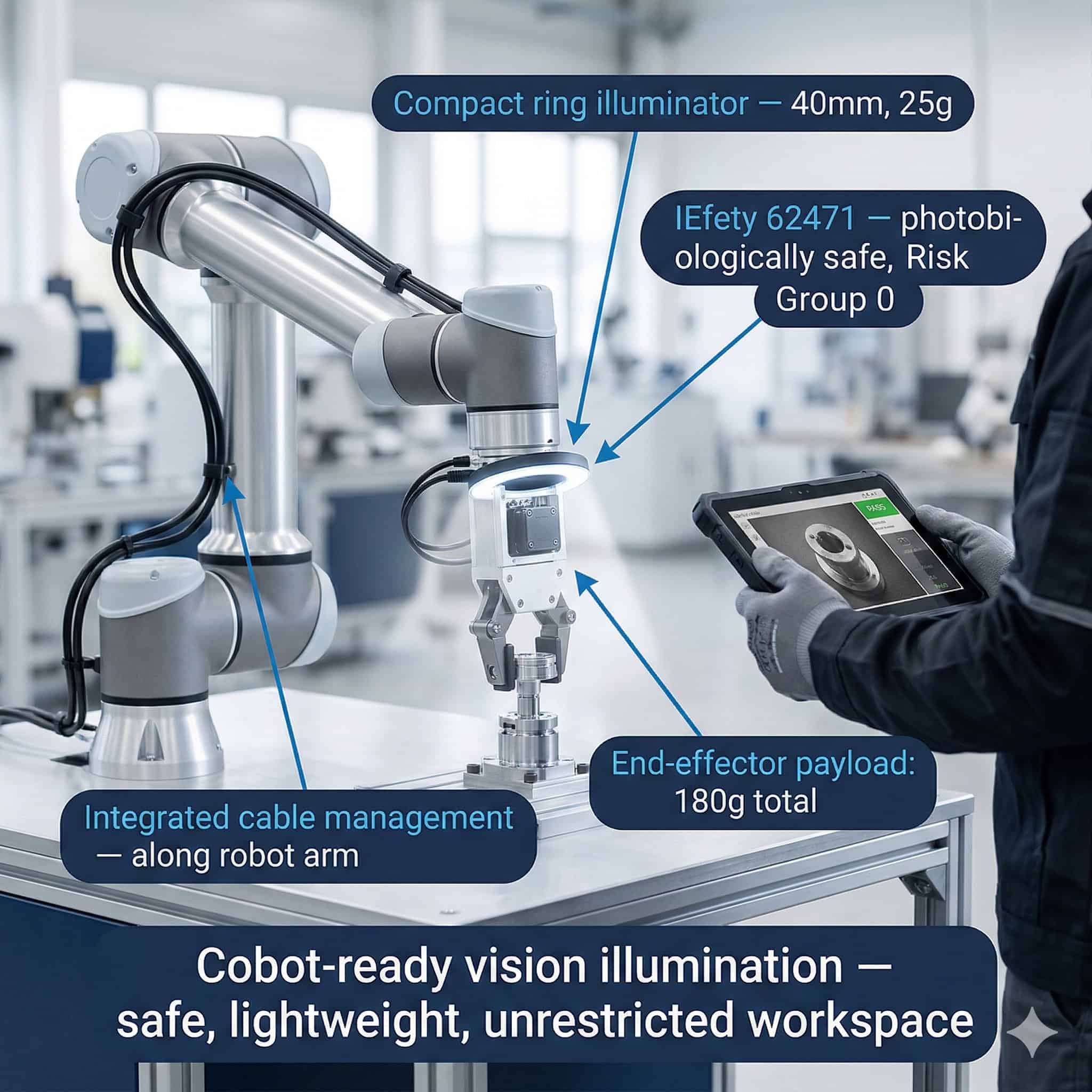
Collaborative robots—cobots—are designed to work alongside human operators in shared workspaces. Unlike traditional industrial robots shut inside safety cages, cobots operate in open production areas where human presence is expected and intended.
Vision-guided cobots use cameras and lighting to locate parts, verify assembly steps, guide grippers, and inspect components. The lighting system in a cobot vision cell has to meet requirements that do not exist in fixed automation: photobiological safety, compact form factor, vibration tolerance, and compatibility with flexible mounting configurations.
What Makes Cobot Vision Different from Fixed Automation
In a fixed automation cell, the illuminator sits in a defined position relative to the part and the camera. The geometry is set during commissioning and does not change during production. No human operators are in the inspection zone during normal operation. The illuminator can be sized and specified without weighing the effect of light on human workers.
In a cobot cell, the picture is different. The robot arm may sit on a mobile base or be repositioned between production runs. Operators work alongside the cobot and may pass through the inspection zone regularly. The illuminator may attach directly to the robot arm and move with it during operation.

Do you want help choosing the product?
These differences create a set of specific engineering requirements that have to be handled during illuminator selection and cell design. Ignoring them can lead to photobiological safety issues, mechanical integration problems, or unreliable inspection performance from illuminator vibration during robot motion.
Photobiological Safety: IEC 62471 for Human-Shared Workspaces
Photobiological safety refers to the potential for optical radiation—light—to harm the eye or skin. The relevant standard is IEC 62471, which defines risk groups for light sources based on their emission characteristics.
In a traditional machine vision cell, photobiological safety is not a primary concern because human operators are not present during inspection. In a cobot cell, operators stay in the workspace continuously. Illuminators have to be assessed and classified under IEC 62471. High-intensity illuminators in the blue, UV, or IR wavelength ranges need particular attention.
Risk Group Classification and Practical Implications
IEC 62471 defines four risk groups: exempt, low risk (RG1), moderate risk (RG2), and high risk (RG3). An illuminator classified as RG2 or RG3 may call for additional control measures such as shielding, warning signs, or restricted access zones, even in a cobot cell.
Engineers designing cobot vision systems should verify the IEC 62471 classification of any illuminator they specify for a shared workspace. Illuminators running in the visible spectrum at moderate intensity are generally classified as exempt or RG1. Strobe illuminators firing at high peak intensities need a separate assessment of the stroboscopic effect on human operators.
RODER Vision illuminators intended for cobot applications are available with optics that limit the angular spread of the emitted beam. Concentrating the light onto the inspection target cuts stray illumination in the surrounding workspace and lowers the photobiological exposure of nearby operators.
Compact and Lightweight Illuminators for Robot-Mounted Integration
When an illuminator mounts on the end effector of a robot arm, its weight and dimensions feed straight into the dynamic performance of the arm. Every gram added to the end effector cuts the payload available for the gripper and the part being handled. Large illuminators extend the reach of the end effector and increase the moment arm, trimming effective payload further.
Compact illuminators with high luminous efficiency are preferred for robot-mounted applications. High efficiency means more light output per watt of electrical input, so a physically smaller illuminator can produce the same photometric output as a larger, less efficient unit.
RODER Vision’s dense LED matrix technology packs a high density of emitters into a small surface area, producing high luminance output from a compact form factor. The result is an illuminator small enough to integrate on most cobot end effectors without a significant payload penalty.
Mounting and Cable Management on Cobot Arms
Cable management is a significant practical challenge in robot-mounted illuminator integration. The illuminator cable has to follow the motion of the robot arm without creating snag points or fatigue failures at the connector. Cable carriers, spiral wraps, and strain relief systems are the standard solutions. The illuminator connector has to be rated for the bending cycles and the environmental conditions of the application.
RODER Vision illuminators use M8 and M12 circular connectors with vibration-resistant locking mechanisms. These connectors are rated for repeated mating cycles and work with standard cable carrier and drag chain systems used on robot arms.
Vibration Tolerance: Illuminator Reliability Under Robot Motion
A robot arm in motion generates vibration. The acceleration and deceleration of the arm during pick-and-place cycles subjects the end effector and any attached components to mechanical shock. An illuminator mounted on the end effector has to ride out these loads without mechanical failure or degradation of optical performance.
Vibration failures in illuminators usually occur at the LED solder joints, the LED-to-heatsink interface, or the connector. RODER Vision illuminators are built using a thermal bonding approach that also gives mechanical rigidity at the LED-to-substrate interface. The connector type and mounting configuration are designed to resist vibration loosening.
For applications with particularly high dynamic loads, engineers should consult RODER Vision’s application team to confirm the selected illuminator configuration suits the robot’s motion profile and payload conditions.
Flexible Production: Quick-Change Illuminator Systems
One of the primary benefits of collaborative robots is how quickly they can be redeployed between different production tasks. A cobot that inspects connector pins in the morning may be repositioned to verify label placement in the afternoon. That flexibility calls for vision and lighting systems that can be reconfigured fast.
Quick-change end effector systems are available from several suppliers and allow the complete end effector—camera and illuminator included—to be swapped in minutes without tools. The illuminator has to suit the quick-change interface in both physical mounting and electrical connection.
RODER Vision illuminators are available with custom mounting flanges and connector configurations that support integration into quick-change end effector systems. The standard M8 and M12 connectors allow rapid disconnection and reconnection without specialist tools or cable termination.
Illumination Geometry for Cobot Inspection Tasks
Cobot vision applications span a wide range of inspection tasks. Part location for gripper guidance usually needs consistent, uniform illumination across the field of view. Assembly verification needs enough contrast to tell correct from incorrect component states. Surface inspection needs angle-dependent illumination to reveal texture and defects.
Ring illuminators are frequently used in robot-mounted configurations because they give coaxial or near-coaxial illumination through the camera axis. The circular geometry produces even illumination on parts centred in the field of view. For assembly verification tasks, a matrix illuminator mounted at a fixed offset from the camera gives broad, diffuse illumination that holds down specular reflections from component surfaces.
The illumination geometry has to be set during the initial system design and validated with the actual parts before the cobot cell is commissioned. Changes to the illumination geometry after commissioning call for reconfiguration of the vision algorithm and may affect robot calibration if the camera-to-part relationship changes.
Integration with Cobot Controllers and Vision Software
Cobot vision systems usually sync the illuminator trigger with the camera shutter. The illuminator fires for the duration of the camera exposure. This synchronisation is handled either by the camera controller, the robot controller, or a dedicated vision processing unit.
RODER Vision illuminators support both continuous operation and triggered strobe mode. In strobe mode, a digital input signal triggers a defined light pulse, with pulse duration and intensity set via the driver electronics. That lets the illuminator drop into the robot’s I/O system using standard PNP or NPN digital signals without additional interface hardware.
For more advanced integration, IO-Link compatible driver variants let the illuminator be configured and monitored remotely through the robot controller’s IO-Link master port. That simplifies cabling and enables remote adjustment of illumination parameters during recipe changes without physical access to the illuminator.
Products and Technologies
RODER Vision Illuminator Families for Cobot Integration
The RODER Vision families below suit collaborative robot and cobot vision applications best. Each offers compact dimensions, vibration-resistant construction, and flexible connectivity options.

DC6 — High Density LED Ring
Compact ring illuminator for robot-mounted coaxial inspection. Vibration-resistant M8 connector. Ideal for part location and assembly verification tasks.

DL6 — High Density LED Matrix
Dense matrix for end-effector mounting. High luminance in a compact size. HTTM thermal stability. Multi-wavelength options for flexible production.

DL5 — High Intensity LED Matrix
High peak intensity with strobe mode. Suitable for fast robot motion cycles. Compatible with PNP/NPN trigger and IO-Link control.

BL3 — LED Backlight Illuminators
High-uniformity backlight for cobot dimensional gauging and silhouette inspection. Stable output for consistent measurement in flexible production cells.
Frequently Asked Questions
In a fixed automation cell, operators are not present during inspection and the illuminator geometry is fixed. In a cobot cell, operators share the workspace with the robot, the illuminator may move with the robot arm, and photobiological safety has to be assessed under IEC 62471. The illuminator also has to be compact and light enough to fit on the robot end effector without exceeding the payload limit.
IEC 62471 is the international standard for photobiological safety of light sources and luminaires. It defines risk groups based on the potential of a light source to harm the eye or skin. In a cobot workspace where human operators are continuously present, any illuminator has to be classified under this standard. Illuminators in risk group RG2 or RG3 may need additional safety controls.
The illuminator should be as compact and light as possible to keep payload use down. It should use a vibration-resistant connector such as M8 or M12 with a locking mechanism. The cable should run through a cable carrier or spiral wrap to head off fatigue at the connector. The mounting bracket should be rigid enough to keep the illuminator from moving relative to the camera during robot motion.
Yes. RODER Vision offers illuminator driver variants compatible with IO-Link. These let the illuminator be configured and monitored through the robot controller’s IO-Link master port. Intensity, operating mode, and diagnostic data can be reached remotely. This simplifies recipe management in flexible production cells where the same cobot runs different tasks between production runs.
For part location tasks, a ring illuminator giving coaxial or near-coaxial illumination through the camera axis is usually the most effective choice. It produces even, specular-free illumination on the part surface, giving consistent contrast for the vision algorithm whatever the part orientation. For flat, highly reflective parts, a diffuse matrix or dome illuminator may be preferred to hold down bright specular reflections.
Contacts & Information
Contact for general information : info@roder.it
Systems and Sensor Integration Partner : www.roder.it
RODER Artificial Vision Division : www.rodervision.com
RODER Instruments Division : www.innovacheck.com
More information about RODER VISION : about us
The information on this website is provided for informational purposes only. Although it has been prepared with the utmost care, it does not constitute a contractual offer or a binding commitment to supply. It may contain transcription, translation, or typographical errors. For precise and up-to-date information, please contact our company directly.
Please note: Some images on this website have been intentionally generated using Artificial Intelligence (AI). This is due to the fact that, for many applications and projects, it is not possible to disclose photographs of the actual installation or system due to confidentiality agreements, contractual clauses, and Non-Disclosure Agreements (NDAs).