


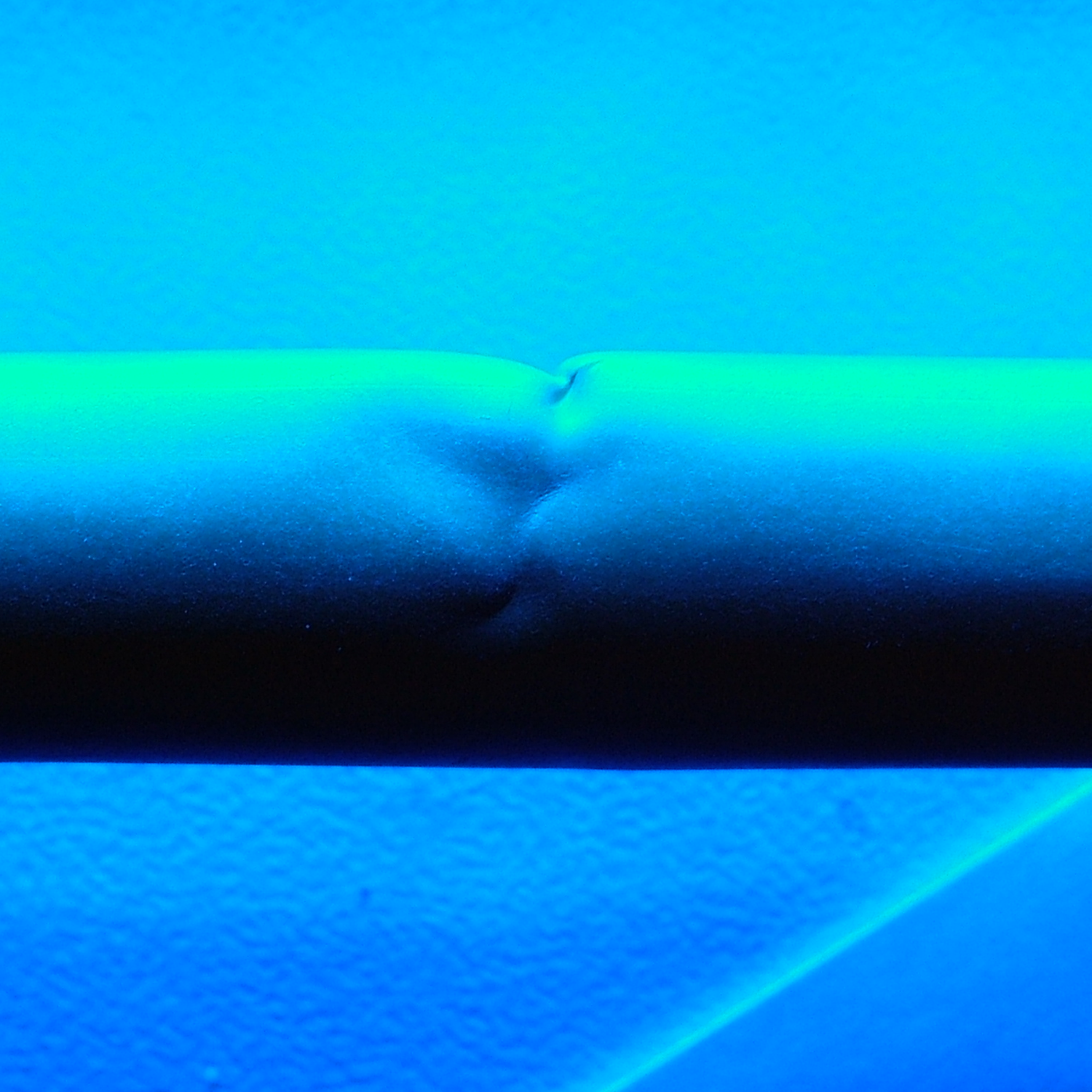
Lighting is the most critical and most frequently underrated element in any machine vision system. The quality of the image the camera captures depends almost entirely on the illumination. A wrong lighting configuration makes it impossible to pull reliable information from the image, no matter how sophisticated the vision algorithm or how high the camera resolution.
Engineers and system integrators have to weigh several key parameters when choosing illumination: geometry, light source type, wavelength, the material’s optical properties, inspection speed, and integration constraints. Each parameter shapes the final image quality in a direct, measurable way.
The Role of Light in Machine Vision
Light interacts with materials through three fundamental mechanisms: reflection, transmission, and absorption. How much each mechanism contributes decides how a surface looks in the captured image. Grasping these interactions is essential when designing an illumination setup for a specific inspection task.
Light is characterised by its wavelength, measured in nanometres (nm). The visible spectrum runs from roughly 400 nm (violet) to 700 nm (red). Machine vision systems often work outside this range, using near-infrared (NIR) light to penetrate packaging materials, or ultraviolet (UV) light to reveal surface features that stay hidden in the visible spectrum.

Do you want help choosing the product?
LED Technology for Industrial Illumination
LEDs are the standard light source for industrial machine vision. They bring monochromatic emission, high efficiency, long service life, and the ability to run in strobe mode. Set against traditional sources such as fluorescent tubes or halogen lamps, LEDs give the stable, repeatable output that automated inspection depends on.
Monochromatic and White LED Sources
Monochromatic LEDs emit light at a single dominant wavelength, which is ideal for maximising contrast on specific surface features or colour differences. White LEDs are produced either by combining RGB emitters or by applying a yellow phosphor coating over a blue LED. Both methods bring a broader spectrum that suits colour inspection applications.
Current Regulation and Thermal Management
Stable current regulation is essential for repeatable illumination intensity. Swings in drive current produce swings in light output that feed straight into image noise and inspection errors. Sound thermal management extends LED service life and keeps luminous flux from degrading over time. RODER Vision LED illuminators build in precision current drivers and optimised thermal dissipation to hold long-term stability in 24/7 industrial environments.
Strobe and Pulse Operation
Running LEDs in strobe or pulse mode allows very high peak currents for short bursts, producing light intensities far above the continuous rating. The technique is essential for freezing motion on fast production lines. Strobe synchronisation with the camera trigger makes sure each image is captured at the exact moment of maximum illumination, clearing motion blur and lifting contrast on dynamic objects.
Illumination Geometries for Machine Vision
The geometric relationship between the light source, the object, and the camera decides the kind of information captured in the image. Choosing the correct geometry is the single most important decision in illumination design.
Direct Front Lighting: Bright Field and Dark Field
In bright field direct illumination, the light source and camera sit on the same axis or at a small angle. The camera captures the specular or diffuse reflection from the object surface. This geometry works well on flat, matte surfaces where defects create changes in local reflectivity.
Dark field illumination uses a grazing angle of incidence, typically below 30 degrees from the surface plane. Only surface features with height variations—scratches, embossed marks, surface texture—scatter light toward the camera. The background reads dark while defects and relief details read bright. The technique is highly effective for surface inspection of metals, plastics, and glass.
Backlighting for Silhouette and Dimensional Inspection
Backlighting puts the illuminator behind the object and the camera in front. The object reads as a silhouette against a bright, uniform background. This geometry is ideal for dimensional inspection, contour measurement, and detecting the presence or absence of features. It also serves the inspection of transparent containers, pharmaceutical blister packs, and precision mechanical components.
Coaxial Illumination for Reflective Surfaces
Coaxial illumination brings light in along the same optical axis as the camera using a beamsplitter. The light strikes the object surface head-on and the specular reflection returns straight through the lens. The technique clears shadows and lays down uniform illumination on flat, highly reflective surfaces such as mirror-finish metals, PCBs, and polished components.
Dome and Flat Dome Illumination
Dome illuminators wrap the object in a diffuse, omnidirectional light field. That clears directional shadows and specular reflections on curved, three-dimensional, or irregular surfaces. The result is a flat, evenly lit image that makes colour variations, surface defects, and printed markings easier to detect. Flat dome illuminators reach similar results in a lower-profile format, which suits integration above conveyor belts and inspection stations with limited vertical space.
Wavelength Selection in Machine Vision Lighting
Correct wavelength selection maximises image contrast and trims sensitivity to irrelevant variation. The basic principle is that surfaces absorb their complementary colour and reflect their own. Lighting a red object with red light yields a bright image; lighting the same object with green or blue light yields a dark one.
For monochrome cameras, the wavelength that produces the biggest grey-level difference between the feature of interest and the background is the best pick. Blue and UV illumination offer fine spatial resolution for catching micro-defects and surface contamination. Red and NIR illumination reach into shallow layers and reduce the visibility of surface texture on granular materials.
Structured and Pattern Projection Lighting
Structured light techniques project a known pattern onto the object surface. Deformations of the projected pattern encode depth information, opening the way to 3D surface reconstruction. LEDs are preferred over laser sources here because they produce uniform, speckle-free patterns with consistent intensity across the projected area. The approach is widely used for 3D measurement of complex geometries, weld inspection, and surface flatness verification.
Key Parameters for Illumination System Design
A well-designed illumination system has to meet four measurable requirements.
- Intensity: enough to reach the target exposure at the required frame rate and aperture setting.
- Uniformity: high enough across the field of view to avoid grey-level gradients that could be read as defects.
- Stability: held over time and temperature variation to keep inspection results repeatable.
- Spectral match: the illuminator wavelength has to match the camera sensor response to maximise signal-to-noise ratio and detection sensitivity.
Products and Technologies
RODER Vision Illuminator Families
RODER Vision designs and manufactures a full range of LED illuminators for every machine vision geometry and application. The product families below cover the most common illumination needs in industrial inspection systems.

DL6 – High Density LED Matrix
High density direct illumination for front-lit inspection. Multiple formats and wavelengths. Strobe compatible. Suited to general-purpose industrial inspection stations.

DC6 – High Density LED Ring
Ring illumination for direct front lighting around the camera axis. Compact design for close-range inspection. Multiple diameters and wavelengths available.

BL3 – LED Backlights
High uniformity backlighting for silhouette inspection, dimensional measurement, and contour analysis. Multiple formats. Strobe compatible for high-speed lines.

FD3 – Flat Dome Illuminators
Diffuse dome illumination for curved, irregular, and reflective surfaces. Clears directional shadows. Ideal for label inspection, surface grading, and colour verification.
Frequently Asked Questions
Illumination geometry is the most critical factor. The angular relationship between the light source, the object, and the camera decides which surface features become visible and which stay hidden. No image processing algorithm can recover information that was never captured. Choosing the correct geometry, whether bright field, dark field, backlight, coaxial, or dome, is the first and most important design decision.
Dark field illumination is ideal when the task is to detect surface relief features such as scratches, embossed marks, cracks, and surface texture. The light source sits at a very low angle to the surface, so only features with height variation scatter light toward the camera. The background reads dark while defects read bright.
The best wavelength depends on the spectral properties of the object and the defect to be detected. For maximum contrast between two colours, use a wavelength that one colour absorbs and the other reflects. For sub-surface inspection, near-infrared wavelengths (750-1000 nm) are effective. For micro-defects, shorter wavelengths such as blue or UV give better spatial resolution.
Strobe illumination drives LEDs with short, high-intensity pulses synced to the camera exposure. It is required when objects move at speeds where continuous illumination would produce motion blur. It also increases depth of field and reduces ambient light interference.
Backlighting places the LED illuminator behind the object being inspected, with the camera on the opposite side. The object blocks light from reaching the camera, forming a high-contrast silhouette. This geometry is used for dimensional measurement, contour analysis, and detecting the presence or absence of features.
Contacts & Information
Contact for general information : info@roder.it
Systems and Sensor Integration Partner : www.roder.it
RODER Artificial Vision Division : www.rodervision.com
RODER Instruments Division : www.innovacheck.com
More information about RODER VISION : about us
The information on this website is provided for informational purposes only. Although it has been prepared with the utmost care, it does not constitute a contractual offer or a binding commitment to supply. It may contain transcription, translation, or typographical errors. For precise and up-to-date information, please contact our company directly.
Please note: Some images on this website have been intentionally generated using Artificial Intelligence (AI). This is due to the fact that, for many applications and projects, it is not possible to disclose photographs of the actual installation or system due to confidentiality agreements, contractual clauses, and Non-Disclosure Agreements (NDAs).


